
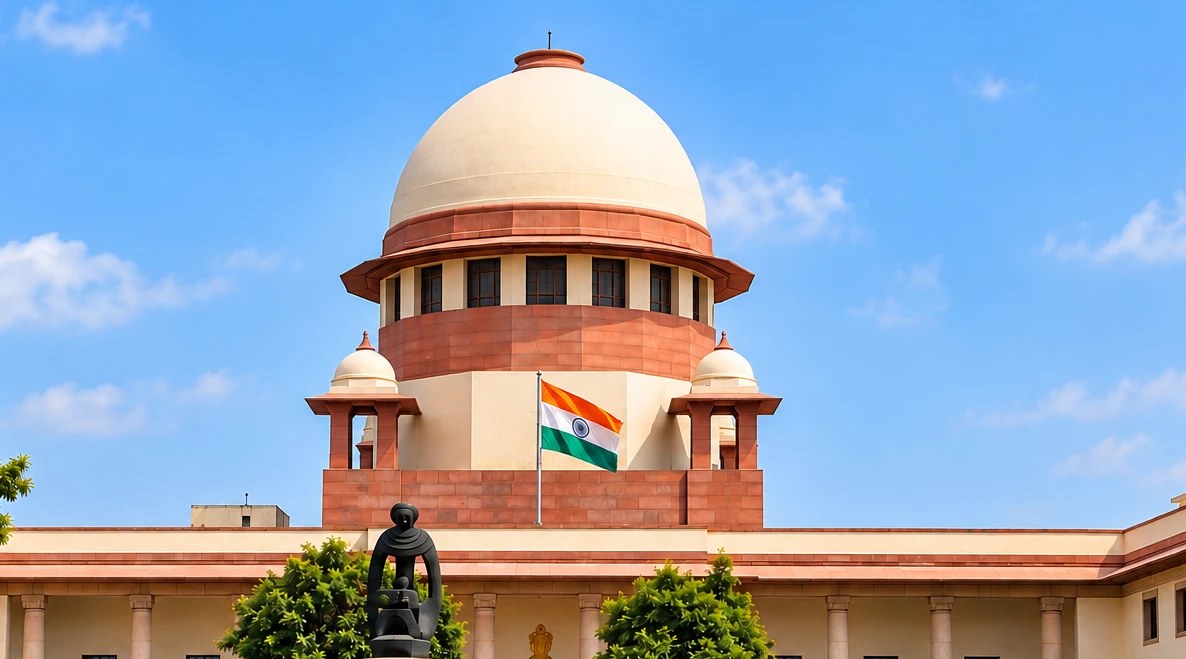
By 8:1, a nine-Judge Bench held that royalty paid by a mining lessee is a contractual consideration, not a tax, overruling India Cement on that point. The power to tax mineral rights belongs to the States under Entry 50 of List II, and the MMDR Act places no limitation on it. Mineral-bearing land may be taxed under Entry 49, with mineral produce or royalty as the measure (Chandrachud CJI, para 342). Nagarathna J. dissented.
A two-judge Bench split on the 2022 approval for environmental release of genetically modified mustard DMH-11. Justice Nagarathna held it vitiated for want of reasons and contrary to the precautionary principle and the public trust doctrine; Justice Karol upheld it as an expert decision bound by strict conditions. Agreeing that such decisions are open to judicial review, the Bench directed a National Policy on GM crops and sent the DMH-11 question to the Chief Justice (Order, paras 1-3).

A Division Bench of the Rajasthan High Court dismissed a writ petition by two candidates whose OMR sheets could not be machine-evaluated because one left the question booklet series blank and the other did not darken its bubble (paras 4-5). Holding that examination instructions are mandatory and that letting candidates correct rejected sheets would derail selection and invite misuse, the Court followed G. Hemalathaa and Jagdish Chandra Jat (paras 8-12).

The Rajasthan High Court declined to entertain a petition to quash an FIR under Sections 500 and 120-B IPC and Sections 66 and 66C of the Information Technology Act, holding that at the preliminary stage a quashing plea could not rest merely on self-serving affidavits (para 7). The petitioners should first have approached a superior police officer under Section 36 CrPC; the petition was disposed of with that liberty, the alleged offences being bailable (paras 8-9).

The Supreme Court set aside bail granted to an HIV-positive woman accused of possessing 1.040 kg of heroin, because the Meghalaya High Court granted it only on her HIV status without recording satisfaction of the twin conditions in Section 37(1)(b)(ii) of the NDPS Act. It ordered her surrender, but directed the trial court to decide her case on priority under Section 34(2) of the HIV and AIDS Act, 2017 (paras 5-13).
The Supreme Court held that courts can judicially review an arrest under Section 19(1) of the PMLA, and that the 'reasons to believe' must be supplied to the arrestee and must weigh exonerating material too, but declined to quash Arvind Kejriwal's arrest on that limited review. It referred to a larger Bench whether the 'need and necessity to arrest' is a separate ground of challenge, and released him on interim bail (paras 21, 36, 55, 65, 84-85).
The Supreme Court held that Section 9 of the Foreigners Act, which puts on a person the burden of proving that he is not a foreigner, does not let the State pick anyone at random. Authorities must hold some material basis for suspicion and share the main grounds and that material before the burden shifts. Finding no such material and only minor spelling and date discrepancies, it set aside the Tribunal's orders and declared the appellant an Indian citizen (paras 34-35, 39, 55).
A Division Bench of the Rajasthan High Court dismissed two intra-court appeals by candidates in the 2021 Patwari recruitment examination who challenged an Expert Committee's change of the answer key, for a question on where Saint Peepa's cave is, from ‘Toda’ to ‘Gagron’ (paras 7-9, 39). Courts may interfere with an answer key only where it is demonstrably wrong without inferential reasoning; where authentic texts conflict, the benefit of doubt goes to the examining body (paras 26, 36-37).

The Rajasthan High Court refused to quash an SDO's notice/warrant under Sections 97-98 CrPC, issued on a complaint that a husband was illegally detaining his wife and children. These proceedings are a legally valid way to ascertain wrongful confinement, and a husband's claim that he cannot detain his own wife and children may not always hold true where there is evidence or a credible allegation of coercion, threat or abuse (paras 5-6). No coercive steps may be taken against the petitioners (para 10).
The Supreme Court deleted two bail conditions imposed on a foreign national accused in an NDPS case: dropping a pin on Google Maps for the investigating officer, and producing a certificate of assurance from his country's Embassy or High Commission. Bail conditions cannot be fanciful or so onerous as to defeat bail, and a condition letting the police constantly watch an accused's movements violates the right to privacy under Article 21 (paras 7, 10, 12, 15).
The Rajasthan High Court set aside a GST appellate order that had quashed a manufacturer's refund of accumulated input tax credit solely on the basis of Circular No. 135/15/2020-GST. A Division Bench of the Court had already held, in Baker Hughes Asia Pacific Limited, that the circular conflicts with Section 54(3)(ii) of the CGST Act (paras 5-6). As the circular had not withstood judicial scrutiny, the Department's appeal was remitted to the Appellate Authority for a fresh decision (para 7).

The Rajasthan High Court set aside a magistrate's order directing a cheque-case accused to pay 20% of the cheque amount as interim compensation under Section 143A of the Negotiable Instruments Act, 1881. The order recorded only that arguments were heard and the file examined, without any reasons (paras 2-3). The trial court has the power, but must exercise it in line with the Supreme Court's parameters in Rakesh Ranjan Shrivastava v. State of Jharkhand (paras 4-6).