Introduction
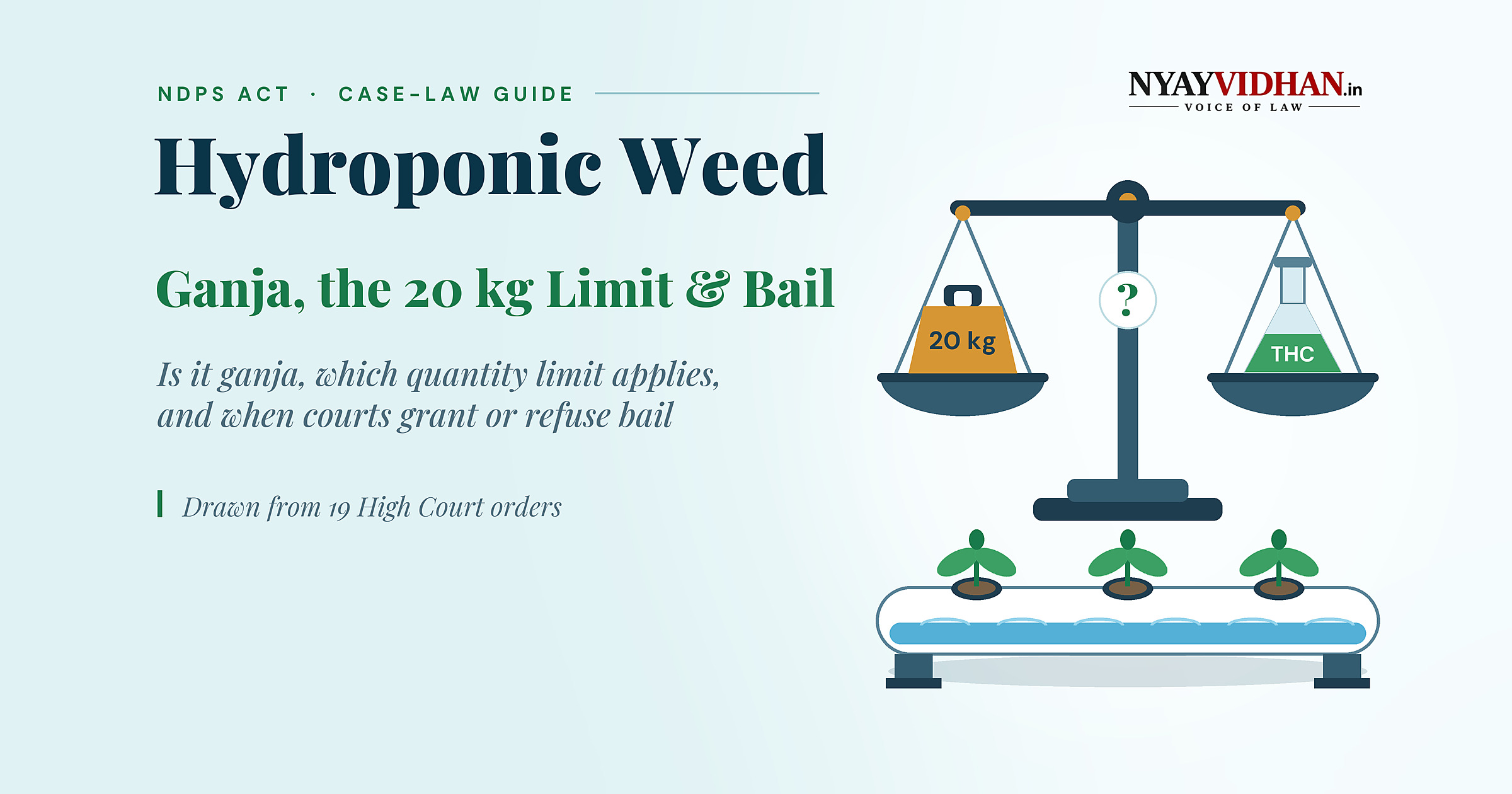
Hydroponic weed is cannabis grown without soil, in nutrient-fed water. The Narcotic Drugs and Psychotropic Substances Act, 1985 does not use the term: hydroponic ganja is neither defined in the Act nor listed in the notification of small and commercial quantities (Jafar Ali Iqbal v. Union of India, 2026:KHC:43699, paras 8, 10). Yet High Courts across the country now meet it regularly, mostly after seizures at airports, and they have described it as a highly potent and very valuable form of cannabis (Karan Mehra v. Union of India, 2025:RJ-JP:40276, para 5). Potency here means the drug's content of tetrahydrocannabinol (THC), the main intoxicating compound in cannabis.
That gap raises three questions. Is hydroponic weed “ganja”? Which quantity limit applies to it? And does a recovery below that limit bring bail? This guide answers them from 19 orders of ten High Courts, decided between October 2025 and October 2026 and published on NyayVidhan, each cited with the Court's own paragraph numbers. All of them are orders on bail: its grant, refusal, cancellation or setting aside. What they say is a prima facie view for that purpose and does not decide guilt.
Is Hydroponic Weed “Ganja”?
The courts that have decided the point say yes. Section 2(iii)(b) of the NDPS Act defines ganja as “the flowering or fruiting tops of the cannabis plant (excluding the seeds and leaves when not accompanied by the tops), by whatever name they may be known or designated”, as the Orissa and Madras High Courts set it out (Kizakkekalayil Anujikumar Anujith v. Union of India, Orissa High Court, BLAPL No. 4294 of 2025, para 3; Vinoy Soni v. Union of India, Madras High Court, Crl.O.P.(MD) No. 18133 of 2026, para 9). The Orissa High Court held that marijuana, hydro-ganja, hydroponic weed or high-grade ganja is a cannabis product and, as flowering tops, falls within that definition; the seized packets there held a dried flower or plant-like substance (Anujith, paras 3-5). The Madras High Court added that the name “hydroponic weed” cannot by itself decide how a substance is classified (Vinoy Soni, para 9), and carried that view into a later order (Mohamed Ali v. Union of India, Madras High Court, Crl.O.P.(MD) No. 16866 of 2026, paras 5-6).
The Karnataka High Court reached the same result on punishment: since hydroponic ganja has no entry of its own, the ganja entry at serial number 55 of the notification governs (Jafar Ali Iqbal, paras 8, 10). The punishment for ganja, by quantity, is in Section 20 of the NDPS Act.
Three things are therefore kept apart: “hydroponic” describes how the plant was grown; whether the seized material is ganja depends on what it is, namely flowering or fruiting tops and not seeds or leaves on their own; and its THC content is a chemical property, which is the subject of the next section.
Which Quantity Limit: 20 kg or a THC-Based Threshold?
Treated as ganja, the commercial quantity is 20 kg (Anujith, para 5; Vinoy Soni, para 10). Prosecuting agencies have argued for a much lower threshold based on the drug's THC content. That argument has not succeeded where it was examined:
- Orissa. A THC-based threshold of 50 grams was rejected: no material showed a commercial quantity, and the schedule does not list marijuana. A recovery of 3.990 kg was an intermediate quantity (Anujith, paras 3, 5).
- Madras. Without a chemical analysis report, the claim of high THC concentration could not turn 5.20 kg into a commercial quantity (Vinoy Soni, paras 8-10). The same reasoning was applied to another seizure below 20 kg (Mohamed Ali, paras 5-6).
- Above 20 kg there is no debate. A recovery of 39.706 kg of hydroponic marijuana was by itself a commercial quantity (State v. Anchit Jain, Delhi High Court, CRL.M.C. 4041/2025 & CRL.M.A. 36414/2025, para 63).
Two orders of the Rajasthan High Court at Jaipur strike a different note. In refusing bail over 11.410 kg and 15.740 kg, they speak of the substance's intensity, rather than its weight, as exceeding the prescribed commercial quantity, on a reported THC content of about 25 per cent that was still to be confirmed by the laboratory report (Mir Shahid Hussain v. Union of India, 2025:RJ-JP:48258, paras 6-7; Kuldeep Singh v. Directorate of Revenue Intelligence, 2025:RJ-JP:48260, paras 5-7). These are reasons given for refusing bail at that stage; neither order mentions Section 37 or rests on the THC entry of the notification. Other High Courts left the quantity question open while deciding bail on other grounds (Dilpreet Kaur v. Union of India, Patna High Court, Criminal Miscellaneous No. 45100 of 2026, paras 4-5; Malkeet Singh v. Union of India, 2026:PHHC:100739, para 4).
Below 20 kg: The Section 37 Bar Does Not Apply
The twin conditions for bail in Section 37(1)(b) apply only to offences under Sections 19, 24 and 27A and to offences involving commercial quantity (DRI v. Ms. Anisaben Dadabhai Shekh, 2026:RJ-JP:15565, paras 6-8). Several High Courts have therefore granted bail in hydroponic weed cases below 20 kg:
- Rajasthan. For 6.220 kg, the Section 37 restriction did not apply and bail was granted, following the Supreme Court's order in Puranmal Jat (Sushil Kumar v. Union of India, 2026:RJ-JP:3104, paras 6-8). The Directorate's application to cancel a trial court's bail over 3.727 kg was dismissed for the same reason (Anisaben Dadabhai Shekh, paras 7-8).
- Allahabad. Below commercial quantity the rigours of Section 37 did not apply, and bail is not to be withheld as a punishment (Shailesh Kumar Yadav v. State of U.P., Allahabad High Court, Criminal Misc. Bail Application No. 35955 of 2026, paras 6-7). Bail was also granted over 2 kg 300 grams (Mohd Idrish v. State of U.P., Allahabad High Court, Criminal Misc. Bail Application No. 23304 of 2026, para 11).
- Orissa. An intermediate quantity does not attract Section 37; the accused's role as a carrier, his custody, the framed charges and the absence of similar antecedents also weighed for bail (Anujith, paras 5-7).
The quantity is read with the case alleged against the accused, not only with what was found in one bag. Where three accused had travelled together and brought 36.430 kg in three trolley bags, the Karnataka High Court found prima facie material that they had conspired (Jafar Ali Iqbal, para 14); see the section on conspiracy below.
How the twin conditions work when they do apply is explained in our guide to Section 37 of the NDPS Act.
Below 20 kg, Bail Is Still Not Automatic
Other orders refuse bail although the weight is below the commercial limit, treating the nature of the drug as a reason in itself.
- Rajasthan (Jaipur). A quantity technically below the threshold does not by itself secure bail. The potency and value of the contraband (about Rs 18 crore), a sophisticated method of import, possible links to organised syndicates and the risk of flight weighed against it; keeping imports just below the commercial limit to escape Section 37 was treated as a reason against bail, and long custody with a filed charge-sheet was not enough (Karan Mehra, paras 5-6). Later orders followed it, relying on potency, market value and a continuing investigation (Mir Shahid Hussain, paras 5, 7; Kuldeep Singh, paras 5, 7), and on investigation material linking the accused with a smuggling syndicate (Indrajeet Kumar Nishad v. Union of India, 2026:RJ-JP:5930, para 5).
- Karnataka. The higher THC content and value of hydroponic ganja mean greater harm to society. In bail the interest of society is paramount and the punishment is only one factor, so possession of an intermediate quantity is not by itself a ground for bail (Jafar Ali Iqbal, paras 9-10, 13). The Court applied this to an accused from whom 16 kg 360 grams was seized (Mohammed Azharudeen Burukanudeen v. Union of India, 2026:KHC:57100, paras 6-7).
Sushil Kumar and Indrajeet Kumar Nishad Compared
Two orders of the Rajasthan High Court at Jaipur, three weeks apart, show that weight alone does not settle bail below 20 kg.
- In Sushil Kumar v. Union of India (22 January 2026), the recovery was 6.220 kg. Being below commercial quantity, it did not attract the Section 37 bar (para 6). The Court followed the Supreme Court's order in Puranmal Jat v. State of Rajasthan (paras 7-8) and granted bail with monthly appearance before the Customs Air Intelligence Unit (para 10).
- In Indrajeet Kumar Nishad v. Union of India (9 February 2026), the seizure was smaller, 5.920 kg, and bail was refused (paras 2, 6). The Court relied on the drug's potency and THC content, its value of about Rs 6 crore, and investigation material linking the petitioner to a drug-smuggling syndicate, including payments from gang members in Indian rupees and Thai baht (para 5). It cited Karan Mehra and Mir Shahid Hussain (paras 3-5).
The orders do not explain the difference between them. Read together, they show that below commercial quantity the outcome turned on the material each Court relied on, not on the weight.
The Chemical Analysis Report
Because the case against bail usually rests on potency, the laboratory report matters. In Madras, a pending chemical analysis report was one of the reasons for bail (Vinoy Soni, paras 10-11; Mohamed Ali, para 6). The Bombay High Court granted bail over 13.324 kg because the chemical analysis report had still not been placed before the trial court after the charge-sheet, leaning towards personal liberty and imposing stringent conditions; it noted that whether a charge-sheet without the forensic report is incomplete awaits a larger Bench of the Supreme Court (Neelam Baburao Balla v. Union of India, Bombay High Court, Criminal Bail Application No. 1502 of 2026, paras 7, 8.1, 9). In Rajasthan, by contrast, bail was refused while the THC figure was still awaiting laboratory confirmation (Mir Shahid Hussain, paras 6-7).
Conspiracy and the Accused From Whom Nothing Was Recovered
Hydroponic weed cases often involve several travellers and people who never touched the baggage. A conspiracy under Section 29 does not require physical possession of the contraband, and where a co-accused's disclosure is supported by digital evidence and financial transactions, anticipatory bail may be refused so that the supply network can be traced in custody (Malkeet Singh, paras 6-9). Joint travel with three bags was prima facie material of conspiracy and conscious possession (Jafar Ali Iqbal, para 14). Call records, chats, travel and witness material read together can supply a prima facie link without any recovery from the accused (Anchit Jain, paras 66, 84, 100).
The absence of recovery still counts. Where the accused was implicated through a co-accused, nothing was recovered from his own possession, the charge-sheet had been filed and he had no antecedents, bail was granted (Manoj Kumar Tanwar v. Directorate of Revenue Intelligence, 2026:RJ-JP:1995, para 5). What the prosecution must show for conspiracy is set out on our page on Section 29 of the NDPS Act.
Commercial Quantity and Anticipatory Bail
Where the quantity is commercial, the Section 37 twin conditions govern anticipatory bail as well, and the court must record a positive satisfaction on them; a passing reference to the section is not enough (Anchit Jain, paras 60-61, 65). A bail court should not record the investigating officer's statement on oath, which turns the hearing into a mini-trial (para 86). An order that ignores Section 37 can be set aside without any later misconduct by the accused (paras 87, 90).
Procedure at the Airport
- Customs Act or NDPS Act. In two Rajasthan cases the Court asked why the Customs Act had not been invoked for seizures at an international airport, and accepted the explanation of the Commissioner of Customs that the NDPS Act, as a special statute, governs narcotics brought into India. On that footing it held that not invoking specific provisions of the Customs Act does not by itself vitiate the investigation, so long as the NDPS procedure is followed (Mir Shahid Hussain, paras 1-3; Kuldeep Singh, paras 2-3).
- The 24-hour clock. Under Article 22(2) the 24 hours run from the moment the agency takes effective custody, such as an airport interception after which the person is not free to leave, and not from the arrest time recorded later. Production before the Magistrate beyond that period entitled the accused to bail on that ground alone (Sanjay Dohani v. Union of India, 2026:GAU-AS:9958, paras 10-14).
- Co-travellers. Bail to a companion arrested from the same flight, and the period in custody, were considered in granting bail over 7.070 kg (Dilpreet Kaur, paras 4, 6).
Conditions When Bail Is Granted
Bail in these cases usually comes with conditions suited to an accused who travels: monthly appearance before the Customs or DRI unit until the trial ends (Sushil Kumar, para 10; Manoj Kumar Tanwar, paras 6-8), surrender of the passport (Anujith, paras 8-9; Neelam Baburao Balla, para 9) and daily reporting (Vinoy Soni, paras 11-12).
The 19 Orders at a Glance
The table lists each order with the quantity it records and the main reason for the result. All are bail-stage orders.
| High Court | Order | Quantity | Result | Main reason |
|---|---|---|---|---|
| Rajasthan | Karan Mehra | 18.534 kg (para 2) | Bail refused | Potency, value, import method, syndicate links (paras 5-6) |
| Rajasthan | Kuldeep Singh | 15.740 kg (para 6) | Bail refused | Potency, value, continuing investigation (paras 5, 7) |
| Rajasthan | Mir Shahid Hussain | 11.410 kg (para 6) | Bail refused | Potency, value, continuing investigation (paras 6-7) |
| Rajasthan | Sushil Kumar | 6.220 kg (para 6) | Bail granted | Below commercial quantity; Section 37 not attracted (paras 6-8) |
| Rajasthan | Indrajeet Kumar Nishad | 5.920 kg (para 2) | Bail refused | Potency, value, syndicate link (para 5) |
| Rajasthan | DRI v. Anisaben Dadabhai Shekh | 3.727 kg (paras 2-3) | Cancellation of bail refused | Below commercial quantity (paras 7-8) |
| Rajasthan | Manoj Kumar Tanwar | Nothing from him (para 5) | Bail granted | No recovery from him; charge-sheet filed (para 5) |
| Karnataka | Jafar Ali Iqbal | 36.430 kg, three accused together (para 14) | Bail refused | Higher THC and value; prima facie conspiracy (paras 13-14) |
| Karnataka | Mohammed Azharudeen Burukanudeen | 16 kg 360 g of 26 kg 230 g (para 6) | Bail refused | Follows Jafar Ali Iqbal (paras 6-7) |
| Bombay | Neelam Baburao Balla | 13.324 kg (para 4) | Bail granted | Chemical report not filed (paras 7, 9) |
| Patna | Dilpreet Kaur | 7.070 kg (para 3) | Bail granted | Co-traveller on bail; period in custody (paras 4, 6) |
| Madras | Mohamed Ali | 6.208 kg (para 4) | Bail granted | No chemical report on THC (paras 5-6) |
| Madras | Vinoy Soni | 5.20 kg (paras 8-10) | Bail granted | No chemical report on THC (paras 8-11) |
| Orissa | Anujith | 3.990 kg (para 5) | Bail granted | Ganja; intermediate quantity (para 5) |
| Allahabad | Shailesh Kumar Yadav | 3.721 kg (para 4) | Bail granted | Below commercial quantity (para 7) |
| Allahabad | Mohd Idrish | 2 kg 300 g (para 4) | Bail granted | Below commercial quantity (para 11) |
| Gauhati | Sanjay Dohani | 2.060 kg (para 4) | Bail granted | Late production before the Magistrate, Article 22(2) (paras 13-14) |
| Punjab and Haryana | Malkeet Singh | Nothing from him (para 6) | Anticipatory bail refused | Conspiracy material; custodial interrogation (paras 6-9) |
| Delhi | State v. Anchit Jain | 39.706 kg (para 63) | Anticipatory bail set aside | Commercial quantity; Section 37 not applied (paras 60-61, 63) |
Common Questions
Is hydroponic weed ganja under the NDPS Act?
Yes, where the seized material is the flowering or fruiting tops of the cannabis plant; the name it is sold under does not matter (Anujith, paras 3, 5; Vinoy Soni, para 9).
What is the commercial quantity of hydroponic weed?
Hydroponic weed has no entry of its own in the notification, so courts apply the entry for ganja, under which the commercial quantity is 20 kg (Jafar Ali Iqbal, paras 8, 10; Anujith, para 5).
Does a high THC content lower that limit?
Where the argument was examined, it failed without a chemical analysis report: the Orissa High Court rejected a 50-gram THC-based threshold, and the Madras High Court refused to treat 5.20 kg as a commercial quantity on a claim of high THC (Anujith, paras 3, 5; Vinoy Soni, paras 8-10). Two Rajasthan orders did rely on reported potency in refusing bail (Mir Shahid Hussain, paras 6-7).
Is bail granted if the quantity is below 20 kg?
The Section 37 twin conditions do not apply below commercial quantity, and several High Courts grant bail on that footing (Sushil Kumar, paras 6-8). It is not automatic: the Rajasthan and Karnataka High Courts have refused bail on potency, value and syndicate links (Karan Mehra, paras 5-6; Jafar Ali Iqbal, para 13).
Can bail be granted while the chemical report is awaited?
Yes, in the cases discussed: the Bombay High Court granted bail where the report had not been filed even after the charge-sheet (Neelam Baburao Balla, paras 7, 9), and the Madras High Court counted the pending report among its reasons for bail (Vinoy Soni, paras 10-11).
Must the contraband be recovered from every accused?
No. A conspiracy under Section 29 does not require physical possession (Malkeet Singh, para 6), though the absence of any recovery from an accused weighs in his favour on bail (Manoj Kumar Tanwar, para 5).
Key Points
- Hydroponic weed is ganja under Section 2(iii)(b) when it is the flowering or fruiting tops of the cannabis plant, whatever it is called; it has no separate entry in the Act or the notification (Anujith, paras 3, 5; Vinoy Soni, para 9; Jafar Ali Iqbal, paras 8, 10).
- Treated as ganja, its commercial quantity is 20 kg; a THC-based threshold failed where no chemical report supported it (Anujith, para 5; Vinoy Soni, paras 8-10).
- Below 20 kg the Section 37 twin conditions do not apply, and several High Courts grant bail on that footing (Sushil Kumar, paras 6-8; Shailesh Kumar Yadav, paras 6-7; Anisaben Dadabhai Shekh, paras 6-8).
- Even so, bail is not automatic: the Rajasthan and Karnataka High Courts have refused it on potency, value and syndicate links (Karan Mehra, paras 5-6; Jafar Ali Iqbal, para 13).
- The chemical analysis report, the role of the accused and what was recovered from him often decide the outcome (Neelam Baburao Balla, paras 7, 9; Manoj Kumar Tanwar, para 5).
- Above 20 kg, Section 37 applies in full, to anticipatory bail too (Anchit Jain, paras 60-61, 63).
In Short
Two questions run through these orders. The first is classification: courts treat hydroponic weed as ganja and apply the 20 kg commercial quantity, and a claim of high THC has not changed that without a chemical analysis report. The second is discretion: below 20 kg Section 37 does not bar bail, but courts still weigh potency, value, the role of the accused, conspiracy material and the state of the investigation. The orders do not yet speak with one voice, and they are bail-stage views, not findings on guilt.
All the orders are collected on the Hydroponic Weed and Commercial Quantity pages. See also our guide to conscious possession and the reverse burden.