
Judgment Intelligence
Petition Allowed- Court
- Rajasthan High Court
- Date of Decision
- 26 November 2026
- Bench
- Chief Justice Sanjay K. Agrawal and Justice Baljinder Singh Sandhu
- Relevant Acts & Sections
- Central Goods and Services Tax Act, 2017 and Rajasthan Goods and Services Tax Act, 2017 — Sections 107(1) and 169; Limitation Act, 1963 — Section 5
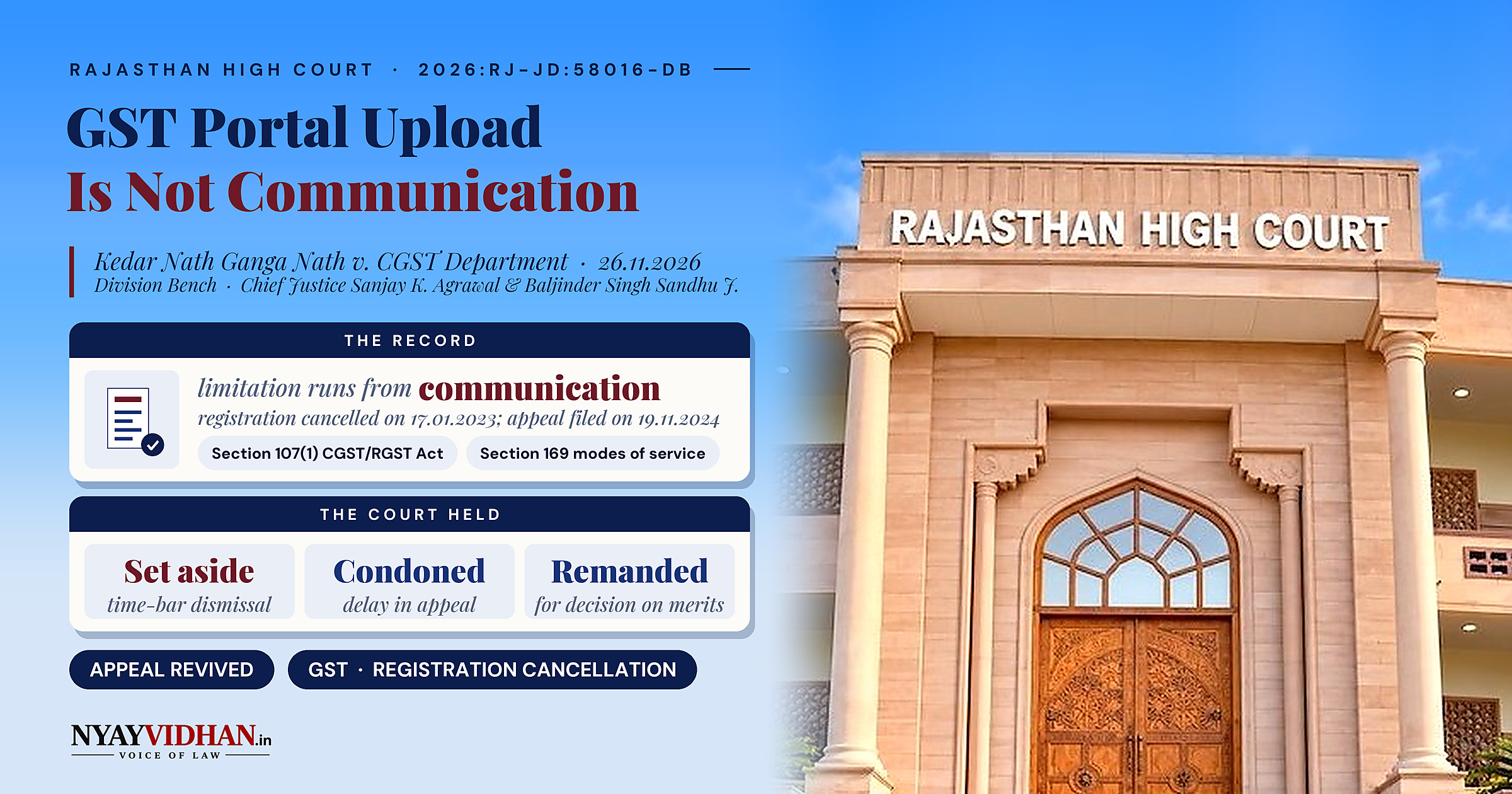
The writ petition was allowed to the extent indicated: the Appellate Authority's order of 28.11.2024 was set aside, the delay in filing the appeal was condoned, and the appeal was remanded to be heard and decided afresh on merits. The Court expressed no opinion on the merits (paras 23-25).
Source Rajasthan High Court, hcraj.nic.in — order dated 26 November 2026
Key holdings
- The three-month limitation for a GST appeal under Section 107(1) runs from the date the order is communicated to the person aggrieved, and communication is mandatory (paras 8, 14, 22).
- Clauses (a) to (c) of Section 169(1), tender, registered or speed post and e-mail, are the alternatives; clauses (d) to (f), including the common portal, follow only if those are not applicable (para 16).
- An order cancelling registration that was only uploaded on the GST portal had not been communicated, so the appeal could not be treated as time-barred (paras 19-20).
- Rules cannot cut down the modes of communication the statute provides or limit service to electronic modes (paras 21-22).
Judgment digest by NyayVidhan: a summary of the court's judgment, not its text. The judgment itself is the authoritative version.
Brief Facts
Court's Findings
As Section 107 allows only three months, plus one month of condonable delay, the order “has to be mandatorily communicated” (para 14). Of the modes of service in Section 169, the Court read clauses (a) to (c), tender, registered or speed post and e-mail, as the alternatives, with clauses (d) to (f), which include making the order available on the common portal, to follow only if those are not applicable; citing Saral Wire Craft, it stressed meaningful and realistic service (paras 15-17).
With Section 5 of the Limitation Act excluded (Singh Enterprises), the authority had to comply strictly with Sections 107(1) and 169(1). An order only uploaded on the GST portal “would not amount to the communication of order”, rules cannot confine service to electronic modes, and the Appellate Authority was “absolutely unjustified” in treating the appeal as time-barred (paras 19-22).
Legal Principle
NyayVidhan's view · Practice note
Why It Matters
The ruling turns on an order that, on the Revenue's own statement, was only uploaded on the GST portal. The Court fixed no date of knowledge: it condoned the delay on counsel's statement that the appeal was filed as soon as the order became known (paras 19, 23). It does not discuss the deeming rule in Section 169(2) or name the rule it says cannot be confined to electronic service (paras 21-22). Paragraph 18 speaks of an appeal “against the order of the Appellate Authority”, evidently meaning the cancellation order. For another limit on portal-based GST orders, see Star Raison Landmarks v. Chief Commissioner, State Tax (2026); this order does not cite it.
Editorial comment by the NyayVidhan Editorial Desk. It is not part of the Court's judgment and is not legal advice.
Precedents Relied Upon
- Chhattisgarh State Electricity Board v. Central Electricity Regulatory Commission and others (2010) 5 SCC 23
A word the statute and its rules do not define is to be interpreted by contextual interpretation, keeping in view the language of the relevant provisions; applied to "communication" in Section 107(1) of the GST Act.
- Union of India v. S.P. Singh (2008) 5 SCC 438
The ordinary meaning of "communicate" is to impart, confer or transmit information.
- Kubic Darusz v. Union of India and others (1990) 1 SCC 568
The word "communicate" is a strong one: under the COFEPOSA Act, sufficient knowledge of the basic facts constituting the grounds of detention must be imparted effectively and fully, in writing and in a language the detenu understands, to enable an effective representation.
View all precedents (8)
- Collector of Central Excise, Madras v. M/s M.M. Rubber and Co., Tamil Nadu 1992 Supp (1) SCC 471
Where a statutory provision gives a person adversely affected a remedy against an order, the limitation for invoking it runs from the date of communication of the order (Section 35-E of the Central Excises and Salt Act, 1944).
- Municipal Corporation of Delhi v. Qimat Rai Gupta and others (2007) 7 SCC 309
An order is ordinarily presumed to be made when it is signed, but it must be communicated where communication is necessary to bring about an end result or to give a person the opportunity to take recourse to law.
- D. Saibaba v. Bar Council of India and another (2003) 6 SCC 186
The limitation for a review under Section 48AA of the Advocates Act, 1961 runs from the date of communication or knowledge, actual or constructive, of the order, not from the date of the order.
- Saral Wire Craft Private Limited vs. Commissioner of Customs, Central Excise and Service Tax and others (2015) 14 SCC 523
Every effort must be made to serve the affected party meaningfully and realistically, so that he not only knows of the order but can initiate any permissible action (Section 37C of the Central Excise Act).
- Singh Enterprises V. Commissioner of Central Excise, Jamshedpur and others (2008) 3 SCC 70
Where a statute allows a fixed period for appeal and a limited further period for condoning delay, Section 5 of the Limitation Act is wholly excluded; applied to Section 107 of the GST Act.


