
Judgment Intelligence
Bail Rejected- Court
- Rajasthan High Court
- Date of Decision
- 26 November 2026
- Bench
- Justice Ashok Kumar Jain
- Relevant Acts & Sections
- Indian Penal Code, 1860 — Sections 420 and 120-B; Rajasthan Public Examination (Prevention of Unfairmeans) Act, 1992 — Sections 4, 5 and 6; Information Technology Act, 2000 — Section 66-D; Bharatiya Nagarik Suraksha Sanhita, 2023 — Section 483
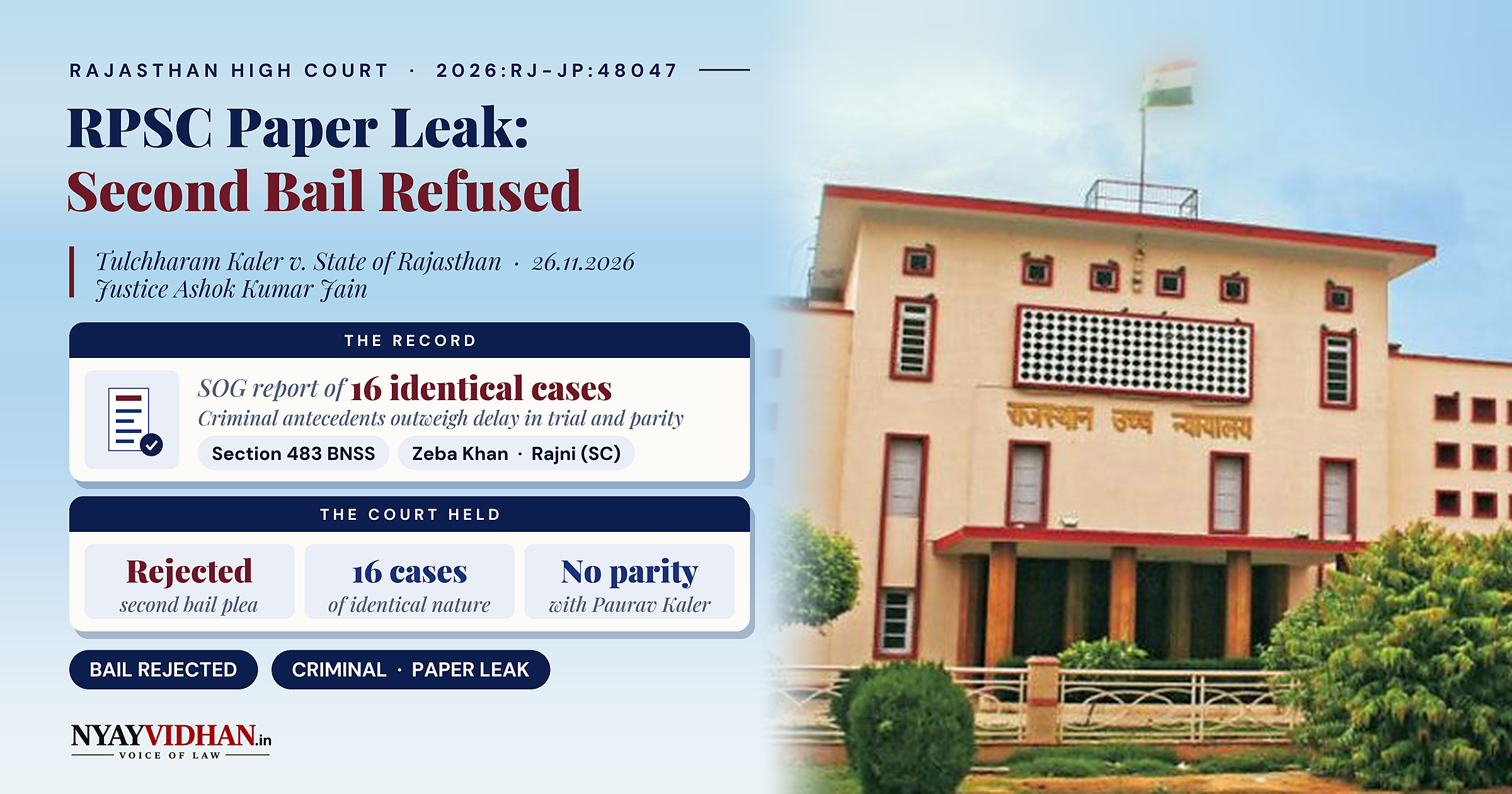
Second bail application under Section 483 BNSS dismissed. The Court found the allegations serious and the petitioner's role prima facie sufficient to show complicity, so that it was not a fit case for bail at this stage (paras 14-16).
Source Rajasthan High Court, hcraj.nic.in — order dated 26 November 2026
Key holdings
- An SOG report of 16 cases of identical nature led the Court to treat the petitioner as part of an organised syndicate influencing public examinations for money (paras 8-9).
- Criminal antecedents bear directly on whether an accused will abide by bail conditions, refrain from repeating offences and keep away from witnesses (paras 10-11).
- A petitioner with such a history is not entitled to bail only because the trial is delayed (para 12).
- Bail granted to co-accused Paurav Kaler by a co-ordinate bench gave no ground for parity (paras 7, 13).
Judgment digest by NyayVidhan: a summary of the court's judgment, not its text. The judgment itself is the authoritative version.
Brief Facts
In this second application, his counsel argued that only two of 78 witnesses had been examined, that he had been in custody for more than two and a half years, and that co-accused Paurav Kaler had been granted bail on 8 April 2026. The Public Prosecutor relied on the Supreme Court's refusal of bail to co-accused Rajaram @ Raju Matrix on 18 May 2026 (paras 2-4).
Court's Findings
On the fresh application, it noted that the Supreme Court had dismissed Rajaram @ Raju Matrix's special leave petition on 18 May 2026 (SLP (Criminal) No. 7556/2026), and that Paurav Kaler, though facing 8 criminal cases, had been bailed by a co-ordinate bench (para 7). The SOG report recorded 16 cases of identical nature against the petitioner. From this the Court concluded that he is “regularly involved in the criminal cases of identical nature” and part of an organised syndicate influencing public examinations for money (paras 8-9).
It then relied on three 2026 Supreme Court decisions. Zeba Khan (2026 INSC 144) and Rajni (2026 SCC OnLine SC 1050) cancelled bail because of criminal antecedents, which Rajni called “a material factor bearing directly on the likelihood of an accused abiding by bail condition”. Vinay Rajashekharappa Kulkarni (2026 INSC 1265) weighed antecedents together with the period of custody and Article 21 (paras 10-11). Applying them, the Court held that the petitioner, with “a checkered history”, is not entitled to bail on delay alone, and rejected parity with Paurav Kaler (paras 12-13). Considering the evidence collected so far, the allegations are serious and the role attributed to him is prima facie sufficient to show complicity, so it was not a fit case for bail at this juncture (paras 14-15).
Legal Principle
NyayVidhan's view · Practice note
Why It Matters
The order turns on the petitioner's record, not the trial's pace. Counsel's arguments on delay (two of 78 witnesses examined) and on parity with Paurav Kaler were met by the SOG report of 16 cases of identical nature, which the Court read as showing an organised syndicate influencing public examinations for money (paras 3, 8-9, 12-13). It also relied on three 2026 Supreme Court rulings that weighed criminal antecedents against bail; one of them, State of Karnataka v. Vinay Rajashekharappa Kulkarni, is on this site (para 10). On the wider paper-leak litigation, see the Division Bench ruling upholding cancellation of the 2021 Sub-Inspector examination in Dr. Sangeeta Arya v. State of Rajasthan; this order does not cite it.
Editorial comment by the NyayVidhan Editorial Desk. It is not part of the Court's judgment and is not legal advice.
Precedents Relied Upon
- Zeba Khan v. State of U.P. & Ors. 2026 INSC 144 2026 INSC 144
Relied upon: the Supreme Court allowed a complainant's plea to cancel bail granted by the High Court after noticing the accused's criminal antecedents; applied to hold that the petitioner's antecedents weigh against bail (paras 10, 12).
Relied upon: as the order reads it, the Supreme Court considered criminal antecedents as one of the grounds, as well as the period of custody with reference to Article 21, and set aside bail granted by the High Court after considering the gravity of the crime (paras 10, 12).
- Rajni v. State of Punjab 2026 SCC OnLine SC 1050
Relied upon: bail cancelled on the ground that criminal antecedents are a material factor bearing directly on the likelihood of an accused abiding by bail conditions, refraining from repeating offences and desisting from intimidating witnesses, and so must weigh heavily in considering bail (paras 11-12).
View all precedents (6)
- Rajaram @ Raju Matrix (Supreme Court, SLP (Criminal) No. 7556/2026) SLP (Crl.) No. 7556/2026, order dated 18.05.2026
Referred to: cited by the Public Prosecutor; the Supreme Court dismissed the special leave petition of the co-accused on 18.05.2026, denying him bail despite his period of custody (paras 4, 7).
- Paurav Kaler (bail order of a Co-ordinate Bench) order dated 08.04.2026
Relied on by the petitioner for parity; the Court noted the bail granted to the co-accused though 8 criminal cases were pending against him, and held that no ground for bail was made out on parity (paras 3, 7, 13).
- Sharwanram @ Sharwan Babal S.B. Criminal Miscellaneous Bail Application No. 197/2025
Referred to: the first-bail order of 01.09.2025, quoted in para 6, decided a bunch of 53 bail cases relating to the Sub-Inspector Direct Recruitment Examination, 2021, including the petitioner's, referring to and relying on this order (para 6).


