
Judgment Intelligence
Reference Answered- Court
- Rajasthan High Court
- Date of Decision
- 27 November 2026
- Bench
- Chief Justice Sanjay K. Agrawal, Justice Vinit Kumar Mathur and Justice Yogendra Kumar Purohit
- Relevant Acts & Sections
- Family Courts Act, 1984 — Sections 3, 7, 8 and 19 (including Section 19(6)); Hindu Marriage Act, 1955 — Sections 9 and 13 (the proceedings in the appeals)
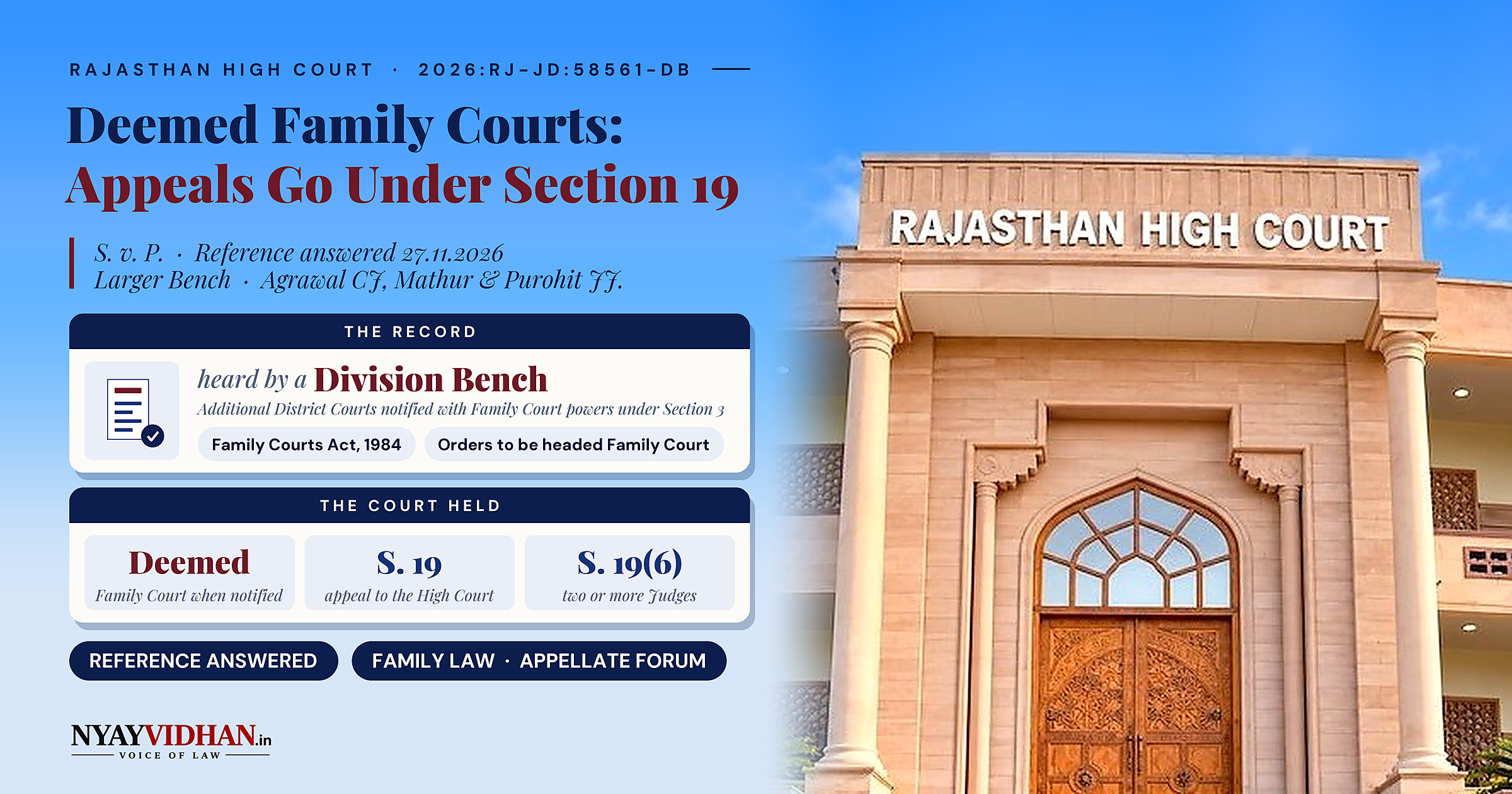
Reference answered: a notified Additional District Court is a deemed Family Court, and appeals lie under Section 19 to a Division Bench. All such courts must head their orders "Family Court" and sign and seal them as such; the order is to be circulated to all subordinate courts (paras 25-28).
Source Rajasthan High Court, hcraj.nic.in — order dated 27 November 2026
Key holdings
- The 01.06.2016 notification withdrew family jurisdiction only from the District Courts; it did not by implication withdraw the jurisdiction separately conferred on Additional District Courts in 2015 (paras 12-13).
- Section 8 of the Family Courts Act must be read with the Section 3 notifications and cannot nullify a specific conferment of Family Court jurisdiction (paras 18, 23).
- The source of jurisdiction and the capacity in which a court decides, not its name, show whether it acted as a Family Court (para 20).
- Judgments and orders of a notified Additional District Court in that jurisdiction are appealable under Section 19 and heard by a Division Bench under Section 19(6) (paras 22, 25).
- The answer covers only courts, areas and subject matters specifically notified, not every Additional District Court in Rajasthan (para 24).
Judgment digest by NyayVidhan: a summary of the court's judgment, not its text. The judgment itself is the authoritative version.
Brief Facts
Questions before the Court (framed by NyayVidhan)
- Are orders of an Additional District Court on which the State has conferred Family Court powers under Section 3 to be treated as orders of a Family Court for the appellate forum under Section 19? (as framed by the Court, para 4)
- Did the notification of 01.06.2016 take away the family jurisdiction conferred on Additional District Courts in 2015?
- Does Section 8 of the Family Courts Act, which excludes other courts once Family Courts are set up, defeat that conferment?
Submissions
For the parties. The order lists the members of the Bar who appeared and records that counsel for the parties were heard (para 4); it does not set out their submissions or say which view each side supported.
For the referring Division Bench. Hearing four appeals against orders of Additional District Judges under the Hindu Marriage Act, it doubted the Jaipur Division Bench's view because the consequences of Section 8, which excludes other courts' jurisdiction once Family Courts are established, had not been considered, and it referred the matter to a Larger Bench (paras 1-3).
For the view under reference. The Jaipur Bench, in U v. Smt. P, had treated Additional District Courts as deemed Family Courts (paras 2-3).
Court's Findings
The notification of 2016
The Court found that the notification of 01.06.2016 specifically withdrew the family jurisdiction conferred on the District Courts in 2015, but did not expressly withdraw the jurisdiction independently conferred on the Additional District Courts and the Magistrates' courts (para 12). The 2015 notification had named District Courts, Additional District Courts and Magistrate Courts separately, while the 2016 one referred only to District Courts; had the State meant to withdraw jurisdiction from all of them, “it could have expressly provided so”, and the withdrawal “cannot be extended by implication” (para 13). The notification of 26.06.2018, conferring Family Court powers on specified Additional District Courts, “further fortifies” that intention (paras 14, 16).
Section 8
Section 8 excludes the jurisdiction of the District Court and subordinate civil courts over the matters in the Explanation to Section 7(1) once a Family Court is established for an area (para 17). But it cannot be considered “in isolation or divorced from” the Section 3 notifications: the exclusion follows the territorial jurisdiction and the allocation of powers they make, and an Additional District Court given Family Court powers for an area does not act merely as an ordinary civil court there (para 18). The name of a court is not decisive; what matters is the source of the jurisdiction, the powers conferred and the capacity in which it decides, so proceedings in the conferred jurisdiction “partake the character of proceedings before a Family Court” even though the officer remains an Additional District Judge (para 20).
The appellate forum
Section 19 gives an appeal on facts and law to the High Court against every judgment or order of a Family Court that is not interlocutory, to be heard by two or more Judges under Section 19(6) (para 21). That special mechanism governs orders passed in the conferred jurisdiction (para 22). The view in U v. Smt. P that such a court is a deemed Family Court for deciding the appellate forum “does not suffer from any infirmity”, and Section 8 cannot be construed “so as to nullify or render ineffective” a specific conferment under Section 3 (para 23). The answer is confined to courts specifically notified, for the areas and subject matters covered (para 24). Although the capacity in which an order was passed can usually be inferred, the presiding officer should state it on the order itself (paras 19-20).
Legal Principle
NyayVidhan's view · Practice note
Why It Matters
Rajasthan's notifications have given Family Court powers to Additional District Courts, including 22 named courts outside headquarters in 2018 (paras 14-15). This answer settles that their judgments and orders in that jurisdiction are appealable under Section 19 of the Family Courts Act and go to a Division Bench, and the direction to head such orders “Family Court” should make the forum plain on the face of each order. The ruling reaches only courts, areas and subjects covered by a notification. The opinion does not discuss Section 28 of the Hindu Marriage Act or appeals already filed elsewhere, and it does not decide the four appeals that gave rise to the reference.
Editorial comment by the NyayVidhan Editorial Desk. It is not part of the Court's judgment and is not legal advice.
Precedents Relied Upon
- U v. Smt. P D.B. Civil Miscellaneous Appeal No. 1736/2021 (Rajasthan High Court, Jaipur Bench)
An Additional District Court conferred with the powers and jurisdiction of a Family Court by the State Government's notifications is to be treated as a deemed Family Court for determining the appellate forum; the Larger Bench held that this view "does not suffer from any infirmity".