
Thursday, 26 November 2026
Rajasthan High Court
Environmental Law

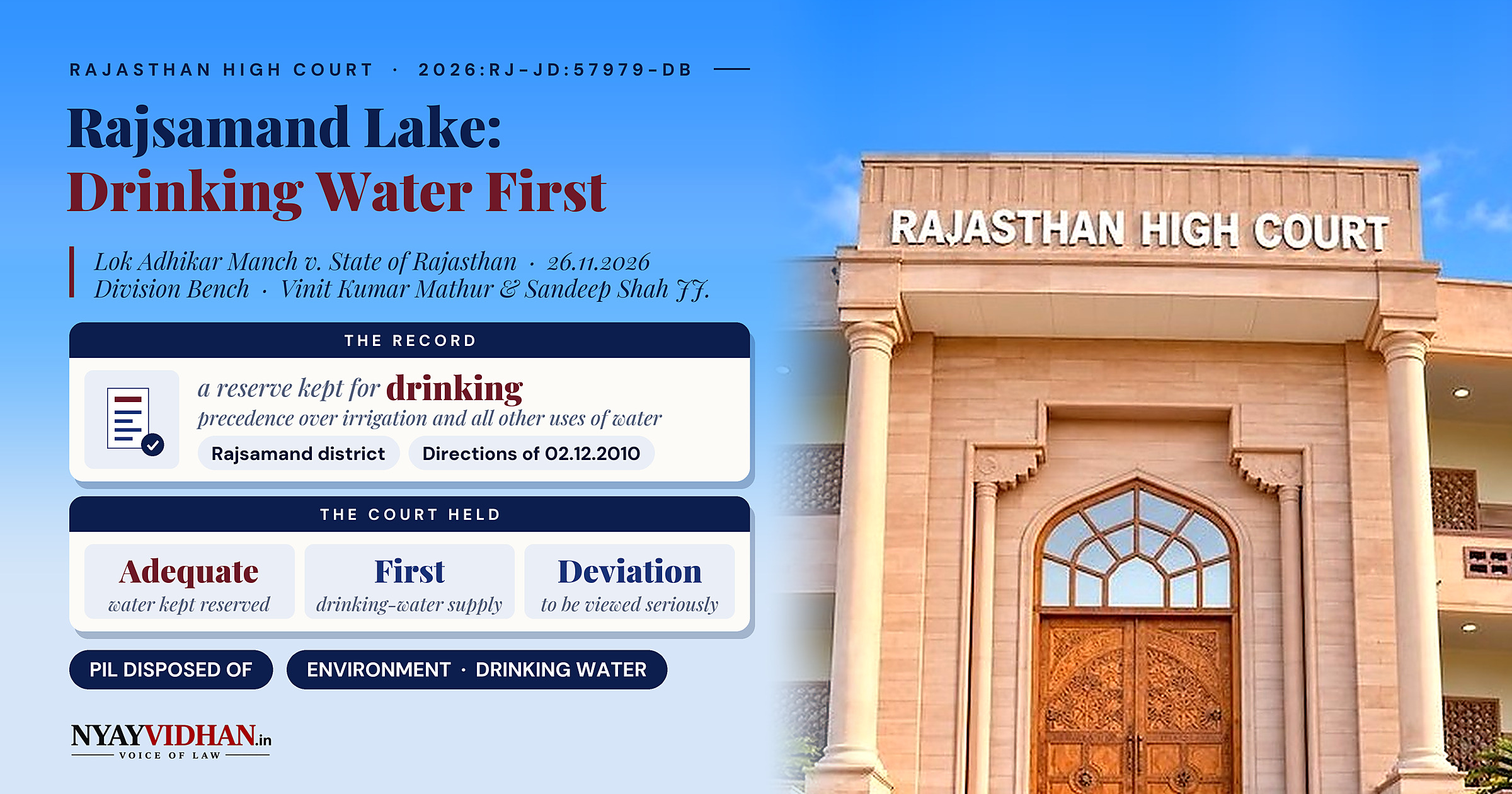
Drinking Water Comes First: Rajasthan High Court Tells State to Keep Rajsamand Lake Reserve for District Supply

Nagrik Adhikar Avam Upbhokta Sanrakshan Sansthan (Lok Adhikar Manch) v. State of Rajasthan & Ors. 2026:RJ-JD:57979-DB Decided 26 November 2026

Published: · NyayVidhan · 3 min read

In Nagrik Adhikar Avam Upbhokta Sanrakshan Sansthan (Lok Adhikar Manch) v. State of Rajasthan (2026:RJ-JD:57979-DB), a Division Bench of the Rajasthan High Court at Jodhpur disposed of a PIL seeking an adequate drinking-water reserve in Rajsamand lake. Relying on the District Collector's affidavit that 10 feet of water had been reserved for drinking, it held that drinking-water supply gets precedence over all other uses, directed the respondents to stick to the parameters for maintaining the lake's level, and warned that any deviation would be viewed seriously (paras 9-15).

Drinking Water Comes First: Rajasthan High Court Tells State to Keep Rajsamand Lake Reserve for District Supply

Judgment Intelligence

Disposed Of
Nagrik Adhikar Avam Upbhokta Sanrakshan Sansthan (Lok Adhikar Manch) v. State of Rajasthan & Ors.
2026:RJ-JD:57979-DB
D.B. Civil Writ Petition No. 17977/2023
Court
Rajasthan High Court
Date of Decision
26 November 2026
Bench
Justice Vinit Kumar Mathur and Justice Sandeep Shah
Final Outcome

Writ petition disposed of. The respondents must keep to the parameters for maintaining Rajsamand lake's water level and maintain an adequate level for drinking-water supply, so that the district does not face a shortage if rainfall fails. Any deviation from these directions will be viewed seriously (paras 13-16).

Source Rajasthan High Court, hcraj.nic.in — order dated 26 November 2026

Key holdings

  1. The petition, a second round after this Court's directions of 02.12.2010, sought an adequate drinking-water reserve in Rajsamand lake for Rajsamand district (paras 2-3).
  2. On the District Collector's affidavit, the Bench found that the required assessment had been made and adequate water reserved for drinking purposes (paras 9-11).
  3. Supply of drinking water in any district, including Rajsamand, gets precedence over all other uses of water (para 12).
  4. The respondents must stick to the parameters for maintaining the lake's level so that the district does not face a drinking-water shortage if rainfall fails; any deviation will be viewed seriously (paras 13-15).

Judgment digest by NyayVidhan: a summary of the court's judgment, not its text. The judgment itself is the authoritative version.

Brief Facts

The petitioner, a Rajsamand society known as Lok Adhikar Manch, asked that adequate water be reserved in Rajsamand lake for the district's drinking-water supply (para 2). Its senior counsel said this was the second round: on 02.12.2010 this Court had directed the State, among other things, to clean the Khari Feeder, examine removing anicuts on the Gomati river, canalise inflow obstructed by mining and keep the lake, as far as possible, at least 600 mcft; a committee was then constituted (paras 3-4). Counsel argued that the State's stand had varied from year to year, that water connections had increased and that, with low rainfall, drinking water should get precedence over irrigation (paras 4-5). The Additional Advocate General replied that an additional affidavit had been filed under the order of 09.10.2026 and that adequate water would be reserved (para 6).

Court's Findings

The Bench reproduced the District Collector's additional affidavit in full (para 9). Its contents are the State's account. According to it, a joint report of the PHED and the Water Resources Department dated 16.11.2026 put drinking-water demand at 430 MCFT and 460 MCFT for two years (both rows carry the year 2026-2027 in the Court's copy), excluding evaporation losses. The lake stood at 17.80 feet against a full tank level of 30 feet, about 1,832 MCFT of storage. Irrigation releases over the last three years were 1,771.95, 1,715.00 and 1,280.00 MCFT. On 06.11.2026 the Water Distribution Committee, chaired by the Collector and including farmers of the command area, unanimously decided to reserve 10 feet of water, about 1,015 MCFT, for drinking (para 9).

The Court's own findings follow. It read the 2010 directions as requiring all-out efforts to conserve and preserve the lake's water and to keep an adequate reserve for drinking water (para 8), and noted that the committee formed under them meets regularly (para 9). On the affidavit, it found that the competent authorities had already made the required assessment and had reserved water at an adequate level, so the concern raised in the petition had been taken note of (paras 10-11). It then stated that drinking-water supply in any district, including Rajsamand, “will get precedence over all other usage of water” (para 12).

The order cites no precedent. It does not test the demand figures, fix a minimum level of its own or call for a compliance report (paras 10-16).

Legal Principle

Where the State shows by affidavit that the competent authorities have assessed drinking-water demand and reserved an adequate quantity in a lake, the High Court may dispose of a public interest litigation while directing the State to keep to those parameters, because supply of drinking water takes precedence over every other use of water (paras 10-13).

NyayVidhan's view · Practice note

Why It Matters

The direction in paragraph 13 does not fix a water level of its own. The “parameters” it refers to are the ones set out in the District Collector's affidavit, in particular the Water Distribution Committee's decision of 06.11.2026 to reserve 10 feet of water (about 1,015 MCFT) for drinking (para 9). That affidavit, read with the 2010 directions (including the level of “at least 600 mcft.” to be kept “as far as possible”), is the benchmark against which any later complaint of deviation would be measured (paras 3, 13-15). The statement that drinking water takes precedence over all other uses is not confined to Rajsamand: the Bench speaks of “any District” (para 12).

Editorial comment by the NyayVidhan Editorial Desk. It is not part of the Court's judgment and is not legal advice.

Join our WhatsApp Group
✕

Try: POCSO, IBC, Electoral Bond, Article 370, NDPS Act, Bail Conditions, SC Contempt