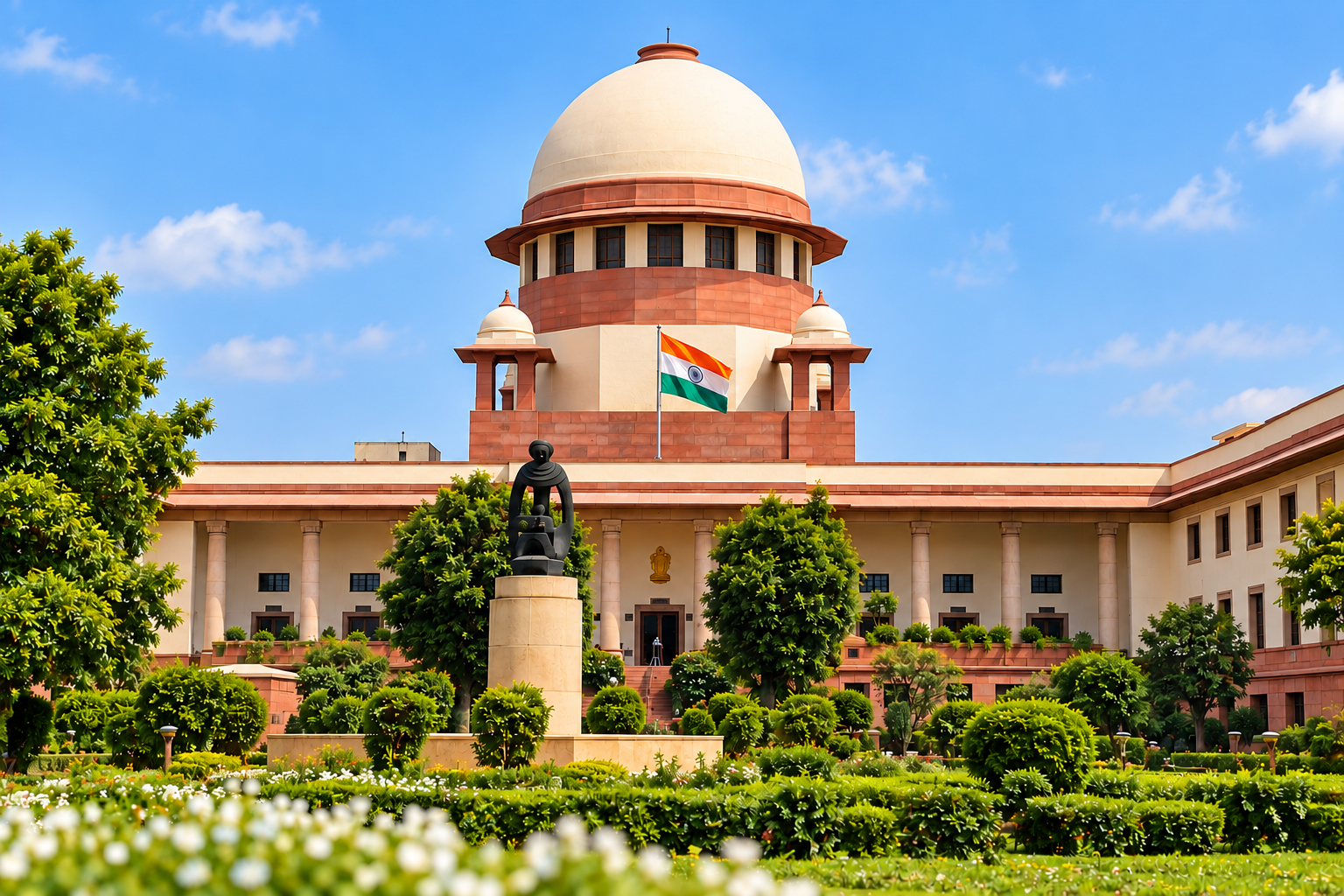

Photo: Subhashish Panigrahi via Wikimedia Commons (CC BY-SA 4.0)
Judgment Intelligence
Petition DismissedSubhas Chandra Sarkar v. State of West Bengal & Ors.
2026 INSC 1052
Special Leave Petition (Crl.) No. 3418 of 2026
- Court
- Supreme Court of India
- Date of Decision
- 22 September 2026
- Bench
- Justices J.B. Pardiwala and K. Vinod Chandran
- Relevant Acts & Sections
- Bharatiya Nagarik Suraksha Sanhita, 2023 — Sections 413, 415, 419; Indian Penal Code, 1860 — Sections 304A, 34
Final Outcome
Special Leave Petition rejected. The High Court's order was upheld. The petitioner may appeal to the jurisdictional Sessions Court; an appeal filed within one month will be admitted and heard on merits without considering the delay. The Court expressed no view on the merits of the acquittal (paras 13-15).
Key holdings
- A victim's appeal against an acquittal is governed by the proviso to Section 413 of the BNSS, not Section 419 (paras 10-11).
- Against a Magistrate's acquittal, that appeal lies to the Sessions Court, which hears appeals from a Magistrate's convictions under Section 415(3) (paras 11-12).
- Admission by one Single Judge does not stop another from holding the appeal not maintainable at the final hearing (paras 4-5).
- An appeal filed within one month must be heard on merits without regard to delay caused by the bona fide High Court proceeding (para 13).
Brief Facts
The petitioner's son, who was suffering from depressive disorders, died by suicide while admitted to a hospital. The petitioner attributed the death to the negligence of a doctor and a nurse, and an FIR was registered for an offence under Section 304A read with Section 34 of the Indian Penal Code, a bailable offence (para 9). The Judicial Magistrate, 9th Court, Alipore, acquitted the accused (para 9). The petitioner's appeal to the High Court was admitted by one Single Judge, but at the final hearing another Single Judge rejected it as not maintainable, leaving him free to appeal before the Sessions Court (paras 3, 5).
Court's Findings
The Court rejected the argument, based on Rajan Chadha v. Sanjay Arora, that a coordinate bench could not hold an appeal admitted by another Single Judge not maintainable. That proposition "does not emanate from the cited decision", which concerned a second Single Judge undoing a contempt finding already recorded (para 4). Holding the appeal not maintainable at the final hearing was "perfectly in order" (para 5). The Amicus Curiae's argument had initial force: under Section 419 of the BNSS, a State appeal against a Magistrate's acquittal goes to the Court of Session only for a cognizable and non-bailable offence, so for a bailable offence it lies to the High Court (paras 6, 8). But a victim's appeal is governed by the proviso to Section 413, under which it lies to the court that ordinarily hears appeals against convictions by the trial court, and Section 419 does not apply when the proviso applies (paras 10-11). Under Section 415(3), a person convicted by a Magistrate of the first or second class appeals to the Court of Session, so the victim's appeal against the Magistrate's acquittal lies there as well (paras 11-12).
Legal Principle
Under the proviso to Section 413 of the BNSS, a victim's appeal against an acquittal lies to the court that ordinarily hears appeals against convictions by the trial court. Since Section 415(3) sends appeals from a Magistrate's conviction to the Court of Session, a victim's appeal against a Magistrate's acquittal lies to the Sessions Court (paras 11-12).