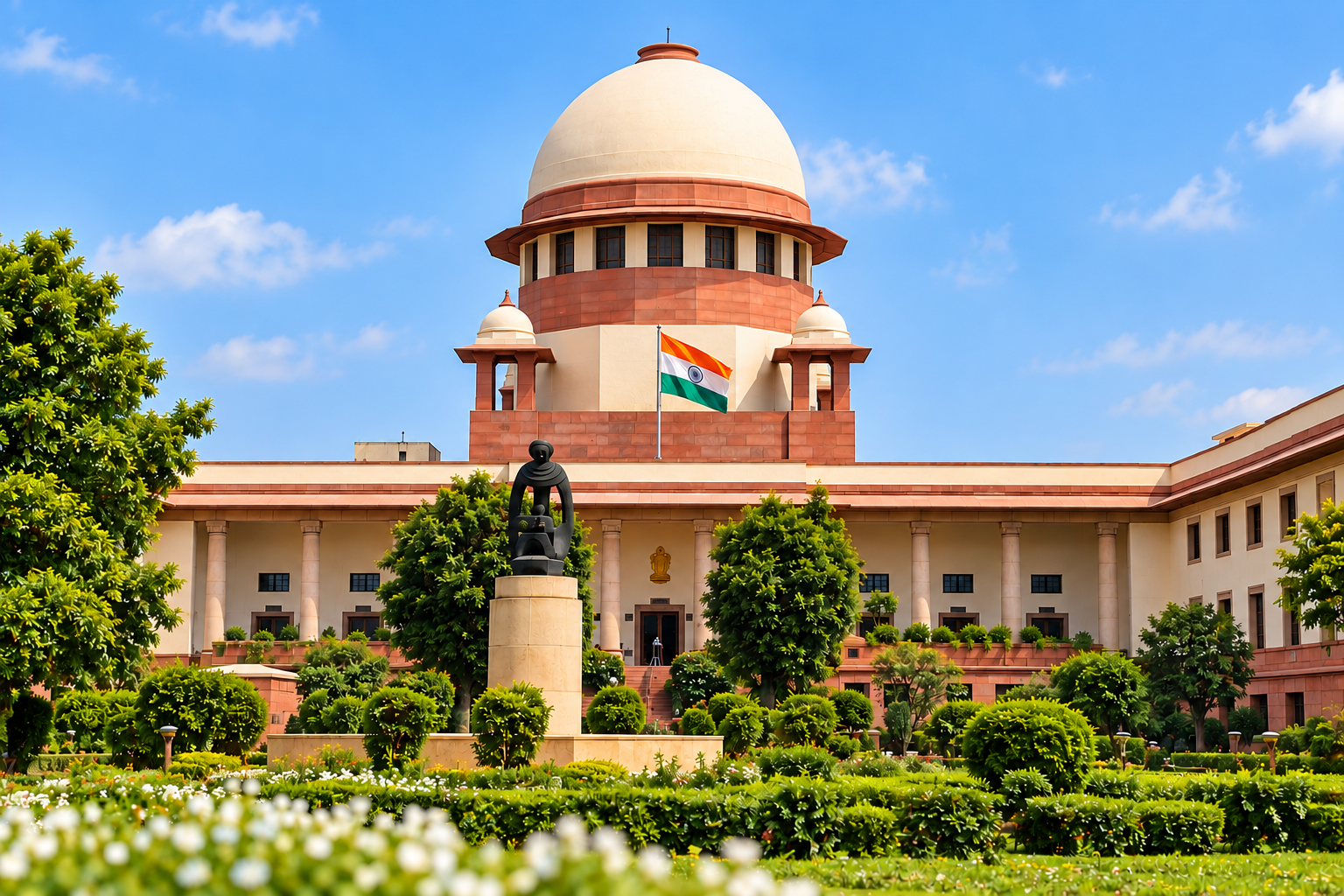

Photo: Subhashish Panigrahi via Wikimedia Commons (CC BY-SA 4.0)
Judgment Intelligence
Conviction Set AsideNeeraj Dutta vs. State (Govt. of NCT of Delhi)
2023 INSC 245
Criminal Appeal No. 1669 of 2009
- Court
- Supreme Court of India
- Date of Decision
- 17 March 2023
- Bench
- Justice Abhay S. Oka, Justice Rajesh Bindal
- Relevant Acts & Sections
- Prevention of Corruption Act, 1988 (pre-2018 amendment) -- Sections 7, 13(1)(d)(i)-(ii), 13(2) and 20
Final Outcome
The appeal was allowed; the judgments of the High Court and the Special Court were set aside, and the appellant's conviction and sentence under Sections 7 and 13(2) of the Prevention of Corruption Act, 1988 were set aside (para 20).
Key holdings
- The Constitution Bench ruling permits proof of demand by circumstantial evidence, but it does not dilute the requirement of proof beyond reasonable doubt (paras 13-14).
- Where demand is proved circumstantially, every circumstance must be established and consistent only with a demand for gratification (para 14).
- A shadow witness who only heard the accused ask for papers and Rs. 10,000, without knowing its purpose, does not prove a demand for gratification (paras 15-16).
- Every demand for payment of money is not a demand for gratification; it has to be something more than a mere demand for money (para 17).
- The Section 20 presumption arises only after demand and acceptance are proved; without proof of demand, the Section 13(1)(d) offence also fails (paras 11, 19).
Brief Facts
Complainant Ravijit Singh, a car dealer, alleged that Neeraj Dutta of the Delhi electricity department demanded Rs. 15,000, settled at Rs. 10,000, to install an electricity meter at his shop. A trap was laid on 17 April 2000. The complainant died before the trial. The Special Judge convicted her under Sections 7 and 13(2) of the PC Act, and the High Court affirmed. Her appeal was first referred to a Constitution Bench.
Court's Findings
Applying the Constitution Bench's answer to the reference, the Court held that demand and acceptance may be proved by circumstantial evidence, but the requirement of proof beyond reasonable doubt is not diluted; every circumstance must be established and consistent only with guilt (paras 13-14). The only evidence of demand was the shadow witness, PW-5, who said the appellant merely asked for the meter papers and Rs. 10,000 as she was in a hurry (para 15). He knew nothing of earlier dealings or the purpose of the payment, and every demand for money is not a demand for gratification (paras 16-17). Her defence of a dues-collection drive was supported by the Rs. 71,900 found in her car (para 17). The application for a meter was never proved, and the stolen-meter complaint was registered eight days after the alleged demand, making the prosecution's case extremely doubtful (para 18).
Legal Principle
Proof of demand and acceptance of illegal gratification is a sine qua non under Sections 7 and 13(1)(d) of the PC Act and must be established beyond reasonable doubt, even when proved circumstantially. A mere request for money is not a demand for gratification (paras 9, 14, 17).