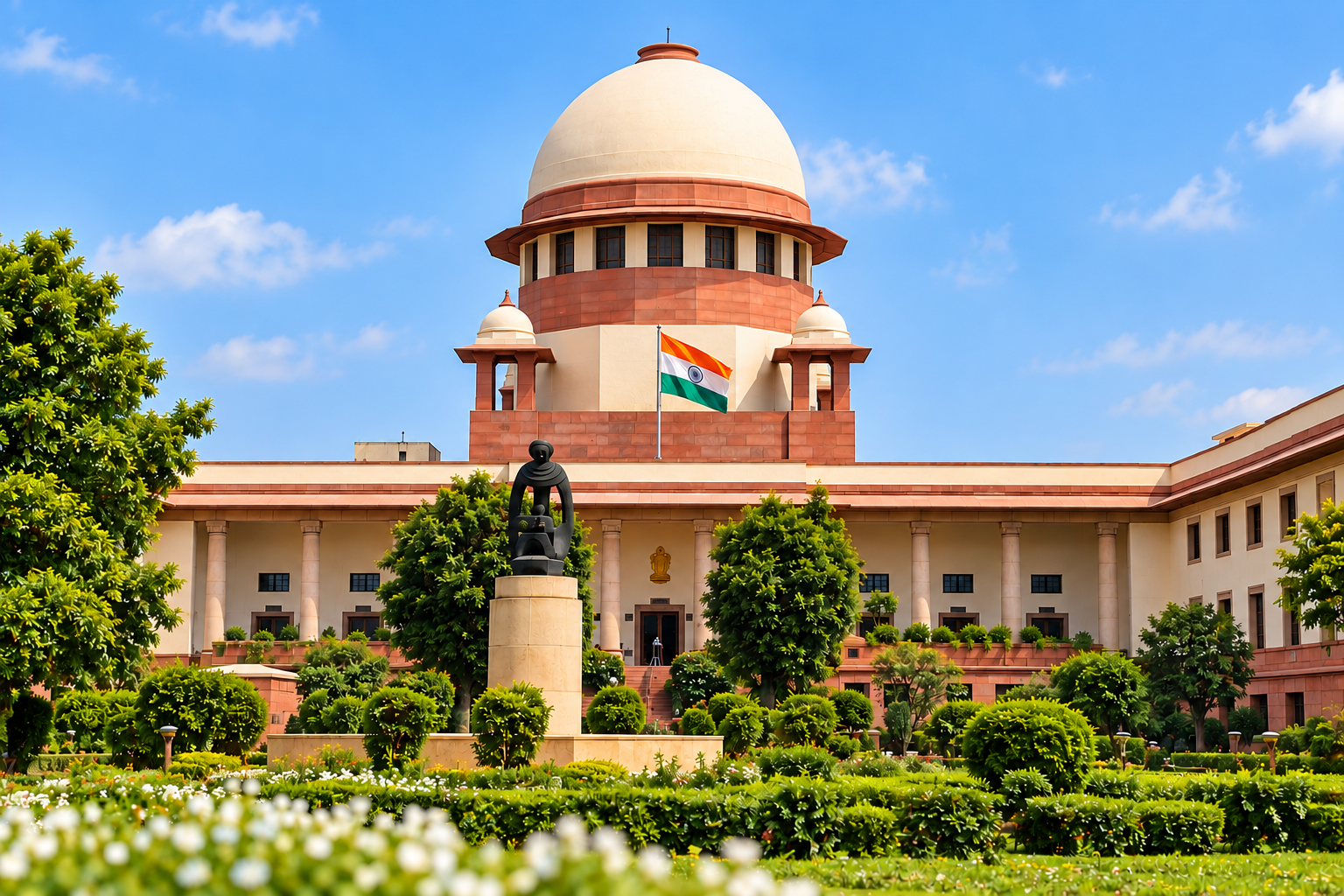

Photo: Subhashish Panigrahi via Wikimedia Commons (CC BY-SA 4.0)
Judgment Intelligence
Petition AllowedJaskaran Jeet Singh Deol v. State of Punjab
2026 INSC 1022
Criminal Appeal No. 4234 of 2026 (arising out of SLP (Crl.) No. 11103 of 2026)
- Court
- Supreme Court of India
- Date of Decision
- 21 September 2026
- Bench
- Justices Ujjal Bhuyan and Atul S. Chandurkar
- Relevant Acts & Sections
- Constitution of India — Articles 21, 22(1), 22(2); Bharatiya Nagarik Suraksha Sanhita, 2023 — Sections 47, 58; Code of Criminal Procedure, 1973 — Sections 50, 57
Final Outcome
Appeal allowed. The High Court's order of 29 May 2026 and the Magistrate's observations of 18 May 2026 were set aside. Any custodial interrogation must follow Mihir Rajesh Shah and this judgment's procedure. No opinion on the merits. Copies go to all DGPs and High Courts (paras 38-40).
Key holdings
- A breach of Article 22(1) vitiates arrest and remand without any need to show prejudice; the accused is released from unconstitutional detention, not on bail (para 23).
- To re-arrest, the police must apply to the Magistrate after furnishing written grounds, stating reasons, necessity and an explanation for the lapse, with the immediate superior's endorsement; the Magistrate should decide preferably within a week (para 24).
- The superior officer must hand the investigation to another officer and direct a departmental enquiry, with adverse findings entered in the service book (para 25).
- The same procedure applies after a breach of Article 22(2), and the High Court may award compensation as a public-law remedy (para 36).
Brief Facts
The appellant, accused of offences under the BNS and the POCSO Act, was arrested at about 7:54 am on 17 May 2026 and produced before the duty Magistrate at around noon the next day (para 3). He had not been given written grounds of arrest, so the Magistrate held the arrest illegal and released him, while observing that the police could seek custody after supplying the grounds (para 3). A fresh custody application failed because the grounds had still not been supplied (para 3). The High Court then held that the police could not be restrained from re-arresting him, leaving him to pursue the officers for his detention beyond 24 hours (paras 3, 27).
Court's Findings
The Court restated the Article 22(1) principles: written grounds of arrest, in a language the accused understands, must be furnished in every case, and a breach vitiates arrest and remand; a later chargesheet does not cure it (para 23). "When there is violation of the Constitution, question of prejudice or demonstrable prejudice does not arise" (para 23). Mihir Rajesh Shah states the binding law: Sri Darshan was decided, and the arrest in Sonam Raghuvanshi made, before it (para 22). An accused released for such a breach "is not enlarged on bail"; he is freed from unconstitutional detention (para 23). The power to re-arrest "must not be left to the discretion of the very same authority" that violated the Constitution. "It must have the judicial imprimatur" (para 25). The same procedure applies after a breach of Article 22(2) (para 36). Sanjay Dutt and Rakesh Kumar Paul, which permit re-arrest after default bail, were distinguished because here both breaches occurred at the threshold of arrest (paras 34-35).
Legal Principle
An accused released because the police breached Article 22(1) or 22(2) cannot be re-arrested at the police's discretion. Re-arrest requires the Magistrate's permission on an application made after furnishing written grounds, explaining the lapse and endorsed by the immediate superior. No prejudice need be shown, and the gravity of the offence is no answer (paras 23-25, 36-37).