
Judgment Intelligence
Disposed Of- Court
- Rajasthan High Court
- Date of Decision
- 26 November 2026
- Bench
- Chief Justice Sanjay K. Agrawal and Justice Baljinder Singh Sandhu
- Relevant Acts & Sections
- Central Goods and Services Tax Act, 2017 — Section 6(2)(b); Rajasthan Goods and Services Tax Act, 2017 — Section 6(2)(b)
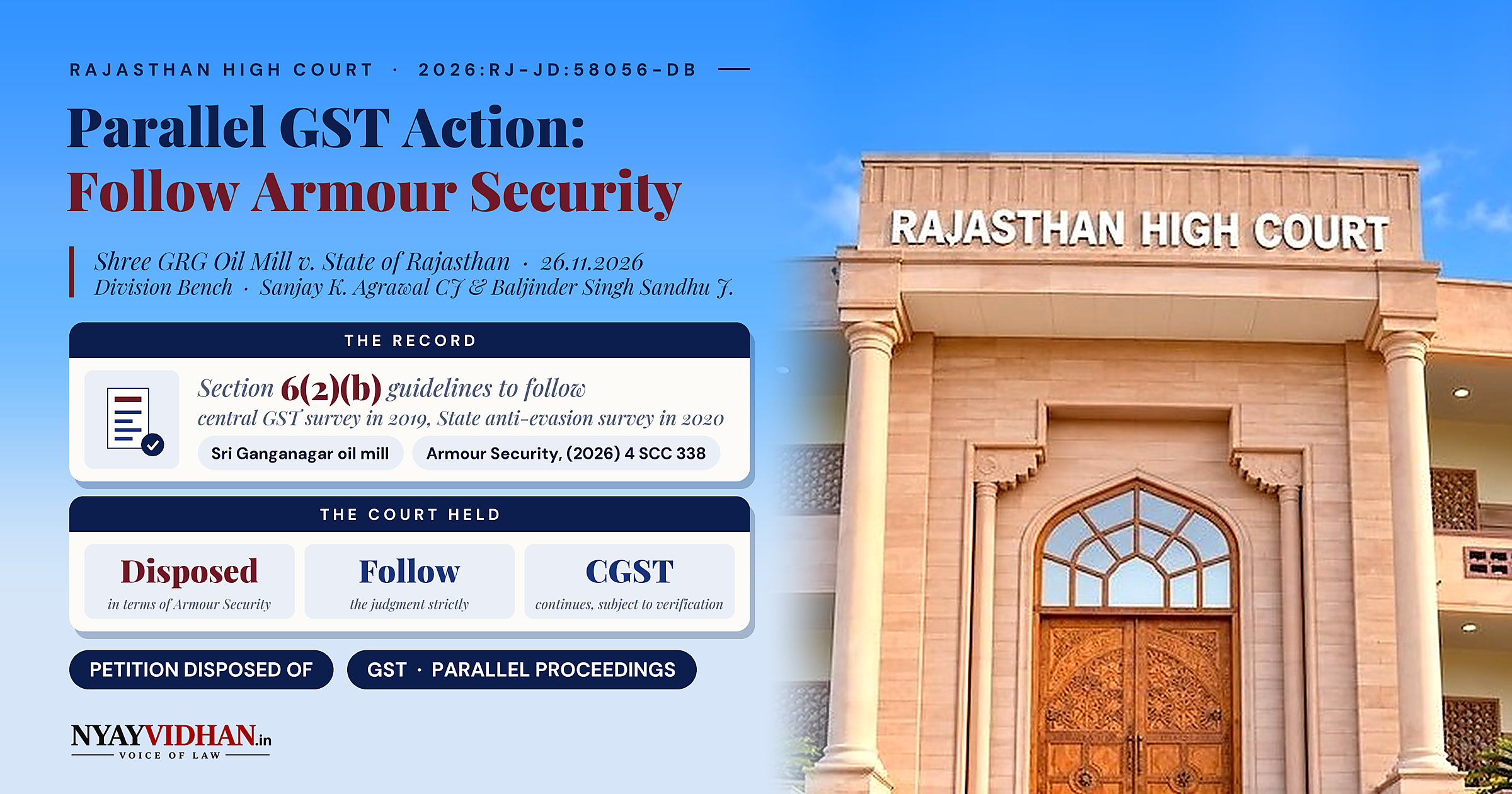
The writ petition was disposed of in terms of Armour Security, with the authorities to follow it strictly; the proceedings initiated by the CGST authorities would continue subject to verification. The Court quashed no notice or proceeding and made no finding on whether the two inquiries overlap (para 5).
Source Rajasthan High Court, hcraj.nic.in — order dated 26 November 2026
Key holdings
- The firm said central GST officers took up its case after a survey on 26.09.2019, and that the State survey of 21.12.2020 followed its Rs. 70 lakh deposit (para 1).
- The Court quoted the Supreme Court's conclusions in Armour Security: Section 6(2)(b) bars a second tax administration from initiating proceedings, meaning a show-cause notice, on the same subject-matter (para 4).
- Under the quoted guidelines, the taxpayer must inform the later authority in writing, the two authorities must verify the overlap between themselves, and the first to begin continues if they cannot agree (para 4).
- The petition was disposed of in terms of Armour Security; the authorities must follow it strictly, and the CGST proceedings continue subject to verification (para 5).
Judgment digest by NyayVidhan: a summary of the court's judgment, not its text. The judgment itself is the authoritative version.
Brief Facts
Court's Findings
As quoted, the Supreme Court held that Section 6(2)(b) of the CGST Act and the equivalent State laws bar the “initiation of any proceedings” on the “same subject-matter”. Intelligence-based enforcement may be started by either the Central or the State administration, but the other should not start parallel proceedings once one has begun. Steps to gather evidence, such as summons, search or seizure, are not “proceedings”; the expression means the formal start of adjudication by a show-cause notice. The subject-matter is the same where two proceedings seek to assess or recover an identical or partly overlapping liability arising from a particular contravention (para 4).
The quoted guidelines require the taxpayer first to answer a summons or notice, and then to tell the later authority in writing about the earlier inquiry. The two authorities must verify the claim with each other, and either give reasons for treating the matters as distinct or decide which of them continues; if they cannot agree, the authority that began first carries the matter through. A show-cause notice on a liability already covered by an existing one is to be quashed (para 4).
The High Court then disposed of the petition in terms of Armour Security (para 5).
Legal Principle
NyayVidhan's view · Practice note
Why It Matters
The order does not decide the overlap itself: it records the firm's case, quotes the Supreme Court's conclusions and guidelines in Armour Security and leaves the authorities to apply them. It says nothing about what happens to the State proceedings, and only that the CGST proceedings “would continue subject to verification”, although no central GST authority was a respondent. Under the quoted guidelines, a taxpayer facing similar action from both administrations first answers the summons or notice, then writes to the later authority about the earlier inquiry so that the two departments can verify it between themselves; a writ petition lies if they do not follow the guidelines (paras 4-5).
Editorial comment by the NyayVidhan Editorial Desk. It is not part of the Court's judgment and is not legal advice.
Precedents Relied Upon
- Armour Security (India) Limited Vs. Commissioner, CGST, Delhi East Commissionerate and Another (2026) 4 SCC 338 (Supreme Court of India)
Section 6(2)(b) of the CGST Act and the equivalent State enactments bar the initiation of proceedings (the formal start of adjudication by a show-cause notice, not summons, search or seizure) on the same subject-matter by a second tax administration; the Supreme Court laid down guidelines on intimation by the taxpayer, verification between the authorities and which authority continues. The writ petition was disposed of in terms of that judgment.