
Judgment Intelligence
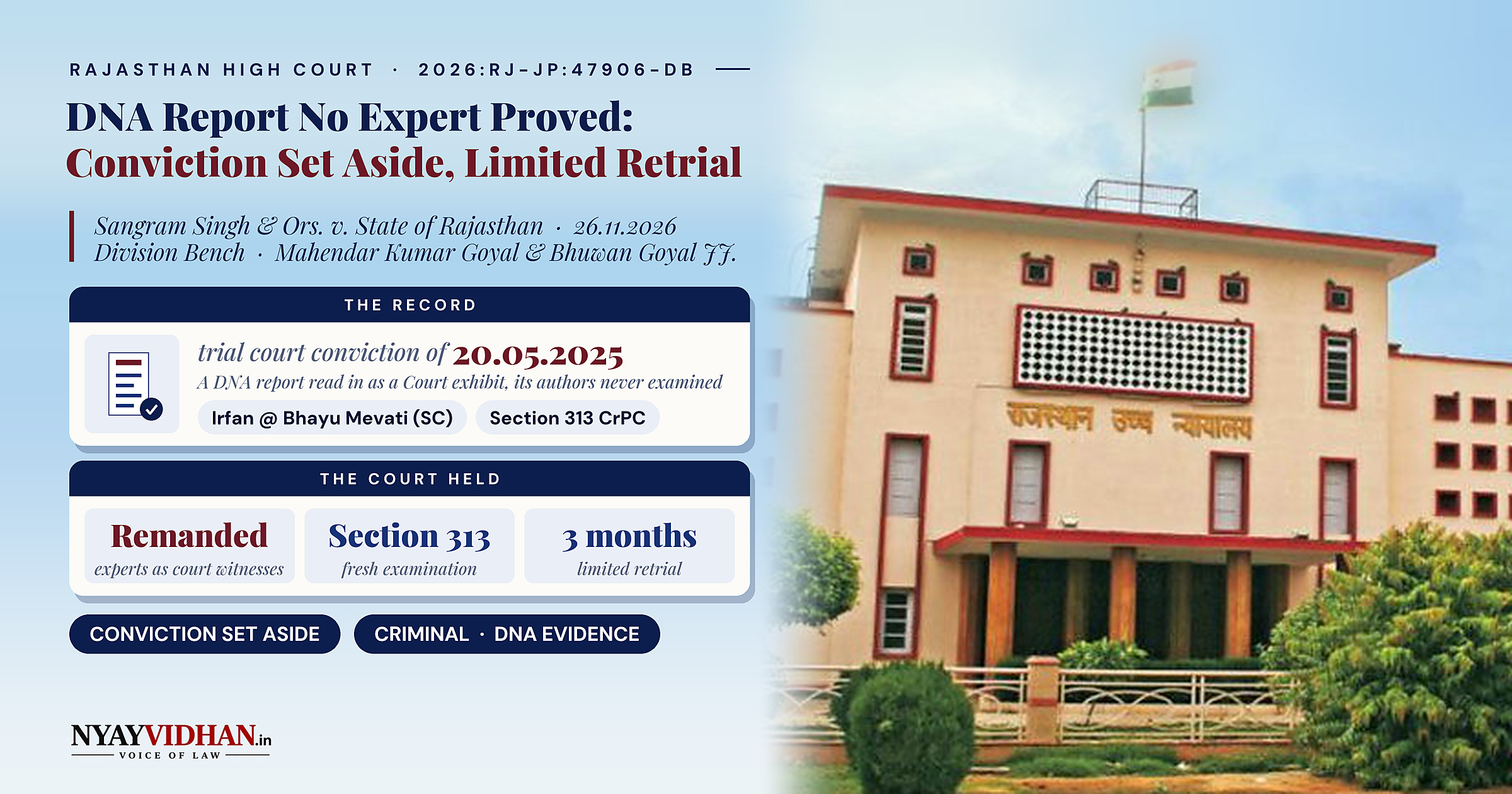
Conviction Set Aside- Court
- Rajasthan High Court
- Date of Decision
- 26 November 2026
- Bench
- Justice Mahendar Kumar Goyal and Justice Bhuwan Goyal
- Relevant Acts & Sections
- Code of Criminal Procedure, 1973 — Section 313
Appeals allowed. The conviction and sentence of 20 May 2025 in Sessions Case No. 78/2017 were quashed and set aside, and the matters remanded for a retrial confined to the DNA experts' evidence, to be completed within three months (p. 12).
Source Rajasthan High Court, hcraj.nic.in — order dated 26 November 2026
Key holdings
- Relying on a DNA report that the prosecution never exhibited and that was read only as a Court exhibit, without examining the expert who prepared it, was unsafe (pp. 3, 11-12).
- Following Irfan, the experts must be summoned with the entire supporting material and examined as court witnesses (pp. 3-12).
- The accused must be questioned again under Section 313 CrPC on the fresh evidence and may lead defence evidence before the case is decided afresh (p. 12).
- Because the incident is almost ten years old, the limited retrial must be completed within three months of receipt of the order (p. 12).
Judgment digest by NyayVidhan: a summary of the court's judgment, not its text. The judgment itself is the authoritative version.
Brief Facts
At the hearing, counsel for the appellants pointed to these findings and, relying on Irfan alias Bhayu Mevati (2025 INSC 150), asked that the matter be remanded so that the experts who prepared the report could be examined and cross-examined. The Public Prosecutor did not oppose the prayer (p. 3).
Court's Findings
Applying that “precedential law” to the facts, the Bench held that it “was unsafe for the learned trial Court to have relied upon the DNA report in absence of examination of the Scientific Expert(s) who had prepared the same and without affording the accused-appellants an opportunity to cross-examine him” (pp. 11-12). It remanded the matters on the same pattern: the trial court must summon the experts with the entire supporting material as court witnesses, let both sides examine them, question the accused again under Section 313 CrPC on the fresh evidence, allow defence evidence and hear the case again (p. 12). As the incident is almost ten years old, it fixed three months and confined the retrial to that extent (p. 12).
Legal Principle
NyayVidhan's view · Practice note
Why It Matters
The remand is narrow. The Court did not weigh the rest of the evidence, and the order neither records the offences nor gives any direction on custody or bail while the retrial runs. Its lesson for trial courts is the one it took from Irfan: a forensic report on which the case turns must be proved by the expert who prepared it, who can then be cross-examined; reading it in as a Court exhibit is not enough (pp. 3-12). The same Bench examined DNA evidence in S.S. & Ors. v. State of Rajasthan (2026), where it acquitted after finding the chain of custody broken; this order does not cite it.
Editorial comment by the NyayVidhan Editorial Desk. It is not part of the Court's judgment and is not legal advice.
Precedents Relied Upon
- Irfan alias Bhayu Mevati v. State of Madhya Pradesh 2025 INSC 150 2025 INSC 150
Relied on by the appellants; the Court treated the case as an identical situation and quoted paras 22-35 of the three-Judge Bench judgment: a DNA report on which the prosecution case rests is of doubtful probative value when no scientific expert who prepared it is examined, and the matter was remanded for the experts to be examined as court witnesses, a fresh Section 313 CrPC examination and a fresh decision. Followed: conviction set aside and the matters remanded on the same pattern, within three months (pp. 3-12).