
Judgment Intelligence
Appeal Partly Allowed- Court
- Rajasthan High Court
- Date of Decision
- 28 November 2026
- Bench
- Justice Mahendar Kumar Goyal and Justice Bhuwan Goyal
- Relevant Acts & Sections
- Indian Penal Code, 1860 — Sections 148, 149, 299, 300, 302, 304, 320, 323, 336, 341 and 427; Code of Criminal Procedure, 1973 — Sections 313 and 437-A (Section 481 BNSS)
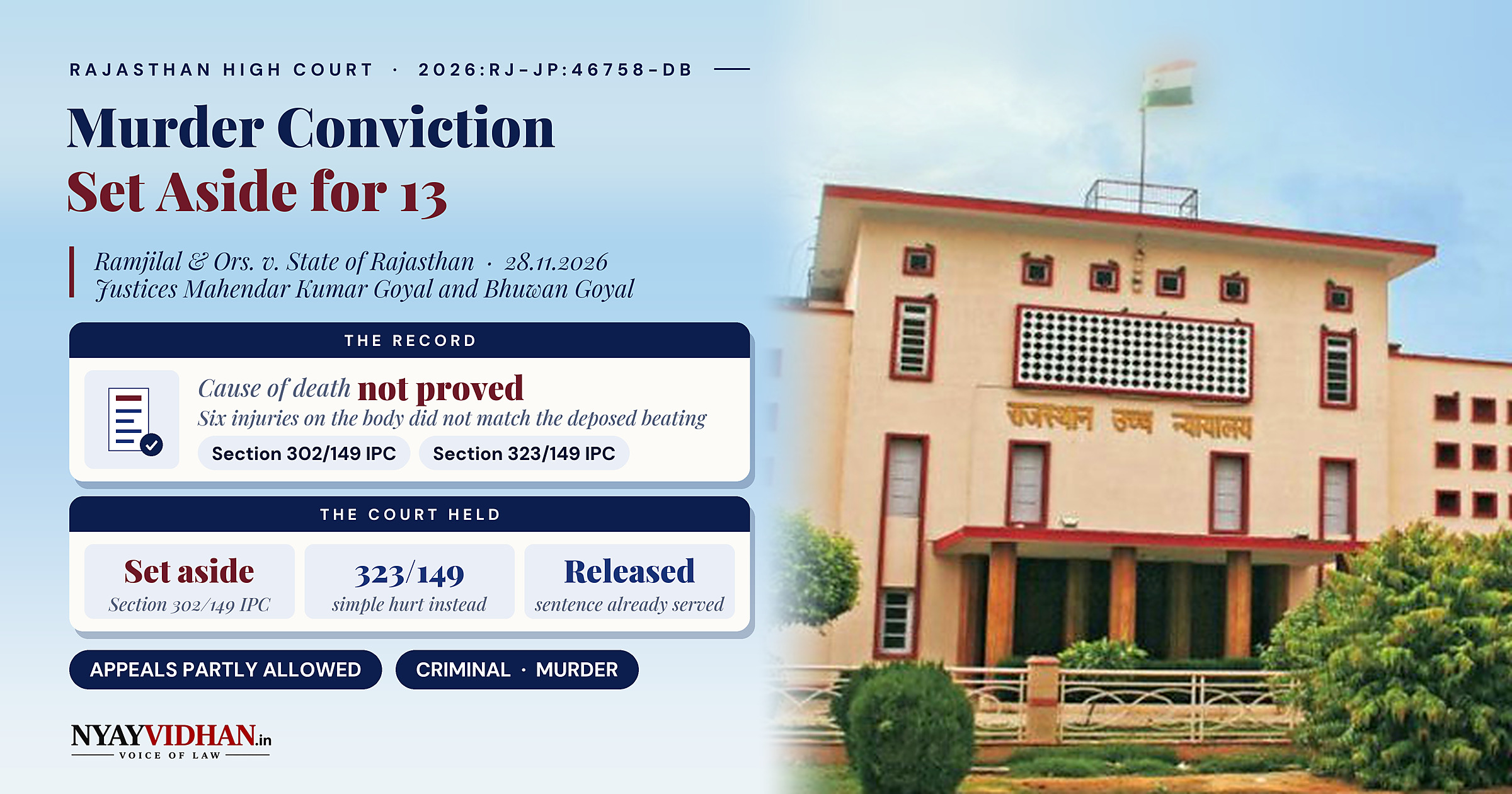
Appeals partly allowed. The Section 302/149 and Section 149 convictions were set aside; the other convictions and fines stand, with sentences cut to at most seven and a half months, already served. The four still jailed were ordered released, the rest freed from bail, on Section 437-A bonds (pp. 30-32).
Source Rajasthan High Court, hcraj.nic.in — judgment dated 28 November 2026
Key holdings
- A head injury without a fracture of the skull is not grievous hurt under Section 320 IPC unless it endangered life (pp. 13-14).
- Where both doctors on the medical board concede that death could have had another cause, the prosecution has not proved that the assault caused it (pp. 13-16).
- A great disparity between the number of assailants and weapons deposed to and the injuries actually found can make a Section 302 conviction unsustainable (p. 23).
- A charge under Section 302 instead of Section 302/149 is defective but does not vitiate the trial where no prejudice is shown (pp. 27-28).
- No separate conviction or sentence can be recorded under Section 149 IPC, which only imposes vicarious liability (p. 28).
- Private defence and a plea of alibi cannot be raised together (p. 29).
Judgment digest by NyayVidhan: a summary of the court's judgment, not its text. The judgment itself is the authoritative version.
Brief Facts
On 17 May 2018 the Special Judge (C.B.I.) No. 4, Jaipur convicted the appellants and sentenced them to life imprisonment under Section 302 read with Section 149 IPC, with lesser terms under Sections 148, 149, 323/149, 336/149, 341/149 and 427/149 (pp. 2-3). The appeal of one appellant, Bhonri Lal, abated on his death, and so did that of Mohan Lal, a co-accused convicted later. The High Court decided the appeals of the remaining 12 appellants and of Omprakash, who had appealed separately (pp. 3-5, 30).
Questions before the Court (framed by NyayVidhan)
- Did the prosecution prove that the head injury caused by the appellants was the cause of Kamal Prakash Katta’s death?
- Did the unlawful assembly share a common object to kill him, or to cause injuries likely to cause death, so as to sustain a conviction under Section 302/149 or Section 304 IPC?
- What follows from a charge framed under Section 302 alone, and from a separate conviction under Section 149?
- Was it a free fight, or did the appellants act in private defence or stand on an alibi?
Submissions
For the appellants. Counsel for the 12 appellants argued false implication and a free fight, said that the beating was alleged against as many as 15 accused while the medical reports showed no corresponding injuries, and that no witness attributed a specific injury to any appellant. The recoveries were doubted because the appellants had been arrested at the spot and the weapons recovered four days later, and both seizure witnesses turned hostile (pp. 4-5). Counsel for Omprakash pleaded private defence against an attempt to dispossess the accused party, and an alibi that he was at a wedding near Chomu, adding that the post-mortem showed only simple injuries (pp. 5-6).
For the State. The Public Prosecutor said the judgment was well-reasoned and based on cogent evidence, and sought dismissal of the appeals (p. 6).
Court's Findings
The cause of death was not proved
The post-mortem recorded five simple abrasions and a bruise on the right temporo-parietal region with a sub-scalp haematoma but no skull fracture (pp. 11-12). The final opinion on the cause of death awaited a histopathology report that never came and an FSL report that was negative (pp. 12-13). In cross-examination one member of the medical board accepted that death could have had another cause; the other conceded that there was no injury to the brain, no countercoup and a possibility of vasovagal shock from fright, and a son of the deceased admitted that his father was a heart patient (pp. 13-14). Without a fracture the head injury was not grievous hurt under Section 320 IPC unless it endangered life. Applying Rupinder Singh Sandhu, the Bench held that the death could not be attributed beyond reasonable doubt only to the head injury (pp. 13-16). The alleged kick had left no injury, and a fall on the hard, stony ground could not be ruled out (pp. 16, 18-19).
No common object to kill
Had six to eight armed men beaten him as the witnesses said, he would in all probability have suffered far more serious injuries (pp. 18-20). Following Naragudem Papireddy and Nirmala Bai Devidas Chavhan, the Court held that a great disparity between the deposed assault and the injuries found can defeat a Section 302 conviction (pp. 20-23). Nor was a common object to cause injuries likely to cause death proved, so with Anbazhagan's test neither part of Section 304 applied; the conviction was altered to Section 323/149 (pp. 24-27).
The charge and Section 149
The charge under Section 302 alone was defective but caused no prejudice, as the evidence was led on the footing of an unlawful assembly (pp. 27-28). Section 149 creates vicarious liability and is not a substantive offence, so the separate conviction under it fell (p. 28).
Free fight, private defence and alibi
The plots were in the complainant party's exclusive possession, and no injury report or FIR came from the accused side (pp. 8-10). The appellants formed an unlawful assembly to demolish the wall and assault the complainants, damaged their cars and caused the sons simple injuries, so the other convictions stood (pp. 10-11, 28-29). Private defence and alibi cannot go together (p. 29).
Legal Principle
NyayVidhan's view · Practice note
Why It Matters
Ramjilal shows that a murder conviction for a group clash rests on the medical evidence as much as on the eyewitnesses. Fifteen people were convicted of murder on accounts of a sustained beating, yet the post-mortem showed six injuries, neither doctor could rule out another cause of death, and the head injury might have come from a fall on stony ground (pp. 13-19). By the custody certificates, four appellants had served more than 14 years when the conviction was reduced to simple hurt (pp. 30-31). The same Bench applied a similar test in Kripal Singh v. State of Rajasthan, as did the Supreme Court in Prabhu Singh v. State of Uttar Pradesh; this judgment cites neither.
Editorial comment by the NyayVidhan Editorial Desk. It is not part of the Court's judgment and is not legal advice.
Precedents Relied Upon
- Rupinder Singh Sandhu v. State of Punjab and Ors. (2018) 16 SCC 475
Relied upon: where the medical evidence is uncertain about the cause of death and the opinion that the head injury caused it is mere ipse dixit, a finding that the death was caused by the injury rather than cardiac arrest is conjecture; the passage was quoted and applied to hold that the death could not be attributed only to the head injury (pp. 14-16).
- State of A.P. v. Naragudem Papireddy and Ors. (2004) 9 SCC 14
Relied upon: where witnesses said all the accused beat the victims mercilessly but only minor injuries were found, the nature of the injuries and the manner of attack showed no intention to cause death; quoted to hold that the unlawful assembly shared no common object to commit murder (pp. 19-21, 23).
- Nirmala Bai Devidas Chavhan v. State of Maharashtra and Ors. etc. 2026 LiveLaw (SC) 779
Relied upon: acquittal sustained where four assailants were said to have beaten the deceased on the head with iron pipes but the post-mortem showed a single injury; a mismatch between the ocular account and the medical evidence can create reasonable doubt (pp. 21-23).
View all precedents (4)
- Anbazhagan v. The State Represented by the Inspector of Police 23 INSC 632 (as printed)
Referred to for the distinction between Part I and Part II of Section 304 IPC and between culpable homicide and murder; the Court held that no common object to cause death, or injuries likely to cause death, was proved, so neither part of Section 304 applied (pp. 24-27).


