
Judgment Intelligence
Petition Allowed- Court
- Rajasthan High Court
- Date of Decision
- 27 November 2026
- Bench
- Justice Mukesh Rajpurohit
- Relevant Acts & Sections
- Rajasthan Public Trusts Act, 1959 — Sections 1(4), 2(11), 17, 18 and 20; Constitution of India — Article 227
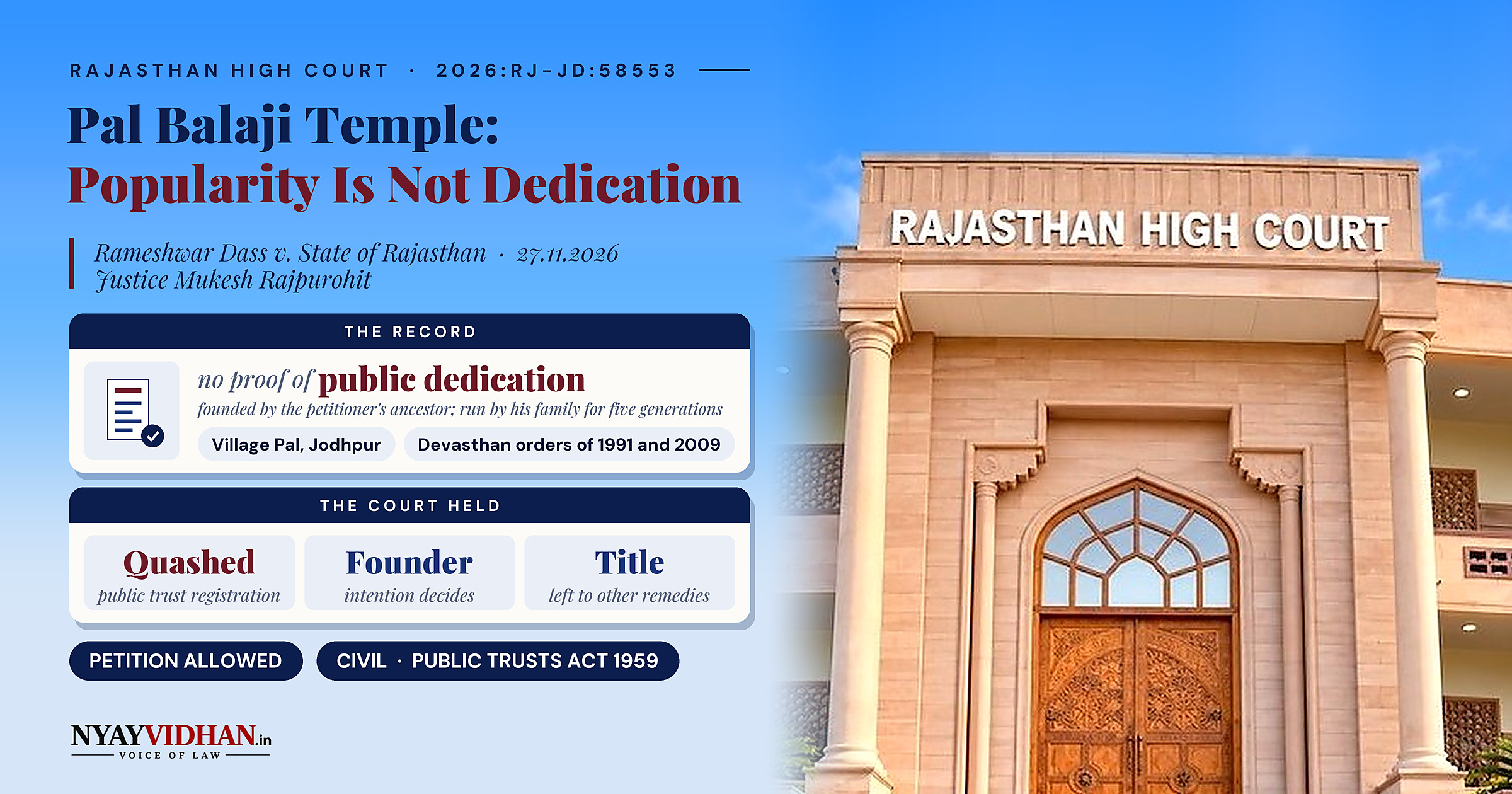
Writ petition allowed. The Commissioner's judgment of 10.12.2009 and the Assistant Commissioner's order of 14.03.1991 directing registration of the temple as a public trust were quashed. The ruling decides its character only for the 1959 Act proceedings; any title dispute is left to other remedies. No costs (paras 43-46).
Source Rajasthan High Court, hcraj.nic.in — order dated 27 November 2026
Key holdings
- The character of a religious institution turns on its founder's intention and the nature of any dedication; public access, voluntary offerings and later popularity cannot take the place of proof of dedication (paras 16, 19).
- A temple that was private at its origin stays private unless there is clear and definite evidence of a later dedication to the public (para 33).
- The income threshold notified under Section 1(4) only classifies public trusts for applying parts of the Act; it cannot prove that a temple is one (para 29).
- The mention of the deity's name in a patta is not conclusive proof of public dedication; the whole recital and the rights it records must be examined (paras 24-25).
- An order is not a speaking order merely because it lists reasons; they must address the material issue, here the founder's intention and dedication (para 37).
Judgment digest by NyayVidhan: a summary of the court's judgment, not its text. The judgment itself is the authoritative version.
Brief Facts
Questions before the Court (framed by NyayVidhan)
- Can a temple established by the petitioner's ancestors and managed by his family for generations be declared a public trust merely because the public visit it, devotees make offerings and it has become popular (para 8)?
- After the 2009 remand, did the Commissioner consider the record and apply the settled principles that distinguish a private from a public religious endowment (para 9)?
Submissions
For the petitioner. The Assistant Commissioner's own findings showed the temple's private origin and five generations of family management. Admitting the public, voluntary offerings and popularity cannot by themselves make a temple a public endowment without proof of a public right, as opposed to permission, to worship, or of dedication by the founder. The patta records the ownership of the Mahant and his descendants, and the Rs.3,000 income is only the threshold in the 1962 notification for applying parts of the Act (para 5).
For the State. The Commissioner reconsidered the whole record as the 2009 remand required. The temple stands in an independent building, not a room in the petitioner's house, and the patta was issued in the name of Shri Pal Balaji. Thousands of devotees make offerings, so many that traffic has to be regulated, and the temple has acquired a distinct public character (para 6).
Court's Findings
Dedication, not popularity
A public trust under Section 2(11) includes a temple, but the mere existence of a temple or of worship in it does not make it one: the distinction lies in the beneficial interest and the founder's intention (para 11). Drawing on Deoki Nandan, Charusila Dasi, Babu Bhagwan Din, Radhakanta Deb and Haribhanu Maharaj of Baroda, the Court asked whether the public worship as of right or as invitees, and whether management rests with the public or with the founder's descendants (paras 12-17). Mere public access, voluntary offerings and later popularity “cannot substitute the requirement of establishing a dedication” (para 19). The Assistant Commissioner's findings, the former Sarpanch's statement and a Gram Panchayat resolution of 04.01.1991 supported private origin and family management, and no express dedication by Shri Khushal Dass was shown (paras 20-23). Crowds on Tuesdays and Saturdays, offerings made without any donation box or receipts, and an income above Rs.3,000, a threshold under Section 1(4) that “presupposes that the institution otherwise qualifies as a public trust”, did not prove public character (paras 26-29). Hereditary management is not always conclusive, but here it carried “considerable evidentiary significance”, and there was no clear and definite evidence of a later dedication (paras 32-33).
The Commissioner's order after remand
The Commissioner treated the patta as issued only in the deity's name without examining its recital, which the petitioner said recorded the ownership of the Mahant and his descendants; the mere mention of Shri Pal Balaji could not be conclusive proof of public dedication (paras 24-25). He relied on the crowds, the separate building, the patta and the offerings, but never examined whether there had been an original or later dedication for public worship (para 36). “An order does not become a legally sustainable speaking order merely because several reasons have been enumerated” (para 37). Under Article 227 the Court does not reappreciate evidence, but it may interfere where an incorrect legal test is applied; the judgment suffered from an error apparent on the face of the record (paras 38-39).
Legal Principle
NyayVidhan's view · Practice note
Why It Matters
Village temples that draw large crowds are often registered as public trusts on the strength of attendance, offerings and income. This order makes the founder's intention and proof of dedication the test, and treats the Rs.3,000 income figure under Section 1(4) as a classification rule that presupposes a public trust rather than proving one (paras 19, 29). Two limits: it decides the temple's character only for the 1959 Act proceedings, leaving any title dispute to other remedies (para 44), and the patta recital it discussed is the one reproduced in the writ petition (para 24). For a contrasting case on a public temple, see Sapna Nimawat v. State of Rajasthan (2024); this order does not cite it.
Editorial comment by the NyayVidhan Editorial Desk. It is not part of the Court's judgment and is not legal advice.
Precedents Relied Upon
- Deoki Nandan v. Murlidhar and others AIR 1957 SC 133
A religious endowment is private or public according as its beneficiaries are specific individuals or the general public or a section of it; the cardinal point is whether the founder intended specified individuals or the public to have the right of worship.
- State of Bihar and others v. Sm. Charusila Dasi AIR 1959 Supreme Court 1002
The cardinal consideration in deciding whether an endowment is public or private is the founder's intention: whether the right of worship was to be conferred on specified individuals or on the general public or a specified section of it.
- Babu Bhagwan Din and others v. Gir Har Swaroop and others 1939 Supreme (SC) 46
The mere fact that Hindu worshippers are freely admitted to a temple does not necessarily establish that it is a public temple; dedication to the public must be proved (Privy Council).
View all precedents (7)
- Radhakanta Deb and another v. The Commissioner of Hindu Religious Endowments, Orissa 1981 Supreme (SC) 90
Whether a religious endowment is private or public depends on the facts proved; crucial tests are whether management is in the hands of strangers or the public or of the founders and their descendants, and whether worship is exercised as of right or as a concession.
- Haribhanu Maharaj of Baroda v. Charity Commissioner, Ahmedabad 1986 Supreme (SC) 278
Where a Math or Mandir was private in character at its origin, its private character is not effaced merely because members of the public were later permitted to visit and worship; clear and definite evidence of a later dedication to the public is needed.
- Narayan Bhagwantrao Gosavi Balajiwale v. Gopal Vinayak Gosavi and others 1959 Supreme (SC) 164
Relied on by the respondents; the Court held that the judgments they relied on did not advance their case to the extent necessary to sustain the impugned order, the principles having to be applied in the factual context of each case.
- V. Mahadeva Gurukkal v. The Commissioner for the Board of Hindu Religious Endowment, Madras 1955 Supreme (Mad) 103
Relied on by the respondents; the Court held that the judgments they relied on did not advance their case to the extent necessary to sustain the impugned order, the principles having to be applied in the factual context of each case.