
Judgment Intelligence
Petition Allowed- Court
- Rajasthan High Court
- Date of Decision
- 14 November 2026
- Bench
- Justice Farjand Ali
- Relevant Acts & Sections
- Constitution of India — Articles 226, 243-O; Rajasthan Panchayati Raj Act, 1994 — Section 18; Rajasthan Panchayati Raj (Election) Rules, 1994 — Rules 13, 14, 17, 20, 21, 21-A
The writ petition was allowed: the petitioner's name is to be moved to Gram Panchayat Bhaniyana's roll by a supplementary list sent at once to the officers concerned, and she may vote there and contest any post if otherwise eligible and her nomination is in order (paras 12-13).
Source Rajasthan High Court, hcraj.nic.in — order dated 14 November 2026
Key holdings
- Under Rule 17, claims and objections must be decided before the roll is published with the list of amendments (paras 6.4-6.6).
- ‘If any’ in Rule 17(3) does not allow a duly filed claim to be postponed indefinitely (para 6.7).
- Rule 21-A cannot be used to benefit an authority that left a timely, verified claim undecided (paras 8, 8.3).
- Article 243-O does not give statutory authorities blanket immunity for unlawful action before the election (paras 9-10).
- Correcting one voter's entry differs from reopening reservation or ward structure (paras 8.5-8.6).
Judgment digest by NyayVidhan: a summary of the court's judgment, not its text. The judgment itself is the authoritative version.
Brief Facts
Questions before the Court (framed by NyayVidhan)
- Must a claim filed under Rule 13 be decided before the electoral roll is published under Rule 17?
- Can Rule 21-A or Article 243-O defeat a timely, verified claim that the authority left undecided until the election process began?
- Do the Division Bench rulings in Pawan and Kanti Lal require the claim to be refused?
Submissions
For the petitioner. The rejection was arbitrary and ignored the authorities' own verification report of 14 February 2026, which recorded her residence at Bhaniyana; it came belatedly, just before the election notice, and Surta Rani showed that Article 243-O did not bar relief (paras 2.6, 3).
For the State. Benches of the Court had declined to interfere once the election process began (Manoj Kumar Godara, Kanti Lal, Pawan); the objection had been examined; and after the public notice of 31 October 2026 under Rules 23 and 58, Rule 21-A barred any amendment or inclusion until the elections ended (para 4).
Court's Findings
Claims must be decided before the roll is published
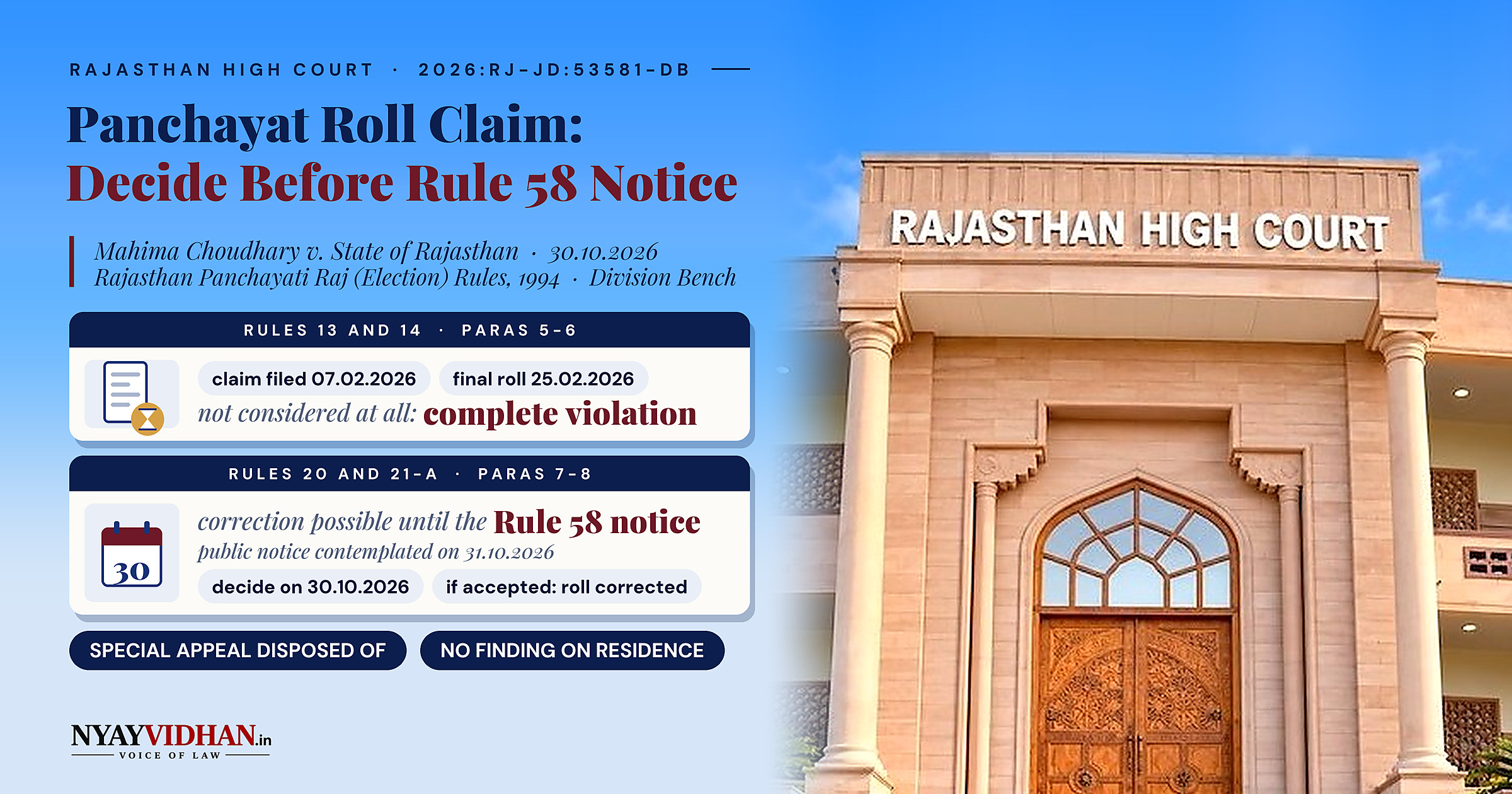
Reading Rules 13 to 17 together, the Court held that preparing a roll is a statutory exercise, not a formality: claims must be enquired into and decided, the list of amendments prepared, and only ‘thereafter’ the roll published under Rule 17; ‘if any’ in Rule 17(3) does not let the authority postpone a claim indefinitely (paras 6.4-6.7). Her claim of 7 February was verified but never adjudicated; the decision of 29 October concerned a later application of 20 September, and the Division Bench's direction of 30 October was not followed (paras 7-7.2).
No advantage from the authority's own failure
The claim was instituted and enquired into long before the poll, so Rule 21-A could not be used to confer an advantage on an authority that had failed to act; following Kusheshwar Prasad Singh, no party may benefit from its own wrong (paras 8-8.3). Article 243-O gives no blanket immunity for unlawful action preceding the election, and under Ashok Kumar intervention that does not stall the poll is permissible (paras 9-10). The verification report supported her residence at Bhaniyana, and a similarly placed voter had been included (paras 8.7-8.8).
Pawan and Kanti Lal distinguished
Pawan had not considered the sequence fixed by ‘thereafter’ in Rule 17, so it did not decide this question; Kanti Lal concerned the reservation of a territorial area, which could disturb the whole electoral arrangement (paras 8.4-8.5). Correcting one voter's entry by a supplementary list does not alter reservation or the electoral structure (paras 8.5-8.6).
Legal Principle
NyayVidhan's view · Practice note
Why It Matters
This order adds to this month's Rajasthan High Court rulings on mid-poll changes to Panchayat rolls. Pawan held that Rule 21A bars amending a roll after the Rule 58 notice, and State Election Commission v. Indraj Singh held that the Article 243-O bar also stops an appellate authority deleting names after the poll programme. Here a Single Judge distinguished Pawan because the voter's claim had been filed and verified months earlier but never decided (paras 8.3-8.6), following the Division Bench's direction in her own case (Mahima Choudhary, 30 October 2026). For voters, the lesson is to file roll claims early and keep proof that they were verified.
Editorial comment by the NyayVidhan Editorial Desk. It is not part of the Court's judgment and is not legal advice.
Precedents Relied Upon
- Mahima Choudhary v. State of Rajasthan & Ors. D.B. Special Appeal Writ No. 1299/2026, decided on 30.10.2026
The petitioner's earlier appeal, in which a Division Bench directed that her claim be decided the same day and her entry corrected if transposition was found due (paras 2.3, 7.1). The Court held that its direction was not followed and relied on its undisturbed finding that Rules 13 and 14 were violated before publication under Rule 17 (paras 7.1-7.2, 8.2).
- Kusheshwar Prasad Singh v. State of Bihar (2007) 11 SCC 447
No party can take advantage of its own wrong (commodum ex injuria sua nemo habere debet); applied to hold that the authorities cannot defeat the petitioner's claim by relying on their own failure to decide it (paras 8.1-8.2).
- Election Commission of India through Secretary v. Ashok Kumar & Ors. (2000) 8 SCC 216
The constitutional bar on judicial interference during an election is not absolute: intervention that facilitates completion of the election, rather than obstructing, interrupting or protracting it, is permissible (para 10).
View all precedents (7)
- Pawan v. State of Rajasthan & Ors. D.B. Civil Writ Petition No. 24025/2026, decided on 27.10.2026
Relied on by the State (para 4). Distinguished: it did not deal with the sequential operation of the Rules, particularly ‘thereafter’ in Rule 17, so it is not determinative of that question (para 8.4).
- Kanti Lal v. State of Rajasthan & Ors. D.B. Special Appeal Writ No. 1237/2026, order dated 15.10.2026
Relied on by the State (para 4). Distinguished: it concerned the reservation of a territorial area and the reservation status of a constituency, which could disturb the electoral framework, not the correction of one voter's entry (paras 8.5-8.6).
- Surta Rani v. State of Rajasthan & Ors. S.B. Civil Writ Petition No. 694/2015
Relied on by the petitioner on the scope of judicial review under Article 226 in relation to Article 243-O (paras 2.6, 3). Not discussed in the Court's findings.
- Manoj Kumar Godara v. State S.B. Civil Writ Petition No. 26293/2026, order dated 18.10.2026
Relied on by the State for the submission that courts decline to interfere once the election process has commenced (para 4). Not discussed in the Court's findings.


