
Judgment Intelligence
Petition Dismissed- Court
- Rajasthan High Court
- Date of Decision
- 28 November 2026
- Bench
- Justice Arun Monga and Justice Yogendra Kumar Purohit
- Relevant Acts & Sections
- Contempt of Courts Act, 1971 — Sections 2(b) and 12
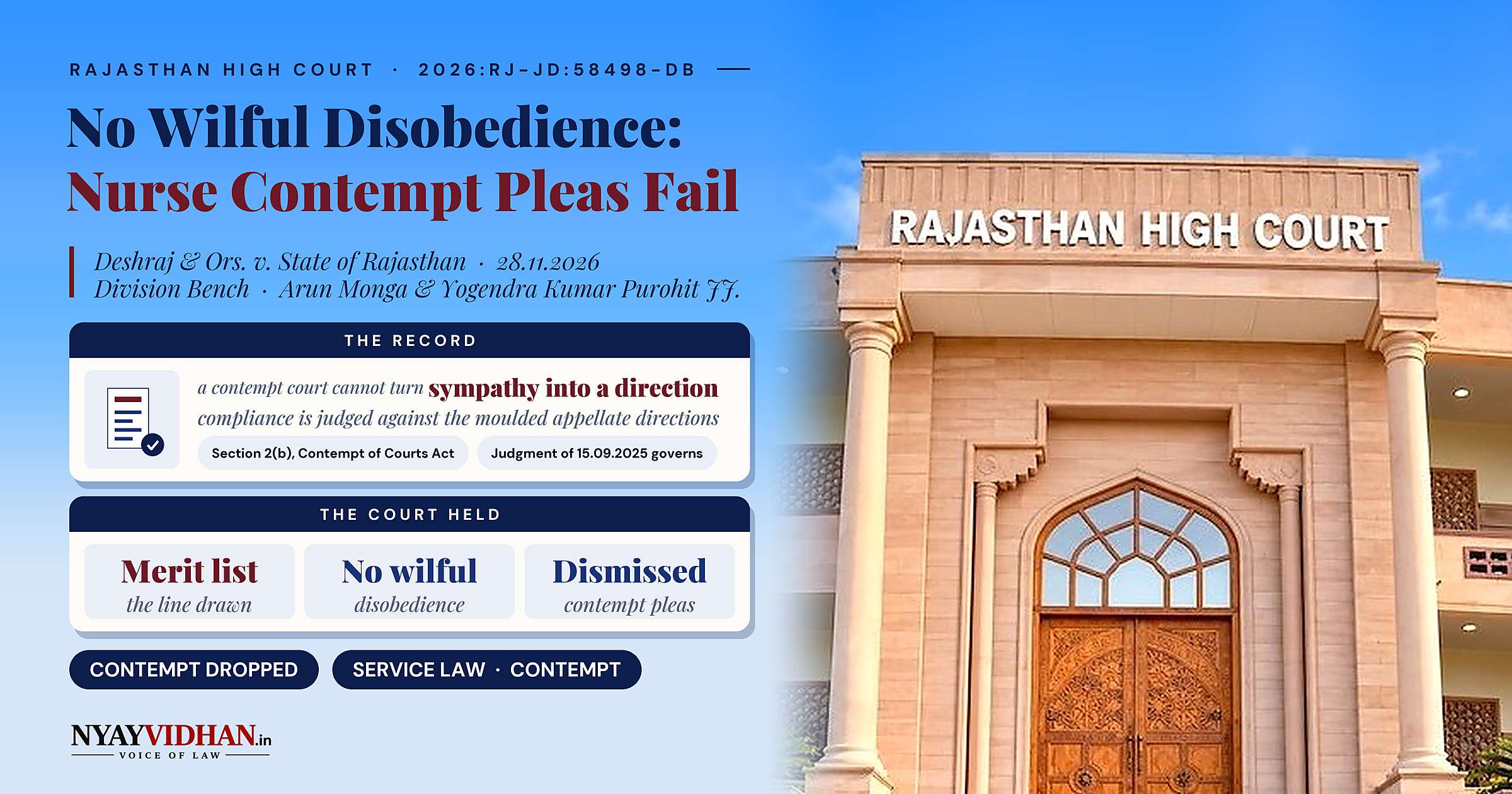
All the contempt petitions were dismissed, the proceedings dropped and the notices discharged. The judgment of 15.09.2025 governs compliance, the respondents had taken the steps its paragraphs 28 to 30 required, and no wilful disobedience was made out; no opinion was expressed on claims outside that judgment (paras 55-57).
Source Rajasthan High Court, hcraj.nic.in — judgment pronounced on 28 November 2026
Key holdings
- When an appeal is decided, the lower court's order merges in the appellate judgment, and compliance is tested against the appellate directions (paras 28, 30-31).
- Where the appellate court tied relief to a published merit list, a petitioner must be named in that list and must have applied in time; otherwise the judgment gives no enforceable right (paras 33, 35).
- Not complying while an interim order holds the directions in abeyance is not contempt (para 36).
- Delay in a long administrative exercise, or a gap in the record, does not by itself prove wilful defiance (paras 40, 42).
- An unconditional apology offered only as a fallback does not purge contempt; the decision must rest on whether any disobedience was wilful (para 51).
Judgment digest by NyayVidhan: a summary of the court's judgment, not its text. The judgment itself is the authoritative version.
Brief Facts
Questions before the Court (framed by NyayVidhan)
- What exactly are the directions now in force, after the Division Bench judgment of 15.09.2025 (para 29)?
- Which of the petitioners meet the conditions those directions lay down for appointment (para 29)?
- Have the respondents complied, including with the priority and future-advertisement directions of that judgment (para 29)?
- If there is any default, is it wilful, so as to amount to civil contempt (para 29)?
Submissions
For the petitioners. The judgments have attained finality, the respondents knew of them and the directions could be complied with at once. The State was bound to find all GNM posts up to 15.04.2008, distribute them district-wise and appoint the petitioners against the additional 2,500 posts, and the Division Bench gave them priority over candidates under the advertisement of 28.01.2025. Their representations and a notice of 13.07.2026 went unanswered, and they sought action under Sections 2(b) and 12 of the Contempt of Courts Act, 1971 (paras 16-18).
For the State. There was no disobedience, much less wilful disobedience. The merit list of 6,635 candidates dated 28.02.2009 was published on 15.10.2025, the Chief Medical and Health Officers were asked for reports, and a Committee found only three petitioners in the list, who had already been offered appointment and had not joined. In the alternative, the State tendered an unconditional apology (paras 19-22).
Court's Findings
The directions in force
The Single Bench judgment of 19.12.2018 was affirmed on 15.09.2025 and now operates through the appellate judgment, under the doctrine of merger explained in Kunhayammed (paras 28, 30). Because the Division Bench gave fresh directions in its paragraphs 28 to 34, compliance is judged against them, not against the directions of 2016 or 2018 read alone (para 31). Eighteen years on, the Division Bench had replaced a fresh count of posts with a list of names, and a contempt court cannot turn its order “into a mandate to fill a fixed number of posts” (paras 32-34, 37).
Who is covered
The petitioners fall within that judgment, but that “only brings them to the door”: a candidate must also be named in the published list and must have applied by 31.10.2025 (para 35). The other petitioners claimed neither, and a claim of being wrongly left out is a new question needing a decision on merits, which a contempt court cannot decide (paras 44-45).
Compliance
The State could not be faulted for not acting while the 2019 interim order held the field (para 36). The list was published on the last date allowed, district reports followed, a Committee reported and an order issued on 01.07.2026; the offer letters are not on record, but a gap in the record “does not prove that the affidavit is false” (paras 38-40). The delay from November 2025 to June 2026 was not approved, but it was not wilful defiance (para 42). The three listed candidates were offered appointment and none joined (para 43). Priority over the 2025 recruitment was conditional, turned on a disputed fact and helps only listed candidates (paras 46-48).
Wilful default
At the highest, the petitioners had “a dispute about the reach of the order and about the contents of the list”, which is not wilful disobedience under Ram Kishan, Ashok Paper Kamgar Union and Dinesh Kumar Gupta; the apology offered as a fallback “does not purge contempt”, and the decision does not rest on it (paras 25-26, 51). After about nineteen years of litigation, “a contempt court cannot turn sympathy into a direction” (paras 52-53).
Legal Principle
NyayVidhan's view · Practice note
Why It Matters
For bunches of contempt petitions after long recruitment litigation, the judgment sets the test: compliance is measured against the latest appellate directions as moulded, and a candidate who is not in the list those directions rely on cannot enforce the older orders through contempt (paras 31, 35, 37). Two limits. The Bench decided no claim that a name was wrongly left out of the list, which needs evidence and a decision on merits (para 45), and it left open whether the 2025 recruitment was final on 15.09.2025 (paras 46-47). On what remedy lies against an order finding no contempt, see Sukh Lal Dhakar v. Teena Dabi (2026); this judgment does not cite it.
Editorial comment by the NyayVidhan Editorial Desk. It is not part of the Court's judgment and is not legal advice.
Precedents Relied Upon
- Ram Kishan v. Tarun Bajaj & Ors. (2014) 16 SCC 204
Disobedience must be shown to be wilful before a contemnor is punished; since contempt proceedings are quasi criminal, the charge must be proved to a high standard and cannot rest on mere probabilities, and any doubt goes to the benefit of the alleged contemnor.
- Ashok Paper Kamgar Union & Ors. v. Dharam Godha & Ors. (2003) 11 SCC 1
Wilful means an act done voluntarily and with specific intent; it does not cover an act that is careless, inadvertent or done in good faith.
- Anil Ratan Sarkar & Ors. v. Hirak Ghosh & Ors. (2002) 4 SCC 21
The power of contempt is to be used sparingly.
View all precedents (11)
- Sudhir Vasudeva, Chairman & Managing Director, ONGC & Ors. v. M. George Ravishekaran & Ors. (2014) 3 SCC 373
The contempt court must stay within the four corners of the order said to be disobeyed; only explicit and plainly self-evident directions count, and the court cannot add to the order, reopen what was decided or balance equities.
- Jhareswar Prasad Paul & Anr. v. Tarak Nath Ganguly & Ors. (2002) 5 SCC 352
The contempt court cannot decide fresh issues, which belong to the court of original jurisdiction.
- Dinesh Kumar Gupta v. United India Insurance Co. Ltd. & Ors. (2010) 12 SCC 770
Where wilful disobedience is in doubt, the contempt petition must fail.
- Kunhayammed & Ors. v. State of Kerala & Anr. (2000) 6 SCC 359
When an appellate court decides an appeal, the order of the lower court merges in the appellate order, and only one operative order remains (doctrine of merger).
- Arun Jain v. Naresh Pal Gangwar 2026: RJ-JD:14802-DB
Relied on by the respondents; the Court did not discuss it separately because the governing principles are settled by the Supreme Court.
- State of Rajasthan v. Suresh Kumar & Ors. (D.B. Special Appeal No. 414/2019, with connected appeals) Judgment dated 15.09.2025, Rajasthan High Court (Division Bench)
Dismissing the State's appeals, the Division Bench moulded the relief: the State was to publish a merit list by 15.10.2025, candidates named in it were to apply by 31.10.2025 and be appointed (eligibility as on 04.05.2007), with priority over the 2025 recruitment if not finalised; the contempt court held that these directions govern compliance.
- Suresh Kumar & Ors. v. State of Rajasthan & Ors. (S.B. Civil Writ Petition No. 14497/2017) Judgment dated 19.12.2018, Rajasthan High Court
Held that 2,500 more GNM posts were available as on 15.04.2008 beyond the 3,704 filled and directed the State to deal with them in terms of Rajkumar within six weeks; affirmed on 15.09.2025 and now operative only through the appellate judgment.
- Rajkumar & Ors. v. State of Rajasthan & Ors. (S.B. Civil Writ Petition No. 6207/2009) Judgment dated 07.12.2016, Rajasthan High Court
Directed the State to find all GNM posts available up to 15.04.2008, distribute them among the districts and fill them from district-wise merit lists; the contempt court held that this exercise had been replaced by the Division Bench judgment of 15.09.2025.