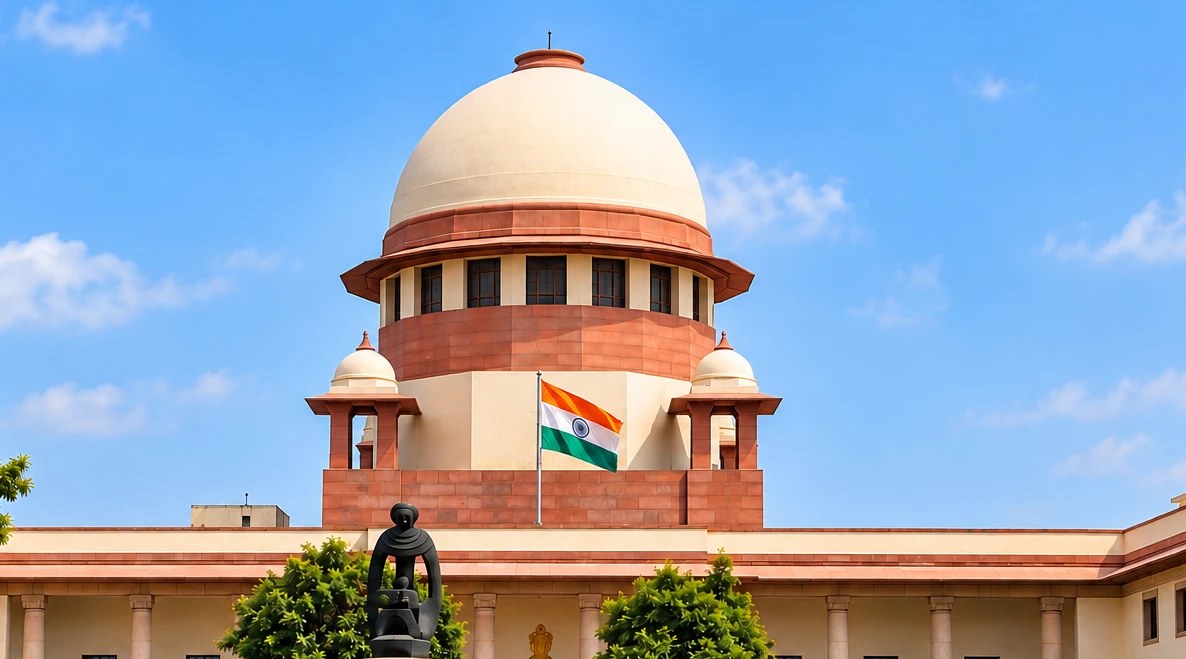

Judgment Intelligence
Reference Answered- Court
- Supreme Court of India
- Date of Decision
- 4 November 2026
- Bench
- Chief Justice Surya Kant, Justice S.V.N. Bhatti, Justice Joymalya Bagchi, Justice N.V. Anjaria, Justice Arun Palli, Justice V. Mohana and Justice K.V. Viswanathan (separate judgment)
- Relevant Acts & Sections
- Constitution of India — Articles 145(3), 246, 265, 266; Seventh Schedule, List II, Entry 54 (as it stood before the Constitution (One Hundred and First Amendment) Act, 2016); Orissa Sales Tax Act, 1947 — Section 5-A; Punjab General Sales Tax Act, 1948 — Sections 5(1-C), 30-AA; Punjab Social Security Act, 2000
Reference answered as rendered infructuous; the competence question is governed by S. Kodar; Section 30-AA and the Article 266 question left open; matters to regular Benches (para 103). The separate judgment answered the reference by holding S. Kodar good law (Viswanathan J., paras 65-67).
Source Supreme Court of India, www.sci.gov.in — judgment dated 4 November 2026 · Court's copy
Key holdings
- The 1998-1999 reference on surcharges computed on sales tax was answered as rendered infructuous (para 103).
- State competence to levy such surcharges is governed by S. Kodar, which continues to hold the field (paras 102-103).
- India Cement's premise that royalty is a tax was overruled in Mineral Area Development Authority, leaving no conflicting decision (para 102).
- Section 30-AA of the Punjab Act and the Article 266 cess question are left open (para 103).
- Viswanathan J. held that S. Kodar was correctly decided and needs no reconsideration (Viswanathan J., para 65).
Judgment digest by NyayVidhan: a summary of the court's judgment, not its text. The judgment itself is the authoritative version.
Brief Facts
Questions before the Court (framed by NyayVidhan)
- Did India Cement really conflict with S. Kodar and Hoechst Pharmaceuticals?
- Is a surcharge computed as a percentage of the sales tax payable a tax on the sale of goods under Entry 54?
- Does the reference still survive for a seven-Judge Bench?
- What happens to the Punjab questions and the pending appeals?
Submissions
For the appellants. The assessees said Entry 54 of List II permits only a tax on the sale or purchase of goods; a surcharge computed on the tax payable, not on turnover, is a 'tax on tax' that no entry authorises; India Cement, a seven-Judge decision, governs; and Hoechst Pharmaceuticals rested on a concession (para 66).
For the States. The question is covered by S. Kodar, which has never been doubted; the surcharge only enhances the rate of sales tax for larger dealers; and India Cement concerned a different levy in an alien field (para 67).
Court's Findings
No real conflict with India Cement
The conflict was more apparent than real even in 1998 (para 79). India Cement concerned a cess on royalty in a field covered by Section 9 of the MMDR Act, not Entry 54 of List II, and never referred to S. Kodar or Hoechst Pharmaceuticals (paras 80-81); it had approved Guruswamy, under which a cess added to a tax is judged like that tax (para 82). Viswanathan J. likewise found no conflict between S. Kodar and Hoechst, and that India Cement had no bearing (Viswanathan J., paras 48, 62-63).
A surcharge on sales tax
The subject of a tax is distinct from its measure (paras 22-23). A 10 per cent surcharge on a 10 per cent sales tax is, in substance, an additional levy of 1 per cent on turnover; it rises with turnover and is payable even by a loss-making dealer, so it is not a tax on income (paras 90-91). S. Kodar, a Constitution Bench ruling, decided the point (paras 87, 92), and Viswanathan J. held it rightly did so (Viswanathan J., paras 61, 65).
Why the reference no longer survives
A reference depends on a continuing doubt; once dispelled, answering it only restates settled law (paras 74, 76). Mineral Area Development Authority held royalty is not a tax, overruling India Cement to that extent, so nothing of equal or greater strength conflicts with S. Kodar (paras 84-86). With Entry 54 substituted and both States' sales-tax Acts replaced, the question has no prospective significance (paras 64-65, 96).
The Punjab questions and the appeals
Section 30-AA, and whether the cess could go directly to the Punjab Social Security Fund under Article 266, were never referred and are left open; past-period rights are for regular Benches (paras 97-101). Viswanathan J. sent the sales-tax appeals for decision under S. Kodar and the Social Security Act appeals to a Division Bench (Viswanathan J., paras 66-67).
Legal Principle
NyayVidhan's view · Practice note
Why It Matters
For the pending sales-tax surcharge appeals, nothing now awaits seven Judges: State competence is to be argued under S. Kodar, and each appeal will be heard by a regular Bench on its own merits, with assessment and relief issues open (paras 97, 103). Challenges to Section 30-AA, which charges exempted units, and to crediting the Social Security cess outside the Consolidated Fund remain open (paras 99-101). The test for when a reference ceases to survive (paras 74-78) may be cited wherever a later, larger Bench has removed the doubt behind a pending reference. Compare the nine-Judge ruling that royalty is not a tax.
Editorial comment by the NyayVidhan Editorial Desk. It is not part of the Court's judgment and is not legal advice.
Precedents Relied Upon
- S. Kodar v. State of Kerala (1974) 4 SCC 422
Constitution Bench: an additional tax computed as a percentage of the sales tax payable by dealers above a turnover threshold is an enhancement of the rate of sales tax and a tax on the sale of goods under Entry 54 of List II, not a tax on income, even where it cannot be passed on. Main judgment: it continues to hold the field and governs the question referred. Separate judgment of Viswanathan J. (cited as [1975] 1 SCR 121; its paras 1, 16-18, 61-62, 65-66): correctly decided, good law, needs no reconsideration.
- Hoechst Pharmaceuticals Ltd. & Ors. v. State of Bihar & Ors. (1983) 4 SCC 45
Three-Judge Bench that applied S. Kodar to the Bihar surcharge; the State power under Entry 54 of List II is plenary (para 72 quoted). Main judgment: despite the concession recorded in it, it independently rejected the argument that the surcharge was a tax on income. Separate judgment of Viswanathan J. (its paras 1, 22, 33-34, 62): consistent with S. Kodar; the concession did not detract from its holding.
- India Cement Ltd. & Ors. v. State of Tamil Nadu & Ors. (1990) 1 SCC 12
Seven-Judge Bench: a cess on royalty was beyond State competence in the field covered by Section 9 of the MMDR Act. Main judgment: concerned a different levy under different entries, did not hold that a levy computed on another tax is for that reason beyond competence, and its premise that royalty is a tax was overruled in Mineral Area Development Authority. Separate judgment of Viswanathan J. (its paras 14, 35-38, 45, 47-48, 57-58, 63): qualitatively different issues; no bearing on S. Kodar.
View all precedents (15)
Nine-Judge Bench: royalty is not a tax; India Cement overruled to that extent. Binding on the seven-Judge Bench, so no decision of equal or greater strength conflicts with S. Kodar; neither the pending curative petition nor the 2026 MMDR amendment affects its approval of S. Kodar. Separate judgment of Viswanathan J. (as MADA, its paras 35, 50, 52-54, 56-59, 61): same.
- M.P.V. Sundararamier & Co. v. State of Andhra Pradesh AIR 1958 SC 468
Taxing entries are enumerated separately from general subjects of legislation; the power to tax must be traced to a specific taxing entry. Separate judgment of Viswanathan J. (its para 55, cited as [1958] SCR 1422, as accepted in Mineral Area Development Authority): same principle noticed.
- Union of India v. Bombay Tyre International Ltd. (1984) 1 SCC 467
The nature of a levy is distinct from its measure; the measure adopted does not determine its character.
- Federation of Hotel & Restaurant Association of India v. Union of India (1989) 3 SCC 634
The measure employed for assessing a tax must not be confused with the nature of the tax; the Legislature has a wide latitude in selecting the measure.
- J.K. Jute Mills Co. Ltd. v. State of U.P. (1962) 2 SCR 1
Noted as relied on in S. Kodar: it is not an essential characteristic of a sales tax that the seller must be able to pass it on to the consumer.
- Konduri Buchirajalingam v. State of Hyderabad AIR 1958 SC 756
Noted as relied on in S. Kodar: it is not an essential characteristic of a sales tax that the seller must be able to pass it on to the consumer.
- Tata Iron and Steel Co. Ltd. v. State of Bihar (1958) 9 STC 267
Noted as followed in the decisions relied on in S. Kodar: a tax can be a sales tax though the primary liability is placed on a person without any power to recoup it.
- M/s Guruswamy & Co. etc. v. State of Mysore & Ors. [1967] 1 SCR 548
A cess levied as an increment to an existing tax is judged in the same way as the tax to which it is an increment; approved in India Cement, and described as the foundation of S. Kodar and Hoechst Pharmaceuticals.
- State of West Bengal v. Kesoram Industries Ltd. (2004) 10 SCC 201
Constitution Bench majority read the observation in India Cement that royalty is a tax as an inadvertent error, narrowing India Cement; the question was later referred to nine Judges. Separate judgment of Viswanathan J. (its para 49): same history.
- Central Board of Dawoodi Bohra Community & Anr. v. State of Maharashtra & Anr. (2005) 2 SCC 673
Law declared by a Bench of larger strength binds Benches of lesser or co-equal strength; a Bench in doubt can only ask the Chief Justice for a larger Bench (para 12 quoted). Followed to hold Mineral Area Development Authority binding.
- H.R.S. Murthy vs. Collector of Chittoor [1964] 6 SCR 666
Separate judgment of Viswanathan J. only (its paras 40 and 45; the main judgment does not cite it): the five-Judge decision relied on by the High Court in India Cements, which India Cements distinguished because the MMDR Act and its Section 9 had not been brought to that Court's attention.
- Jindal Stainless Steel vs. State of Haryana (2017) 12 SCC 1
Separate judgment of Viswanathan J. only (its para 55; the main judgment does not cite it): noted as accepting M.P.V. Sundararamier on the distinctness of fields of taxation from general subjects of legislation, as recorded in Mineral Area Development Authority.