
Uniform Civil Code in India: Constitutional Promise, Legal Uniformity and the Road Ahead.
The Uniform Civil Code, envisaged under Article 44 of the Constitution, remains one of India’s most debated legal questions. With Uttarakhand implementing a UCC, the debate now centres on equality, religious freedom, personal laws, federalism and the future of civil law in India.
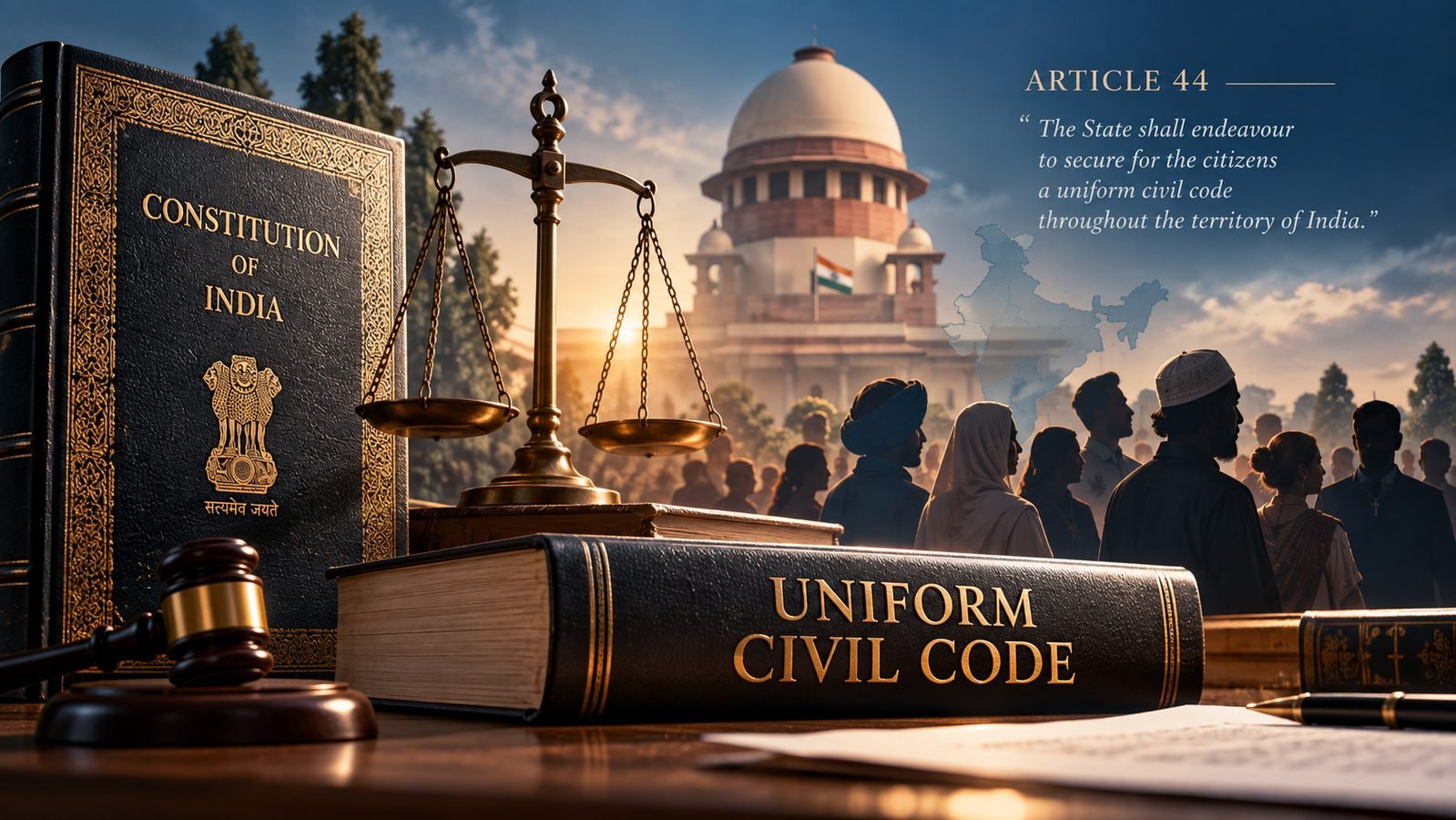
What is the Uniform Civil Code?
The Uniform Civil Code (UCC) refers to a common set of civil laws governing matters such as marriage, divorce, adoption, inheritance and succession, irrespective of a person's religion.
Its constitutional foundation lies in Article 44, which states that the State shall endeavour to secure a uniform civil code for citizens throughout India.
However, Article 44 is part of the Directive Principles of State Policy and is not directly enforceable as a Fundamental Right.
This raises the first major question: Is the UCC a constitutional obligation or a constitutional objective?
Why is the UCC Controversial?
India has historically followed different personal-law systems for different religious communities.
Supporters of the UCC argue that citizens should have equal civil rights regardless of religion, particularly in areas such as marriage, divorce and inheritance.
Those raising concerns about a UCC point towards India's religious and cultural diversity and the constitutional protection of freedom of religion and cultural identity.
The debate therefore lies between two important constitutional values:
Uniformity and equality on one side, and religious and cultural pluralism on the other.
Article 44 vs Fundamental Rights
A UCC cannot be examined through Article 44 alone.
It would also have to be consistent with:
Article 14 – Equality before law
Article 15 – Prohibition of discrimination
Article 21 – Life and personal liberty
Article 25 – Freedom of conscience and religion
Article 26 – Freedom to manage religious affairs
This creates an important constitutional question:
How can civil laws be made uniform while protecting constitutionally guaranteed religious and individual freedoms?
The answer would ultimately depend upon the substance and drafting of the legislation.
Uttarakhand: The UCC Becomes Reality
The UCC debate became significantly more concrete when Uttarakhand's Uniform Civil Code came into force on 27 January 2025.
The framework covers areas including marriage, divorce, succession and live-in relationships, supported by an administrative registration system.
This makes Uttarakhand an important case study.
The debate is no longer purely theoretical. There is now an actual State-level framework whose implementation can be examined for its legal, social and administrative consequences.
The Gender Justice Question
One of the strongest legal arguments surrounding the UCC concerns gender equality.
Rules governing inheritance, maintenance, divorce and matrimonial rights can significantly affect the economic and legal position of women.
A common civil framework could establish common standards across communities.
At the same time, gender equality could also be pursued by reforming individual personal laws.
Thus, the question is not simply whether personal laws should remain or disappear, but how constitutional equality can best be achieved.
What Would a Nationwide UCC Need to Address?
A national UCC would have to answer several practical questions:
Marriage: What conditions would determine a valid marriage?
Divorce: Would all citizens have identical grounds and procedures?
Inheritance: Would succession rights become completely uniform?
Adoption: Would there be one common framework for adoption and guardianship?
Customs: Which customary practices would continue to receive legal recognition?
Existing marriages: What happens to relationships created under earlier personal laws?
These questions demonstrate that a UCC would involve much more than simply replacing several personal-law statutes with one Act.
The Federalism Question
Personal-law subjects such as marriage, divorce, adoption and succession fall within the Concurrent List, giving both Parliament and State Legislatures legislative competence, subject to constitutional limitations.
This creates another interesting question:
What happens if different States adopt different versions of a UCC?
And if Parliament eventually introduces a nationwide code, how would existing State laws be harmonised?
These questions could become important areas of future constitutional litigation.
Conclusion
The Uniform Civil Code sits at the intersection of equality, religious freedom, individual liberty, cultural diversity and federalism.
Article 44 provides the constitutional vision, while Fundamental Rights define the constitutional boundaries within which that vision must operate.
With Uttarakhand's UCC now in force, India has entered a new phase of the debate—from asking whether a UCC is possible to examining how a constitutionally sound UCC could actually work.
The real legal question, therefore, may not simply be “UCC—Yes or No?”
It may be:
“What should a Uniform Civil Code look like in a constitutionally plural and diverse India?”
The Uniform Civil Code (UCC) refers to a common set of civil laws governing matters such as marriage, divorce, adoption, inheritance and succession, irrespective of a person's religion.
Its constitutional foundation lies in Article 44, which states that the State shall endeavour to secure a uniform civil code for citizens throughout India.
However, Article 44 is part of the Directive Principles of State Policy and is not directly enforceable as a Fundamental Right.
This raises the first major question: Is the UCC a constitutional obligation or a constitutional objective?
Why is the UCC Controversial?
India has historically followed different personal-law systems for different religious communities.
Supporters of the UCC argue that citizens should have equal civil rights regardless of religion, particularly in areas such as marriage, divorce and inheritance.
Those raising concerns about a UCC point towards India's religious and cultural diversity and the constitutional protection of freedom of religion and cultural identity.
The debate therefore lies between two important constitutional values:
Uniformity and equality on one side, and religious and cultural pluralism on the other.
Article 44 vs Fundamental Rights
A UCC cannot be examined through Article 44 alone.
It would also have to be consistent with:
Article 14 – Equality before law
Article 15 – Prohibition of discrimination
Article 21 – Life and personal liberty
Article 25 – Freedom of conscience and religion
Article 26 – Freedom to manage religious affairs
This creates an important constitutional question:
How can civil laws be made uniform while protecting constitutionally guaranteed religious and individual freedoms?
The answer would ultimately depend upon the substance and drafting of the legislation.
Uttarakhand: The UCC Becomes Reality
The UCC debate became significantly more concrete when Uttarakhand's Uniform Civil Code came into force on 27 January 2025.
The framework covers areas including marriage, divorce, succession and live-in relationships, supported by an administrative registration system.
This makes Uttarakhand an important case study.
The debate is no longer purely theoretical. There is now an actual State-level framework whose implementation can be examined for its legal, social and administrative consequences.
The Gender Justice Question
One of the strongest legal arguments surrounding the UCC concerns gender equality.
Rules governing inheritance, maintenance, divorce and matrimonial rights can significantly affect the economic and legal position of women.
A common civil framework could establish common standards across communities.
At the same time, gender equality could also be pursued by reforming individual personal laws.
Thus, the question is not simply whether personal laws should remain or disappear, but how constitutional equality can best be achieved.
What Would a Nationwide UCC Need to Address?
A national UCC would have to answer several practical questions:
Marriage: What conditions would determine a valid marriage?
Divorce: Would all citizens have identical grounds and procedures?
Inheritance: Would succession rights become completely uniform?
Adoption: Would there be one common framework for adoption and guardianship?
Customs: Which customary practices would continue to receive legal recognition?
Existing marriages: What happens to relationships created under earlier personal laws?
These questions demonstrate that a UCC would involve much more than simply replacing several personal-law statutes with one Act.
The Federalism Question
Personal-law subjects such as marriage, divorce, adoption and succession fall within the Concurrent List, giving both Parliament and State Legislatures legislative competence, subject to constitutional limitations.
This creates another interesting question:
What happens if different States adopt different versions of a UCC?
And if Parliament eventually introduces a nationwide code, how would existing State laws be harmonised?
These questions could become important areas of future constitutional litigation.
Conclusion
The Uniform Civil Code sits at the intersection of equality, religious freedom, individual liberty, cultural diversity and federalism.
Article 44 provides the constitutional vision, while Fundamental Rights define the constitutional boundaries within which that vision must operate.
With Uttarakhand's UCC now in force, India has entered a new phase of the debate—from asking whether a UCC is possible to examining how a constitutionally sound UCC could actually work.
The real legal question, therefore, may not simply be “UCC—Yes or No?”
It may be:
“What should a Uniform Civil Code look like in a constitutionally plural and diverse India?”