
Latest
Wednesday, October 21, 2026
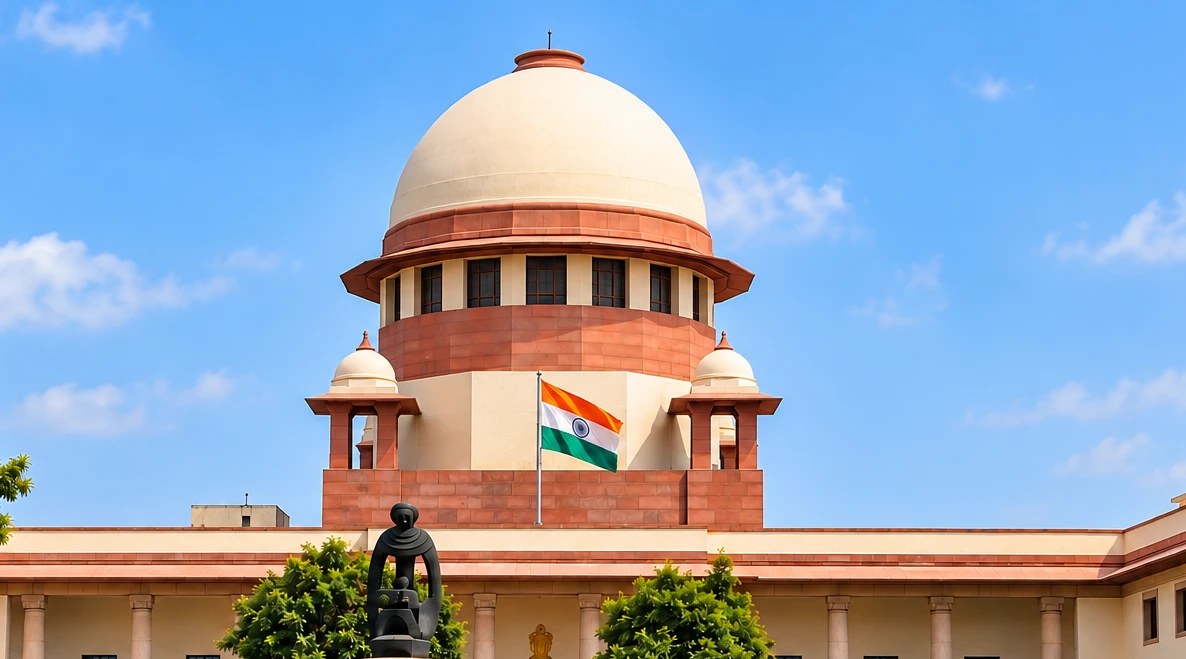
Supreme Court of India
Constitutional Law

Abrogation of Article 370 Upheld: Temporary Provision Could End by Presidential Order Without State Constituent Assembly

Published: · NyayVidhan

A five-Judge Constitution Bench upheld CO 273, by which the President declared under Article 370(3) that Article 370 ceased to operate. In the lead opinion for three Judges, Chandrachud CJI held that Jammu and Kashmir retained no sovereignty, that Article 370 was temporary and that the power under Article 370(3) survived the State Constituent Assembly, although using Article 367 to amend Article 370 was invalid (Chandrachud CJI, para 514). Assembly elections were directed by 30 September 2024.

Abrogation of Article 370 Upheld: Temporary Provision Could End by Presidential Order Without State Constituent Assembly

Judgment Intelligence

Disposed Of
In Re: Article 370 of the Constitution
2023 INSC 1058
Writ Petition (Civil) No. 1099 of 2019 and connected matters (21 connected writ petitions and SLP (C) No. 19618 of 2017)
Court
Supreme Court of India
Date of Decision
11 December 2023
Bench
Chief Justice D.Y. Chandrachud, Justice Sanjay Kishan Kaul, Justice Sanjiv Khanna, Justice B.R. Gavai and Justice Surya Kant
Relevant Acts & Sections
Constitution of India - Articles 1, 3, 356, 367 and 370; Constitution of Jammu and Kashmir - Section 92; Jammu and Kashmir Reorganisation Act, 2019
Final Outcome

Writ petitions and special leave petitions disposed of: CO 273 upheld, the Election Commission directed to hold Assembly elections by 30 September 2024, and statehood to be restored at the earliest (Chandrachud CJI, paras 514-515).

Source Supreme Court of India, www.sci.gov.in — judgment dated 11.12.2023

Key holdings

  1. Jammu and Kashmir retained no element of sovereignty after the Instrument of Accession and the Proclamation of 25 November 1949 adopting the Constitution of India (Chandrachud CJI, para 514).
  2. Paragraph 2 of CO 272, amending Article 370 through Article 367, was ultra vires (Chandrachud CJI, para 514).
  3. CO 273 is valid and the State Constitution is inoperative (Chandrachud CJI, para 514).
  4. Ladakh's Union Territory status was upheld; the wider reorganisation was left undecided on the Solicitor General's statement that statehood would be restored (Chandrachud CJI, para 503).
  5. Kaul J. recommended an impartial truth and reconciliation commission (Kaul J., para 120).

Case explainer by NyayVidhan: an account of this judgment and the law it laid down, not the court's text. The judgment itself is the authoritative version.

Brief Facts

After the Bharatiya Janata Party withdrew support in June 2018, the Governor took over the State Government under Section 92 of the Jammu and Kashmir Constitution and later dissolved the Legislative Assembly (Chandrachud CJI, para 3). President's rule under Article 356 followed in December 2018 (Chandrachud CJI, para 4). On 5 August 2019 CO 272 applied the whole Constitution to the State and added Article 367(4), reading 'Legislative Assembly' for 'Constituent Assembly' in Article 370(3) (Chandrachud CJI, para 7). CO 273 then declared that Article 370 ceased to apply, and the Reorganisation Act split the State into two Union Territories (Chandrachud CJI, paras 10, 12). Writ petitions under Article 32 followed (Chandrachud CJI, para 13).

Court's Findings

Article 370 was a feature of asymmetric federalism, and the State had no internal sovereignty distinct from other States (Chandrachud CJI, paras 164-165). The Proclamations were not examined, since the principal challenge was to actions taken during President's rule (Chandrachud CJI, para 174). Actions after a Proclamation are reviewable, but need only a reasonable nexus with its object; irreversibility alone does not invalidate them (Chandrachud CJI, paras 207, 229). Its historical context and placement in Part XXI make Article 370 temporary (Chandrachud CJI, paras 278, 320-321). The President's power under Article 370(3) did not end with the Constituent Assembly (Chandrachud CJI, para 514). An interpretation clause cannot amend a provision by bypassing its amending procedure, so the change to Article 367 failed (Chandrachud CJI, para 389). Applying all provisions under Article 370(1)(d) without the State Government's concurrence was valid, and CO 273 culminated a gradual integration and was not mala fide (Chandrachud CJI, paras 428, 465). Kaul J. reasoned that Article 370 recognised an internal sovereignty which Article 370(3) was meant to end (Kaul J., paras 67-68). Khanna J. concurred with both opinions (Khanna J., para 3).

Legal Principle

Article 370 was a temporary provision and a feature of asymmetric federalism; the President's power under Article 370(3) survived the dissolution of the State Constituent Assembly, but an interpretation clause such as Article 367 cannot be used to amend a provision while bypassing the procedure laid down for its amendment (Chandrachud CJI, paras 389, 514).

Precedents Relied Upon

  1. SR Bommai v. Union of India (1994) 3 SCC 1
    Applied Discussed at ¶ 183, 196-197

    Actions of the President after a Proclamation under Article 356 are subject to judicial review.

  2. Prem Nath Kaul v. State of Jammu & Kashmir 1959 Suppl (2) SCR 270
    Explained Discussed at ¶ 14, 170

    Decided the Yuvraj's legislative competence before the State Constitution, not whether the State retained sovereignty.

  3. Sampath Prakash v. State of Jammu and Kashmir (1969) 2 SCR 365
    Explained Discussed at ¶ 325, 330

    Held that Article 370 did not lapse with the State Constituent Assembly; the survival of the Article 370(3) power did not arise there.

View all precedents (6)
  1. Krishna Kumar Singh v. State of Bihar (2017) 3 SCC 1
    Distinguished Discussed at ¶ 22, 213, 217

    Its rejection of the enduring rights theory for Ordinances cannot be transposed to limits on Article 356 powers.

  2. Madhav Rao Jivaji Rao Scindia v. Union of India (1971) 1 SCC 85
    Applied Discussed at ¶ 391, 400

    A constitutional power cannot be used for a collateral purpose to obviate the amending procedure.

  3. Babulal Parate v. State of Bombay AIR 1960 SC 51
    Relied Upon Discussed at ¶ 510-511

    The views of a State Legislature under the proviso to Article 3 are not binding on Parliament.

Statutory Provisions

NyayVidhan
Court Judgments · 3 min read
Decided: December 11, 2023 Chief Justice D.Y. Chandrachud, Justice Sanjay Kishan Kaul,...
PDF
 Join our WhatsApp Group
✕

Try: POCSO, IBC, Electoral Bond, Article 370, NDPS Act, Bail Conditions, SC Contempt