
Introduction
Section 52A of the Narcotic Drugs and Psychotropic Substances Act, 1985 (NDPS Act) is one of the most important procedural provisions governing narcotics investigations in India. Introduced through the 1989 amendment, the provision addresses the challenge of preserving large quantities of seized narcotic drugs and psychotropic substances during lengthy criminal trials.
Prior to the enactment of Section 52A, investigating agencies were required to retain seized contraband throughout the trial process. This created serious concerns regarding storage, security, theft, substitution, and deterioration of evidence.
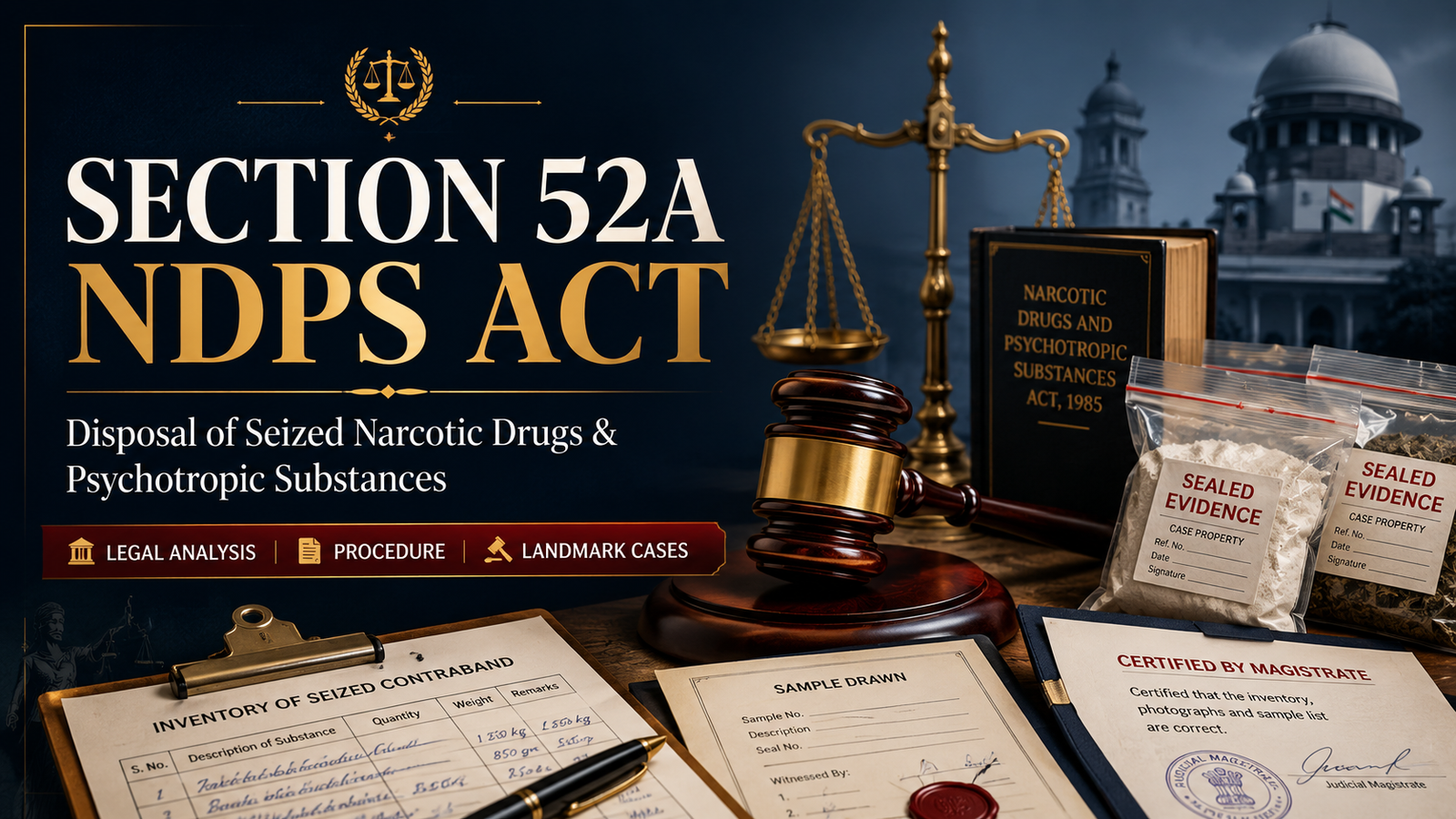
Section 52A provides a statutory mechanism whereby seized narcotic substances can be inventoried, photographed, sampled, certified by a Magistrate, and thereafter disposed of in accordance with prescribed procedures. The certified inventory, photographs, and samples are treated as primary evidence during trial.
Statutory Purpose of Section 52A
The principal objectives of Section 52A are:
Safe disposal of seized narcotic substances.
Prevention of theft, substitution, or misuse of contraband.
Reduction of storage-related difficulties.
Preservation of evidentiary value through Magistrate-certified records.
Ensuring efficient prosecution of NDPS offences.
Understanding the Four Sub-Sections
Section 52A(1): Power of Disposal
This provision empowers the Central Government to notify categories of narcotic drugs and psychotropic substances that may be disposed of soon after seizure, considering factors such as:
Hazardous nature.
Vulnerability to theft.
Risk of substitution.
Storage limitations.
Other relevant administrative considerations.
Section 52A(2): Inventory and Sampling
The investigating officer must:
Prepare a detailed inventory.
Draw representative samples.
Photograph the seized material.
Submit an application before the jurisdictional Magistrate seeking certification.
Section 52A(3): Magistrate's Certification
The Magistrate is required to examine the inventory and sample list and certify their correctness as soon as possible.
Section 52A(4): Primary Evidence
The certified inventory, photographs, and sample lists become primary evidence in NDPS trials and may be relied upon even after disposal of the bulk contraband.
Step-by-Step Procedure Under Section 52A
Step 1: Seizure of Contraband
Narcotic drugs or psychotropic substances are seized by authorized officers under the NDPS Act.
Step 2: Preparation of Inventory
A detailed inventory is prepared mentioning:
Quantity
Weight
Description
Packaging details
Identification marks
Step 3: Drawing Representative Samples
Representative samples are drawn for forensic examination in accordance with applicable Standing Orders and the NDPS Rules.
Step 4: Application Before Magistrate
The officer approaches the jurisdictional Magistrate seeking certification of:
Inventory
Photographs
Samples
Step 5: Certification by Magistrate
The Magistrate verifies the process and certifies the inventory and samples.
Step 6: Disposal of Bulk Contraband
After certification, the bulk contraband may be destroyed or disposed of according to statutory procedures.
Step 7: Use During Trial
The certified documents and samples become admissible as primary evidence during trial.
Evidentiary Significance of Section 52A(4)
Section 52A(4) contains a non-obstante clause overriding ordinary evidentiary requirements.
Its significance lies in the fact that:
Physical production of bulk contraband is not always necessary.
Certified inventories become admissible as primary evidence.
Certified photographs may substitute physical production.
Certified sample lists retain evidentiary value.
However, courts continue to scrutinize:
Chain of custody.
Integrity of samples.
Fairness of the certification process.
Compliance with statutory safeguards.
Landmark Supreme Court Judgments
Union of India v. Mohanlal (2016) 3 SCC 379
This landmark judgment clarified the procedure under Section 52A and emphasized:
Proper inventory preparation.
Sampling before a Magistrate.
Maintenance of chain of custody.
Early disposal of seized narcotics.
The Supreme Court also issued important directions regarding storage and destruction of narcotic substances.
Noor Aga v. State of Punjab (2008) 16 SCC 417
The Court highlighted the importance of procedural safeguards under the NDPS Act and stressed that the prosecution bears a heavy burden in proving compliance with statutory requirements.
Bharat Aambale v. State of Chhattisgarh (2025 INSC 78)
The Supreme Court clarified that:
Section 52A is primarily procedural.
Substantial compliance may suffice.
Minor procedural irregularities do not automatically vitiate prosecution.
Courts must assess whether actual prejudice has been caused.
NCB v. Kashif (2024 SCC OnLine SC 3848)
The Court held that non-compliance with Section 52A does not automatically entitle an accused to acquittal or bail.
Ten Guiding Principles from Bharat Aambale (2025)
The primary objective of Section 52A is safe disposal of contraband.
The provision creates important evidentiary safeguards.
Inventorying and sampling need not necessarily occur at the seizure location.
Sampling need not always take place immediately at seizure.
Presence of the accused is desirable but not always mandatory.
Certified inventories and samples constitute primary evidence.
Substantial compliance may be sufficient.
Courts must assess the entire prosecution case.
Serious procedural lapses creating doubt may weaken prosecution.
Minor irregularities alone do not invalidate a conviction.
Regulatory Framework Governing Section 52A
NCB Standing Order No. 1/88
Provides guidelines regarding:
Sampling procedures.
Storage of contraband.
Documentation requirements.
NDPS (Seizure, Storage, Sampling and Disposal) Rules, 2022
These rules modernized the process by introducing:
Scientific sampling procedures.
Lot formation requirements.
Disposal protocols.
Environmental safeguards.
Ministry of Finance Circular, 2011
Addressed concerns relating to storage and disposal of seized narcotics.
Gazette Notification, 2015
Specified categories of substances eligible for expedited disposal.
Practical Implications
For Prosecutors
Investigating agencies should ensure:
Prompt inventory preparation.
Proper sample collection.
Magistrate certification.
Preservation of chain of custody.
Compliance with NDPS Rules, 2022.
Failure to maintain proper records can weaken the prosecution case.
For Defence Counsel
Defence lawyers should examine:
Delay in certification.
Defects in sampling.
Breaks in chain of custody.
Mismatch between seizure records and forensic reports.
Procedural irregularities causing prejudice.
Non-compliance alone may not be sufficient; actual prejudice must generally be demonstrated.
Bail Considerations
Section 37 of the NDPS Act imposes strict conditions for grant of bail.
Courts have consistently held that procedural irregularities under Section 52A, by themselves, do not automatically satisfy the requirements for bail under Section 37.
Conclusion
Section 52A represents a careful balance between effective narcotics enforcement and protection of evidentiary integrity. It allows investigating agencies to dispose of dangerous contraband while preserving evidence through Magistrate-certified inventories, photographs, and samples.
Recent Supreme Court decisions, particularly Bharat Aambale (2025), indicate that courts will focus on substantial compliance, fairness, and evidentiary reliability rather than rigid technical formalities. Nevertheless, strict adherence to the prescribed procedure remains the safest course for investigating agencies and the strongest safeguard against evidentiary challenges.
Key Takeaways
Section 52A governs disposal of seized narcotic drugs and psychotropic substances.
Certified inventories, photographs, and samples constitute primary evidence.
Magistrate certification plays a central role.
Chain of custody remains critical.
Non-compliance does not automatically invalidate prosecution.
Courts assess whether procedural lapses caused actual prejudice.
The NDPS Rules, 2022 provide the current operational framework.


Discussion (Leave a comment)