
Introduction
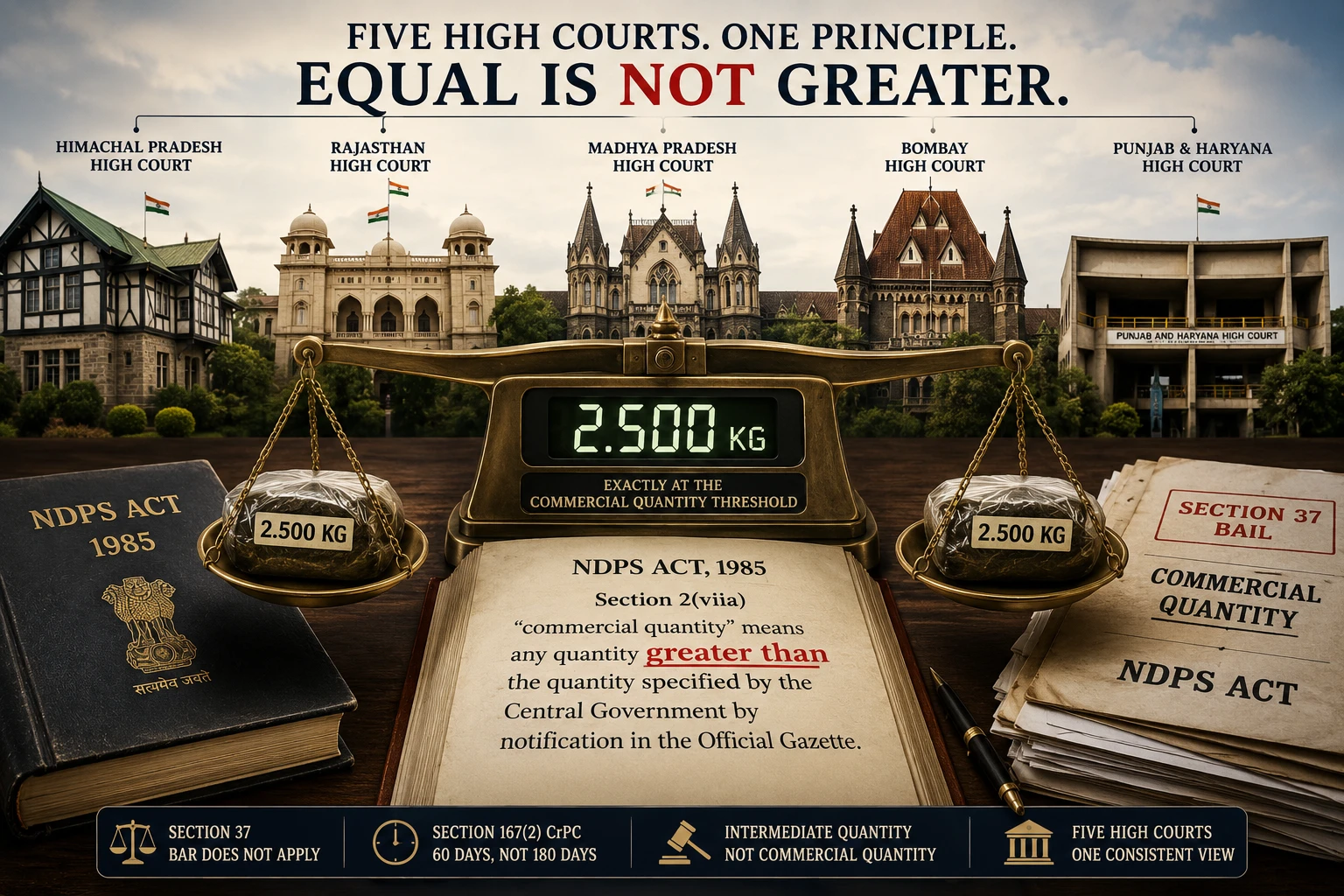
Across at least five Indian High Courts — Himachal Pradesh, Rajasthan, Madhya Pradesh, Bombay, and Punjab and Haryana — a single line of reasoning has been applied with remarkable consistency for over two decades. Where a recovery of contraband under the Narcotic Drugs and Psychotropic Substances Act, 1985 exactly equals the figure stated as commercial quantity in the 19 October 2001 notification, the High Courts have held that the case is not one of commercial quantity at all.
The reasoning is textual. Section 2(viia) of the NDPS Act defines commercial quantity as "any quantity greater than the quantity specified by the Central Government by notification in the Official Gazette." On a literal reading, the notified figure is the floor that must be crossed; the figure itself is not crossed. A subordinate notification, the courts have repeatedly held, cannot read into the parent statute a comparator the statute does not contain.
The consequences of that reading are substantial. The accused steps outside the strict twin-conditions test of Section 37. The default-bail clock under Section 167(2) of the Code of Criminal Procedure begins running at sixty days, not the 180 days that Section 36A(4) prescribes for commercial-quantity cases. The minimum ten-year sentence under the (c) sub-clauses of Sections 20, 21, 22 and 23 gives way to the more flexible (b) sub-clauses. In a punitive regime as carefully calibrated as the NDPS Act, the difference between a recovery of 2.500 kg of opium and 2.501 kg is not academic — it is the difference between two distinct sentencing regimes.
This article is a state-by-state survey of the case law. It maps the doctrine across the five High Courts that have adopted it, identifies the substances on which the doctrine has been applied — charas, opium, ganja, MDMA, mephedrone — notes the few wrinkles that have surfaced, and considers the Supreme Court's adjacent jurisprudence on the connected but distinct question of how the weight under the NDPS Act is to be calculated.
The Comparator and the Notification
Section 2(viia) and Section 2(xxiiia) of the NDPS Act fix the comparator. Both definitions are strictly comparative — "greater than" for commercial quantity and "lesser than" for small quantity — and neither uses "equal to or greater than" or "not less than". The fixing of the number is delegated to the Central Government by notification. The fixing of the meaning of the threshold is retained by the statute.
The notification of 19 October 2001 sets out, for each scheduled substance, two figures. To take the substances that recur in the case law:
Substance | Small quantity | Commercial quantity |
|---|---|---|
Heroin (diacetylmorphine) | 5 g | 250 g |
Charas / hashish | 100 g | 1 kg |
Ganja | 1 kg | 20 kg |
Opium | 25 g | 2.5 kg |
Cocaine | 2 g | 100 g |
MDMA (Ecstasy) | 0.5 g | 10 g |
Mephedrone (MD) | 2 g | 50 g |
The recurring question across the five High Courts is the same: when a seizure memo records a recovery at exactly the commercial-quantity figure in column 6 of the notification, does the case attract the rigour of Section 37? The answer, in every reported decision the courts have considered, has been no.
What Turns on the Comparator
Before walking through the five state lines, it is worth noting precisely what the comparator decides. Section 37(1)(b) of the NDPS Act applies the twin conditions — reasonable grounds to believe the accused is not guilty, and reasonable grounds to believe he will not commit any offence on bail — only to offences punishable under Sections 19, 24, 27-A, or offences involving commercial quantity. Section 36A(4) doubles the chargesheet window from ninety to 180 days (extendable to one year) only for the same set of offences. Sentencing under the (c) sub-clauses of Sections 20, 21, 22 and 23 prescribes rigorous imprisonment of ten to twenty years and a minimum fine of ₹1 lakh, again only for commercial-quantity cases.
A finding that the recovery is "less than commercial quantity" — what practitioners call intermediate quantity — pulls the case out of all three regimes simultaneously. The Section 37 bar falls away. The 180-day chargesheet window contracts to sixty days. The (c) sub-clause minimum disappears, and sentencing returns to the (b) sub-clause range of up to ten years and a fine of up to ₹1 lakh.
Himachal Pradesh — The Source
Ratto v. State of Himachal Pradesh (2003): The Full Bench Reference
The literal-construction approach traces back to Ratto v. State of Himachal Pradesh, Cr. MP(M) No. 1101 of 2002, decided on 13 June 2003 and reported at 2003 (3) Crimes 323 and 2004 (1) RCR (Cri) 501. The case came before a Larger / Full Bench of the Himachal Pradesh High Court on a reference, the underlying question being whether possession of one kilogram of cannabis charas — the figure stated in the 19 October 2001 notification as the commercial-quantity threshold — amounted to commercial quantity within the meaning of Section 2(viia).
The Bench answered in the negative. Four propositions emerge from the judgment. First, the language of Section 2(viia) is plain and unambiguous; the words "quantity greater than" must be given their natural and grammatical meaning. Second, the notification can specify a number, but it cannot rewrite the comparator chosen by the substantive provision. Third, in any event of conflict, the parent provision prevails over the delegated legislation. Fourth, commercial quantity must therefore always be "more than / greater than / bigger than" the notified figure, never equal to it.
In so holding, the Full Bench overruled three of its own earlier single-bench decisions — Mathew Andrews British National v. State of H.P., State v. Munshi Ram, and Sarvjeet Singh v. State — so far as those decisions had treated the notified figure itself as commercial quantity in the context of bail cancellation.
The Himachal Pradesh Line After Ratto
The reasoning has been applied without disturbance in subsequent single-bench decisions of the same Court. In Pratyush Thakur v. State of Himachal Pradesh, Cr. MP(M) No. 390 of 2021, Justice Anoop Chitkara extended the principle to a charas recovery of 704 grams — below the commercial threshold but above the small-quantity figure — and articulated the now-familiar tripartite scheme of small quantity (below the lower figure), intermediate quantity (the residual band), and commercial quantity (above the higher figure). The intermediate band, the Court observed, is the category in which the rigour of Section 37 does not apply. Khekh Ram v. State of Himachal Pradesh and Naresh Kumar v. State of Himachal Pradesh are further single-bench applications of the same reading at the bail stage.
Rajasthan — The Longest Continuous Line
The Rajasthan High Court has applied the Ratto reading more often than any other High Court, in a continuous line that runs from 2009 to 2026 across both the Jaipur and Jodhpur Benches.
Chanda Soni v. State of Rajasthan (2009)
Chanda Soni (Smt.) @ Pushpa v. State of Rajasthan, S.B. Criminal Misc. Bail Application No. 936 of 2008, decided on 16 March 2009 (Justice M.N. Bhandari, Jaipur Bench; reported at 2010 (2) RLW 1431), was a default-bail application under Section 167(2) CrPC. The recovery was 2.5 kg of opium — exactly the commercial-quantity figure for opium under the 19 October 2001 notification. The chargesheet had not been filed within sixty days. The petitioner contended that the case was therefore not one of commercial quantity, Section 36A(4)'s 180-day window did not apply, and she was entitled to default bail.
Justice Bhandari accepted the contention. The Court reproduced both Section 2(viia) and Section 2(xxiiia), observed that the comparator left no room for doubt, expressly relied on Ratto, and granted default bail on a personal bond of ₹1 lakh.
Gyan Chand v. State of Rajasthan (2012)
Three years later, the same High Court extended the doctrine to the sentencing stage. In Gyan Chand v. State of Rajasthan, decided on 10 April 2012, the appellant had been convicted under Section 18(c) of the NDPS Act for possession of 2.5 kg of opium and sentenced to the ten-year minimum. On appeal, the learned Public Prosecutor fairly conceded — relying on Ratto and Chanda Soni — that the minimum sentence under the (c) sub-clause could not stand on the literal reading of Section 2(viia). The High Court modified the conviction, applying the intermediate-tier sentencing under Section 18(b) instead. The case is institutionally important: it shows that the prosecution itself has, on at least one occasion, accepted the Ratto reading at the appellate stage. It is also doctrinally important: the comparator point operates not just at the bail stage but at sentencing.
Sumit Vishvas v. State of Rajasthan (2024)
In Sumit Vishvas v. State of Rajasthan, S.B. Criminal Miscellaneous Bail Application No. 8297 of 2024, decided on 24 September 2024 ([2024:RJ-JP:40684]), Justice Praveer Bhatnagar of the Jaipur Bench applied the doctrine to a recovery of 20 kg of ganja — once again precisely at the commercial-quantity figure under serial no. 55 of the notification. The Public Prosecutor argued that the recovery fell within the bar of Section 37. The Court rejected the submission, applying Chanda Soni and the Ratto reading, and granted bail on a personal bond of ₹50,000 with two sureties.
Samrath v. State of Rajasthan (2026)
The most recent application of the doctrine within Rajasthan is Samrath v. State of Rajasthan, S.B. Criminal Miscellaneous 2nd Bail Application No. 1512 of 2026, decided on 13 March 2026 by Justice Ravi Chirania at the Jodhpur Bench ([2026:RJ-JD:12132]). The recovery, as confirmed by the FSL report, was exactly 50 grams of mephedrone (MD) — the figure stated at the relevant entry of the notification as the commercial-quantity threshold for mephedrone. The earlier first-bail application had been rejected on 30 October 2025, but the petitioner pressed the second bail under Section 483 of the Bharatiya Nagarik Suraksha Sanhita, 2023 on the strength of the FSL report.
Applying the Ratto reading, the Court held that since the notification specifies 50 grams and the recovery was exactly 50 grams and "not more", the rigours of Section 37 were not attracted. Bail was granted on a personal bond of ₹1 lakh with two sureties of ₹50,000 each.
A useful wrinkle from Samrath deserves attention. The Court imposed a forward-looking condition: if the petitioner is found involved in any case of similar nature within two years, the Public Prosecutor is directed to apply for cancellation "without any fail." The order is, in that sense, a useful template for trial courts handling at-the-threshold cases. The Section 37 bar may not apply on the literal text, but the trial court retains discretion to ring the bail with stringent conditions calibrated to the wider context.
Madhya Pradesh — A Parallel Doctrine
The Madhya Pradesh High Court has independently developed the same jurisprudence, principally at the bail stage.
Anil Kumar v. Lakhansingh (2006)
The earliest reported application is Anil Kumar v. Lakhansingh, M.Cr.C. No. 2822 of 2006, in which the High Court granted default bail under Section 167(2) CrPC on the reasoning that where the recovery is not greater than the notified figure, the case is not one of commercial quantity, and Section 36A(4)'s 180-day window does not apply. The Court followed Ratto expressly.
Raju Kori v. State of Madhya Pradesh (2023)
In Raju Kori v. State of M.P., M.Cr.C. No. 43173 of 2023, decided on 16 October 2023 (Justice Sanjay Dwivedi, Jabalpur Bench), the recovery from three accused was 20 kg of ganja — exactly the commercial-quantity figure. The Court, after recording the State's submission that the notification listed 20 kg as commercial quantity, applied the Ratto reading and held that the seizure was "medium quantity" (the Bench's preferred terminology for intermediate quantity), not commercial quantity. Section 37 did not bar the bail application. Bail was granted on a personal bond of ₹1 lakh with one solvent surety.
Manoj v. State of Madhya Pradesh (2024)
The doctrine reached MDMA in Manoj v. State of Madhya Pradesh, M.Cr.C. No. 1973 of 2024, decided on 7 February 2024 (Justice Vijay Kumar Shukla, Indore Bench). The recovery was 10 grams of MDMA — the figure stated at serial no. 134 of the notification as the commercial-quantity threshold for MDMA. The seizure memo recorded exactly 10 grams.
A particular doctrinal wrinkle arose. The Public Prosecutor contended that "while weighing, the quantity was found to be 10.01 gram and therefore it is more than commercial quantity." The Court rejected the submission, holding that the panchnama recorded 10 grams, that the seizure memo binds the prosecution at the bail stage, and that "it is a matter of evidence" whether the contraband was weighed with the polythene or separately. The literal reading of Section 2(viia) was applied, the Section 37 bar was held not to attract, and bail was granted. Manoj is therefore notable for its evidentiary discipline: the comparator must be tested against what the contemporaneous documents say, not against what the prosecution would later wish those documents had said.
Bombay — The Most Articulate Restatement
In Vikas Babbarsingh Itkan v. State of Maharashtra, Bail Application No. 125 of 2023, decided on 16 October 2023 ([2023:BHC-AS:31040]), Justice M.S. Karnik of the Bombay High Court gave the doctrine its most fully reasoned articulation outside Himachal Pradesh. The recovery was 1000 grams of charas — exactly the commercial-quantity figure for charas at entry 23 of the 19 October 2001 notification.
The Bench framed the issue cleanly: was 1000 grams of charas commercial quantity or intermediate quantity? It then reasoned as follows. Section 2(viia) is plain and unambiguous; what the Central Government may specify by notification is the quantity, and commercial quantity for the purposes of Section 2(viia) is any quantity greater than that specified quantity. Merely because the notification's table uses the heading "commercial quantity" does not transform the figure listed there into commercial quantity within the meaning of the statute. The notification is delegated legislation; it cannot override the substantive provision. The two must be harmoniously construed, and the only construction that gives effect to both is the literal one: commercial quantity for charas must be more than 1 kg.
Justice Karnik expressed "respectful agreement" with Ratto v. State of Himachal Pradesh and with the Punjab and Haryana High Court's decision in Vakil v. State of Haryana, and quoted paragraph 4 of Vakil in full. Bail was granted on a personal bond of ₹1 lakh with one or more solvent sureties, subject to a series of stringent conditions including monthly attendance with the investigating officer, surrender of passport, and a prohibition on leaving the country without trial-court permission.
Vikas Babbarsingh is the most quotable single decision in the line. Its articulation of the relationship between delegated and parent legislation — that the title or nomenclature used in the table cannot override the comparator specified by the substantive provision — is the cleanest restatement of Ratto in any of the cases.
Punjab and Haryana — Vakil v. State of Haryana
The fifth state line comes from Vakil v. State of Haryana, 2015 (3) PLJ (Criminal) 677, a decision of the Punjab and Haryana High Court that the Bombay High Court extracted and quoted with approval in Vikas Babbarsingh. The recovery in Vakil was 1 kg of charas. The Court held, in language now repeatedly cited:
"The very definition of commercial quantity of charas as enunciated in Section 2(viia) of the Act makes it sufficiently clear that the quantity to fall within the ambit of commercial quantity must be greater than the quantity specified by the Central Government by notification in the Official Gazette. The notification specifying small quantity and commercial quantity shows 1 kg of charas under the commercial head, and in the light of definition of commercial quantity to fall under the same, it should be more than 1 kg."
Vakil is the brief and operative restatement of the comparator point, and its republication in Vikas Babbarsingh has placed it on a wider footing.
The Unified Reasoning
Read together, the five High Court lines converge on a single set of propositions:
The text of Section 2(viia) and Section 2(xxiiia) is unambiguous. The comparator — "greater than" and "lesser than" — admits no other meaning. A notification issued in exercise of the rule-making power cannot supply a meaning the statute does not contain. The headings used in the table of the notification do not redefine the comparator. The threshold figures define the floor; the figures themselves are not crossed unless the recovery is more than them. A recovery in the residual band — including a recovery at exactly the threshold figure — is intermediate quantity, in which the Section 37 bar does not apply, the 60-day chargesheet window applies, and the intermediate-tier sentencing under the (b) sub-clauses applies.
Across the five courts, those propositions have been applied to charas (1 kg, in Ratto, Vikas Babbarsingh and Vakil), to opium (2.5 kg, in Chanda Soni and Gyan Chand), to ganja (20 kg, in Sumit Vishvas and Raju Kori), to MDMA (10 g, in Manoj), and to mephedrone (50 g, in Samrath). There is no reported decision in which a High Court that addressed the comparator point squarely has decided it the other way.
The Supreme Court's Adjacent Silence
The Supreme Court has addressed connected aspects of the quantum question on more than one occasion. In Hira Singh v. Union of India (2020), a three-Judge Bench resolved a long-running controversy about how the weight is to be calculated — holding that for the purposes of Sections 20, 21 and the schedule, the entire weight of the seized mixture is to be considered, including any neutral substance, and overruling the contrary view in E. Micheal Raj v. Intelligence Officer, (2008) 5 SCC 161. The correctness of Hira Singh is itself now under review, with a Bench of Justices M.M. Sundresh and N.K. Singh having issued notice in 2025 on a petition that questions the inclusion of neutral substances in the weight calculation.
These cases, however, address a different aspect of the quantum question. They concern the calculation of the weight, not the comparator that governs whether the calculated weight crosses the threshold. The comparator question that Ratto and its progeny answer has not been before the Supreme Court for authoritative determination. The High Court doctrine therefore stands.
Counter-currents and Cautions
Two cautions deserve mention.
The first is doctrinal. In Karan Mehra v. Union of India, [2025:RJ-JP:40276], decided in November 2025, Justice Anil Kumar Upman of the Rajasthan High Court declined bail in a below-commercial-quantity case on the policy ground that organised drug syndicates deliberately import contraband in quantities just below the commercial threshold to circumvent Section 37. Karan Mehra does not disturb the comparator reading of Section 2(viia) — the point was not in question — but it serves as a reminder that the absence of the Section 37 bar is not, by itself, a guarantee of bail. The trial court retains its ordinary discretion under Section 483 of the Bhartiya Nagarik Suraksha Sanhita, 2023, and may weigh antecedents, the value of the consignment, and the wider trafficking context.
The second is practical. The conditions imposed in Samrath — particularly the standing direction that the Public Prosecutor must move for cancellation if the petitioner is involved in any similar case within two years — illustrate that at-the-threshold bail orders increasingly come with calibrated guard-rails. The doctrine takes the accused outside the Section 37 bar; it does not place the case outside the trial court's general discretion to attach conditions.
A Substance-Wise Map of the Doctrine
For the practitioner, the survey can be reduced to a quick map of the substances on which the doctrine has been authoritatively applied:
Substance | Commercial-quantity threshold | Cases at the threshold |
|---|---|---|
Charas | 1 kg | Ratto (HP, 2003); Vakil (P&H, 2015); Vikas Babbarsingh (Bombay, 2023) |
Opium | 2.5 kg | Chanda Soni (Raj, 2009); Gyan Chand (Raj, 2012) |
Ganja | 20 kg | Raju Kori (MP, 2023); Sumit Vishvas (Raj, 2024) |
MDMA | 10 g | Manoj (MP, 2024) |
Mephedrone (MD) | 50 g | Samrath (Raj, 2026) |
A recovery recorded at exactly the figure in column 6 of the 19 October 2001 notification, for any of the substances above, has a defensible argument — supported in each instance by at least one and often several High Court decisions — that the case falls outside Section 37, outside the 180-day chargesheet window, and outside the (c) sub-clause minimum sentence.
Conclusion
The five High Court lines — Himachal Pradesh, Rajasthan, Madhya Pradesh, Bombay, and Punjab and Haryana — together constitute a coherent body of jurisprudence that has spanned twenty-three years and shows no sign of internal contradiction. The Supreme Court has not yet pronounced on the comparator question, and there is no reported decision in which any High Court has squarely held the other way. A legislative amendment substituting "greater than or equal to" for "greater than" in Section 2(viia), and "less than or equal to" for "lesser than" in Section 2(xxiiia), would resolve the question with a single phrase in each definition.
Until either occurs, the literal reading prevails. The notification specifies a number; the statute specifies a comparator; and the comparator — as five High Courts have consistently held — governs.
This article is intended as a legal explainer and does not constitute legal advice. Citations should be verified against the certified copies of the relevant judgments and the most recent notification under Section 2(viia) and Section 2(xxiiia) of the NDPS Act before reliance.

Discussion (Leave a comment)