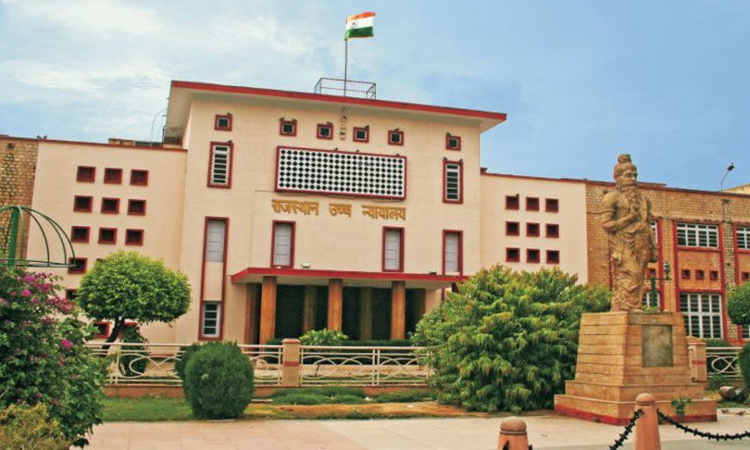

Photo: TrendSPLEND via Wikimedia Commons (CC BY-SA 4.0)
Judgment Intelligence
Petition DismissedSarla Devi Acharya v. District and Sessions Judge, Churu & Ors. (with connected petitions of Rajkumari Purohit, Keshar Devi and Kamla Devi v. State of Rajasthan & Ors.)
2024:RJ-JD:49771
S.B. Civil Writ Petition No. 11923/2024, with S.B. Civil Writ Petitions Nos. 11445/2024, 18031/2024 and 19773/2024
- Court
- Rajasthan High Court
- Date of Decision
- 5 December 2024
- Bench
- Justice Dinesh Mehta
- Relevant Acts & Sections
- Rajasthan Civil Services (Pension) Rules, 1996 — Rules 4, 66, 67
Final Outcome
Finding no substance in the claim to family pension, the Court dismissed all four writ petitions and the stay applications (paras 30, 32-33).
Key holdings
- A claim to family pension is governed by the Rules in force on the government servant’s retirement or death, which is the relevant date for the family’s right (para 23).
- A daughter married on the relevant date is not ‘family’ under Rule 66, even if she is widowed or divorced later (paras 25-26).
- Family pension protects a daughter dependent on the pensioner on the relevant date, not one who becomes dependent decades later (para 27).
- An administrative circular cannot add a class of beneficiaries the Rules do not contemplate; the 16.01.2013 circular was given no credence (paras 29, 31).
Brief Facts
The common judgment decided four writ petitions, taking Sarla Devi Acharya’s case as the lead case (para 2). Her father, a government servant, retired on 31.01.1982 and died on 20.09.2017; she was then married, and her husband died on 20.02.2023 (paras 2.1-2.3). Her application for family pension, made at the age of 73 on 09.02.2024, was rejected on 04.05.2024 (paras 2.4-2.5). She relied on a Pension Department clarification of 16.01.2013 treating daughters widowed after the employee’s death as eligible (paras 5-6). The State relied on a Finance Department clarification of 26.06.2024 taking the opposite view, and on judgments including Ratna Sarkar and Hemlata Sharma (paras 9-12).
Court's Findings
Rules 66 and 67, the Court noted, already covered widowed and divorced daughters; the 2012 and 2018 amendments changed the income ceiling and removed the age limit of 25 years (paras 17-21). The question was whether a daughter whose marriage ends after the government servant’s death qualifies (para 22). Under Rule 4, claims are governed by the Rules in force when the government servant retires or dies, the relevant date for the family’s right (para 23). Here that date was 20.09.2017; the petitioner then had a subsisting marriage and fell outside the definition of ‘family’ in Rule 66 (paras 24-25). A change of status after the death cannot create the right (para 26). The Rules protect a daughter dependent on the pensioner on the relevant date; the petitioner, 73 when she applied, could not claim 40 years of dependency on a father who retired in 1982, and the affidavit of her dependency was ex facie incorrect (para 27). The Court agreed with the Calcutta High Court in Ratna Sarkar (para 28) and, following the Division Bench in Hemlata Sharma, gave the 2013 circular no credence as contrary to the scheme of the Rules, particularly Rule 4 (paras 29, 31).
Legal Principle
Under the Rajasthan Civil Services (Pension) Rules, 1996, eligibility for family pension is judged on the date the government servant retires or dies. A daughter married on that date cannot claim family pension because she is widowed or divorced later, and an administrative circular cannot extend the benefit (paras 23-26, 29-31).
Precedents Relied Upon
- Union of India & Ors. v. Ratna Sarkar WP.CT 10/2017 (Calcutta High Court, Division Bench, decided on 07.02.2022)
The family pension scheme never included a daughter who was married when the pensioner died; a daughter widowed after the pensioner’s death has no fundamental or statutory right to family pension.
- Union of India & Ors. v. Smt. Hemlata Sharma & Anr. D.B. Civil Writ Petition No. 20922/2019 (Rajasthan High Court, Division Bench at Jaipur, decided on 18.11.2021)
Administrative circulars cannot add a class of family-pension beneficiaries that the rules do not contemplate; family pension is for those actually dependent on the employee at death.
- Shri Ram Shridhar Chimurkar v. Union of India & Anr. Civil Appeal No. 386/2023, 2023 4 SCC 312
Cited by counsel for the respondents on family pension; not discussed by the Court.