
Facts of the Case
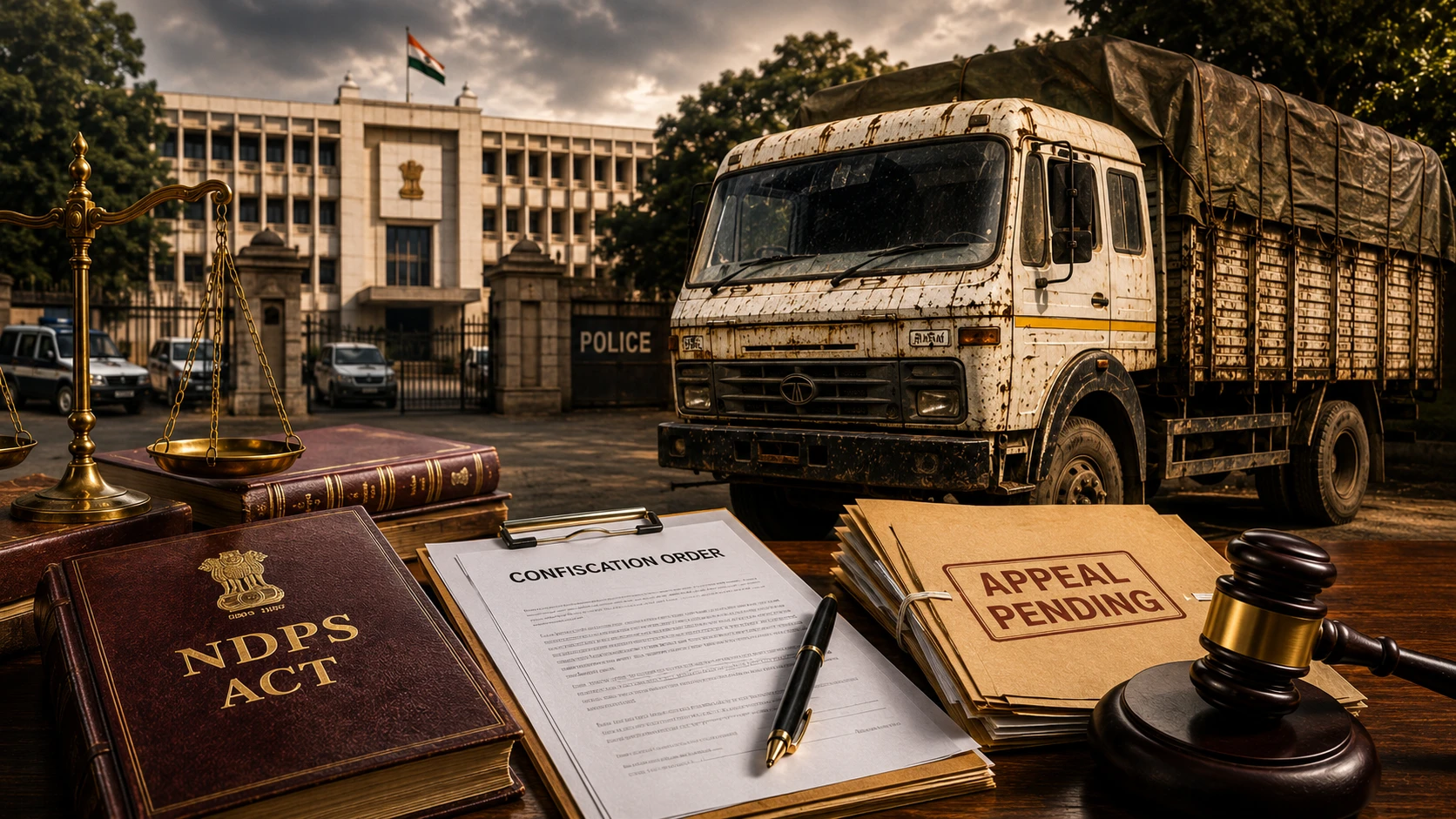
The Punjab and Haryana High Court has ordered the release on financial bonds of a TATA LPT 3118 truck confiscated under the Narcotic Drugs and Psychotropic Substances Act, 1985, holding that confiscated vehicles serve no purpose lying idle in police parking lots while appeals run their course. The order dated 29 May 2026 in Gurjinder Singh v. State of Punjab (CRM-14893-2026 in CRA-D-206 of 2021) was delivered by a Bench of Justice Anoop Chitkara and Justice Sukhvinder Kaur, with Justice Chitkara authoring the opinion.
The truck had been seized in FIR No. 38 of 14 September 2018 registered at PS NCB, Chandigarh, under Sections 15, 25, 27-A and 29 of the NDPS Act, after the Narcotics Control Bureau intercepted it near Bhavanigar Chowk, Samana, on a secret-information tip and recovered 252.6 kg of poppy husk. By judgment dated 17 March 2021, the Special Judge, Patiala, convicted three occupants under Section 15 and the registered owner-applicant, Gurjinder Singh, under Sections 27-A, 25 and 29, and ordered confiscation of the truck. The applicant's appeal was admitted and his sentence suspended on 10 September 2025; he has not been in custody since 29 October 2025.
The Bench took as its starting point the Supreme Court's 2025 decision in Bishwajit Dey v. State of Assam (2025 INSC 32), which holds that confiscation can be ordered only at the conclusion of trial and that the NDPS Act contains no specific bar on interim release of seized vehicles under Sections 451 and 457 CrPC, read with Section 51 of the NDPS Act. To this it added the more recent Denash v. State of Tamil Nadu (2025 INSC 1258), which clarified that the Narcotic Drugs and Psychotropic Substances (Seizure, Storage, Sampling and Disposal) Rules, 2022, being subordinate legislation, cannot override the substantive rights of bona fide owners under Sections 60 and 63 of the parent Act, and that confiscation must conform to natural justice.
Walking through a long line of authority — Basavva Patil, Sunderbhai Ambalal Desai, General Insurance Council, Sundaram Finance, and the Section 52-A inventory regime — the Court reasoned that the photograph-and-inventory mechanism makes physical retention of the vehicle evidentially unnecessary. Vehicles left in police compounds, the Bench observed in a striking passage, "become eyesores" and devalue to junk, with losses borne by financiers, owners, the State, and the planet itself. "The crime was committed by the driver of the vehicle or by the person who kept drugs in the vehicle, not by the vehicle itself."
The Court then laid down a structured release procedure: a current-market-value bond by the applicant and a solvent guarantor, payable with 6% interest compounded annually if confiscation is ultimately upheld; an affidavit of ownership; return of the Registration Certificate; intimation to any hypothecating financier; and a 90-day compliance window failing which the order self-lapses under Sections 403 and 528 BNSS, 2023. District courts were enjoined not to reject such applications mechanically.