
Join our WhatsApp Group
Breaking
Saturday, October 10, 2026 Jaipur Edition
Rajasthan High Court
Constitutional Law

Bar on Withdrawing Voluntary Retirement After Acceptance Is Arbitrary: Rajasthan High Court Reads Down Pension Rule

Published: · NyayVidhan

A Division Bench of the Rajasthan High Court held that the proviso to Rule 50(4) of the Rajasthan Civil Services (Pension) Rules, 1996, which bars a government servant from withdrawing a voluntary retirement notice once its acceptance is communicated, is manifestly arbitrary under Article 14 (paras 36, 39-41). Reading it down, the Court held that a withdrawal request made before the effective retirement date must be considered on merits and administrative inconvenience (para 42). The petitioner's rejected request was sent back for fresh consideration (para 43).

Bar on Withdrawing Voluntary Retirement After Acceptance Is Arbitrary: Rajasthan High Court Reads Down Pension Rule
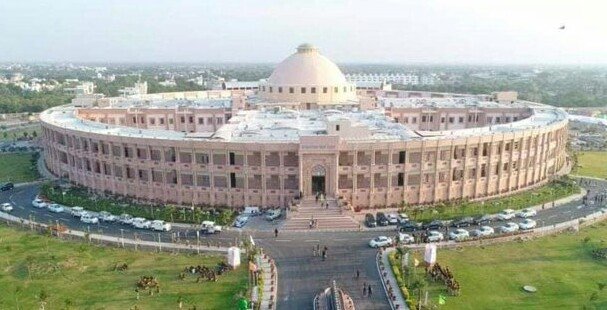
Photo: TrendSPLEND via Wikimedia Commons (CC BY-SA 4.0)

Judgment Intelligence

Petition Allowed
Bhikam Chand v. State of Rajasthan & Ors.
2025:RJ-JD:14994-DB
D.B. Civil Writ Petition No. 737/2023
Court
Rajasthan High Court
Date of Decision
20 March 2025
Bench
Chief Justice Manindra Mohan Shrivastava and Justice Munnuri Laxman
Relevant Acts & Sections
Rajasthan Civil Services (Pension) Rules, 1996 — Rule 50, sub-rule (4) and its proviso; Constitution of India — Articles 14, 226
Final Outcome

Petition allowed. The proviso to Rule 50(4) was read down. The rejection of his withdrawal application was set aside and the case remanded for fresh consideration; any refusal must state reasons of administrative inconvenience as on the date of the withdrawal application (paras 42-43).

Key holdings

  1. A manifestly arbitrary service rule can be read down instead of struck down (paras 14-17, 41).
  2. Accepting a voluntary retirement request only fixes a future date; employment continues until then (para 37).
  3. A complete bar on withdrawal after acceptance, ignoring administrative inconvenience, lacks an adequate determining principle (paras 36, 39-40).
  4. A withdrawal request made before the effective date must be decided on merits, and any refusal must give reasons of administrative inconvenience (paras 42-43).
  5. Once the effective date arrives without a withdrawal request, voluntary retirement takes effect and cannot be withdrawn (para 42).

Brief Facts

The petitioner, a Lab Boy in the Elementary Education department, applied for voluntary retirement under Rule 50 in October 2022, after his son died by suicide (para 2). On 14.11.2022 the request was accepted, with retirement to take effect from 01.02.2023 (para 2). On 07.12.2022 he applied to withdraw it; on 13.12.2022 the request was rejected because the proviso to Rule 50(4) bars withdrawal once acceptance has been communicated in writing (paras 3, 6). He challenged that part of the Rule as manifestly arbitrary under Article 14 (paras 1, 4, 12). The State argued that the Rule only fixes a cut-off for withdrawal and that later withdrawals would cause administrative chaos (para 5).

Court's Findings

Under Shayara Bano and the Electoral Bond judgment, a law is manifestly arbitrary if it is capricious, irrational, without an adequate determining principle, or excessive and disproportionate (paras 14-17). The three-month notice period in Rule 50 gives an employee time to rethink a hasty decision (para 21). Sub-rule (4) itself allows withdrawal with the authority's approval (para 23), but the proviso closes that option once acceptance is communicated, though retirement takes effect only later, so an early acceptance cuts short the window (paras 25-26). Raj Kumar, on resignation taking effect on acceptance, does not apply: accepting a voluntary retirement request only fixes a future date, and the master-servant relationship continues until then (paras 28, 36-37). Wing Commander T. Parthasarathy did not decide the validity of a contrary rule (para 35). Applying P.K. Mittal and Balram Gupta, an employer cannot force an earlier exit date, and flexibility is due where administration is not jeopardised (paras 29-32, 37). Administrative inconvenience is the Rule's determining principle, yet the proviso imposes a complete embargo without reference to it, and the State's reply offered no justification (paras 36, 39-40).

Legal Principle

The proviso to Rule 50(4) of the Rajasthan Civil Services (Pension) Rules, 1996, barring withdrawal of a voluntary retirement notice once acceptance is communicated, is manifestly arbitrary. As read down, a withdrawal application made before the effective date must be considered on merits and administrative inconvenience, and may be allowed with the appointing authority's prior approval (paras 39, 41-42).

Precedents Relied Upon

  1. Shayara Bano v. Union of India & Ors. (2017) 9 SCC 1
    Followed Discussed at ¶ 4, 14, 16, 17

    Legislation, including subordinate legislation, can be struck down under Article 14 if it is manifestly arbitrary: capricious, irrational, without adequate determining principle, or excessive and disproportionate.

  2. Association for Democratic Reforms & Anr. (Electoral Bond Scheme) v. Union of India & Ors. (2024) 5 SCC 1
    Relied Upon Discussed at ¶ 4, 15, 16, 17

    Reiterates the doctrine of manifest arbitrariness: a provision lacks an adequate determining principle if its purpose is not in consonance with constitutional values.

  3. Punjab National Bank v. P.K. Mittal 1989 Supp (2) SCC 175
    Applied Discussed at ¶ 4, 5, 27, 30, 31, 32, 37

    An employee may withdraw a resignation before it becomes effective, and the employer cannot force a date of termination earlier than the one the employee is entitled to choose; applied to voluntary retirement.

View all precedents (11)
  1. Balram Gupta v. Union of India & Anr. 1987 (Supp) SCC 228
    Relied Upon Discussed at ¶ 4, 5, 27, 29, 31, 37

    A notice of voluntary retirement can be withdrawn before retirement becomes effective; approval for withdrawal cannot be refused without reasons of administrative disturbance, and some flexibility should be allowed.

  2. Raj Kumar v. Union of India AIR 1969 SC 180
    Distinguished Discussed at ¶ 4, 5, 27, 28, 29, 36

    A resignation becomes effective once accepted, even without communication; held not to apply to voluntary retirement, which takes effect on a future date.

  3. Union of India & Anr. v. Wing Commander T. Parthasarathy 2001 (1) SCC 158
    Distinguished Discussed at ¶ 4, 5, 33, 34, 35

    An employee may withdraw a request for premature retirement before it becomes effective unless a rule provides otherwise; it did not decide the validity of such a rule.

  4. Independent Thought v. Union of India & Anr. (2017) 10 SCC 800
    Relied Upon Discussed at ¶ 41

    A court may either strike down a law that is arbitrary or read it down so that it does not violate the Constitution.

  5. State of Maharashtra & Anr. v. Chandrakant Anant Kulkarni & Ors. 1981 (4) SCC 130
    Referred To Discussed at ¶ 4, 5

    Cited by both sides on withdrawal of resignation or voluntary retirement.

  6. Faziludeen v. Union of India & Ors. OP (CAT) No. 22 of 2023 (Kerala High Court)
    Referred To Discussed at ¶ 4

    Cited by the petitioner in support of the challenge.

  7. Navtej Singh Johar v. Union of India (2018) 10 SCC 1
    Referred To Discussed at ¶ 16

    Named as one of the decisions developing the doctrine of manifest arbitrariness.

  8. Joseph Shine v. Union of India (2019) 3 SCC 39
    Referred To Discussed at ¶ 16

    Named as one of the decisions developing the doctrine of manifest arbitrariness (printed as Jospeh Shine).
NyayVidhan
Court Judgments · 3 min read
Decided: March 20, 2025 Chief Justice Manindra Mohan Shrivastava and Justice Munnuri...
PDF
WhatsApp Telegram X / Twitter LinkedIn

✕

Popular: POCSO, IBC, Electoral Bond, Article 370, NDPS Act, Bail Conditions, SC Contempt