
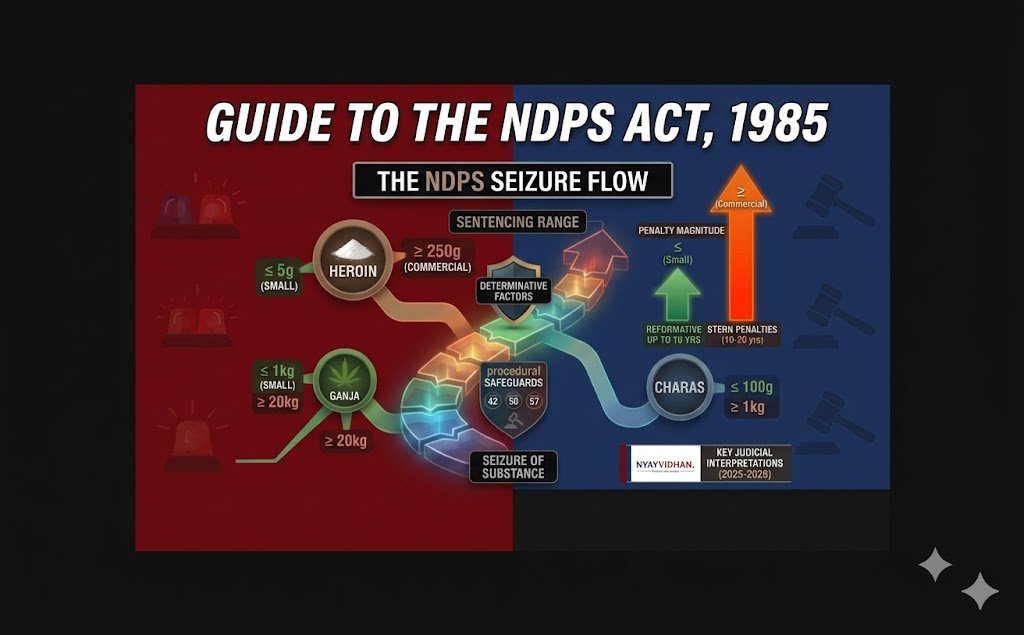
The Narcotic Drugs and Psychotropic Substances (NDPS) Act, 1985 is one of India’s most stringent criminal laws. Enacted to fulfill international treaty obligations, it balances severe penalties for drug trafficking with a reformative approach for addicts.
Below is a comprehensive legal overview of the Act, its key provisions, and recent judicial interpretations as of 2026.
1. The Statutory Framework
The NDPS Act prohibits the cultivation, production, possession, sale, purchase, transport, and consumption of any narcotic drug or psychotropic substance. It categorizes substances into three main types:
- Narcotic Drugs: Coca leaf, cannabis (hemp), opium, and poppy straw.
- Psychotropic Substances: Any natural or synthetic material defined under the 1971 Convention (e.g., LSD, MDMA, Alprazolam).
- Controlled Substances: Chemicals used in the manufacture of drugs (e.g., Ephedrine).
2. The “Graded” Punishment System
Since the 2001 amendment, punishment is tied directly to the quantity of the substance seized.
| Substance | Small Quantity | Commercial Quantity | Punishment (Commercial) |
| Heroin | 5 grams | 250 grams | 10–20 years RI + ₹1–2 Lakh fine |
| Ganja | 1,000 grams (1 kg) | 20,000 grams (20 kg) | 10–20 years RI + ₹1–2 Lakh fine |
| Charas | 100 grams | 1,000 grams (1 kg) | 10–20 years RI + ₹1–2 Lakh fine |
| Cocaine | 2 grams | 100 grams | 10–20 years RI + ₹1–2 Lakh fine |
| LSD | 0.002 grams | 0.1 grams | 10–20 years RI + ₹1–2 Lakh fine |
- Small Quantity: Focuses on reform (up to 1 year RI or fine).
- Intermediate Quantity: Up to 10 years RI and a fine.
- Commercial Quantity: Mandatory minimum of 10 years RI.
3. Critical Procedural Safeguards
Because the penalties are so severe, the law provides mandatory safeguards to prevent police high-handedness. Failure to follow these often leads to the acquittal of the accused.
- Section 42 (Search and Seizure): Officers must record “reason to believe” from personal knowledge or information in writing before conducting a search between sunset and sunrise.
- Section 50 (Personal Search): A person being searched has the legal right to be searched in the presence of a Gazetted Officer or a Magistrate. The officer must inform the accused of this right; a “pre-typed” or “forced” consent is legally invalid.
- Section 57 (Reporting): The arresting officer must submit a full report to their immediate superior within 48 hours of the arrest or seizure.
4. The Section 37 “Bail Hurdle”
Under the NDPS Act, bail is not a right for those caught with commercial quantities. To grant bail, a court must be satisfied that:
- There are reasonable grounds to believe the accused is not guilty.
- The accused is not likely to commit any offence while on bail.
Note: As of 2025-2026, courts have emphasized that prolonged pre-trial detention can override the rigors of Section 37 if the trial is unlikely to conclude speedily.
5. Recent Landmark Judgments (2025–2026)
- Neutral Substance Ruling: In cases of mixtures (e.g., heroin mixed with chalk), the total weight of the mixture, not just the pure drug content, determines whether the quantity is “commercial.”
- Third Option in Consent: The Supreme Court recently reaffirmed that if an officer offers a “third option” (e.g., “Do you want to be searched by me, a Magistrate, or a Gazetted Officer?”), it can invalidate the search as it dilutes the mandatory right under Section 50.
- Digital Evidence: Courts now increasingly set aside denials for access to call data records (CDR) and mobile location data, recognizing them as vital for the accused to prove their innocence at the bail stage.
Conclusion
The NDPS Act remains a “double-edged sword.” While it provides the state with massive power to fight drug cartels, it demands strict adherence to procedural “due process.” For practitioners and citizens alike, understanding the distinction between quantities and the mandatory nature of search procedures is essential for navigating this legal landscape.