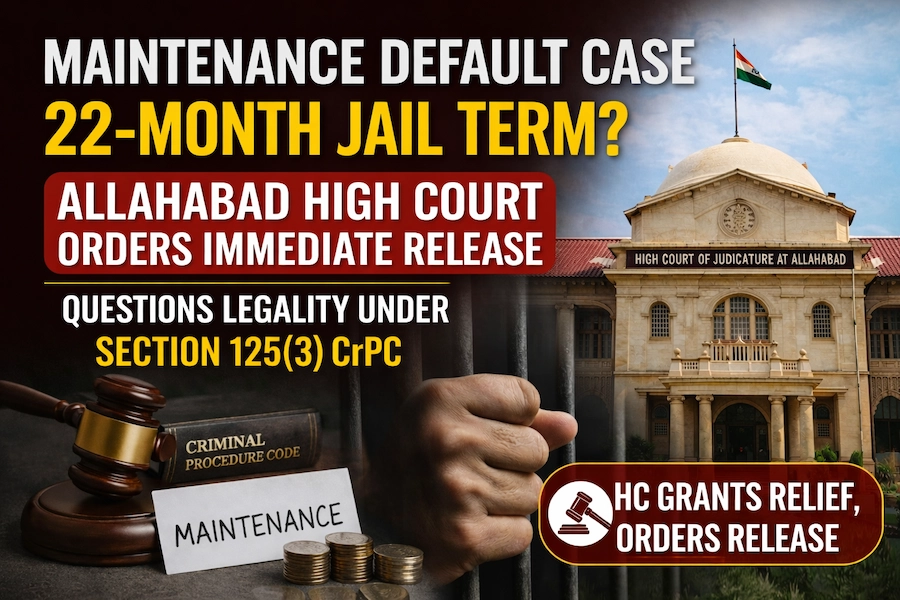
The High Court of Judicature at Allahabad recently addressed Criminal Revision No. 1508 of 2026 concerning Tahir @ Babloo, the revisionist, who challenged an order dated December 16, 2025, passed by the Principal Judge, Family Court, Jhansi, in maintenance case no. 1448/2025. The original order sentenced the revisionist to imprisonment for non-payment of maintenance amounting to 22 months’ dues as claimed by Smt. Afreen @ Chandani and others.
The revisionist’s counsel argued that the imprisonment term exceeded the statutory limit prescribed under Section 125(3) of the Criminal Procedure Code (Cr.P.C.). According to Section 125(3) Cr.P.C., imprisonment for failing to pay maintenance cannot extend beyond one month or until payment is made. The counsel emphasized that if the revisionist fails to pay maintenance, the appropriate course is to imprison for a maximum of one month followed by attachment of property to recover dues, rather than prolonged incarceration.
The impugned order from the Family Court had ordered incarceration for a period covering the entire 22 months’ unpaid maintenance, which the revisionist’s counsel submitted was contrary to the legal provisions. The Family Court had noted that despite notice and opportunity, the revisionist did not deposit the maintenance amount and was arrested following issuance of a recovery warrant. The court further elaborated on the legal interpretation of Section 125(3) Cr.P.C. by referring to relevant judgments from the Rajasthan High Court and Supreme Court, which clarify that the maximum jail term for maintenance default is one month per month of arrears, but need not be served consecutively for each month if a consolidated recovery application is filed.
The Revisionist had been in civil prison since December 3, 2025, following the execution of the arrest warrant. The Family Court’s order mandated 22 months’ imprisonment for non-payment, which was challenged as excessive and not in alignment with the statutory framework.
Upon hearing both parties, the High Court issued notice to the opposite party and granted four weeks for filing a counter affidavit. After considering the facts, the Court granted bail to the revisionist without requiring a bail bond or surety, recognizing that the revisionist was already in civil prison for non-payment of maintenance amount. The Court directed the jail authorities to release the revisionist forthwith and clarified that no certified copy of the order was necessary for this purpose; a verified photocopy of the order from the Court’s official website would suffice.
Additionally, the Court underscored the legal principle that imprisonment for non-payment of maintenance under Section 125(3) Cr.P.C. is meant to compel payment and not to punish indefinitely. If the maintenance remains unpaid beyond the lawful imprisonment period, the prescribed remedy is attachment and sale of the defaulter’s property.
This ruling reinforces the strict interpretation of Section 125(3) Cr.P.C., ensuring that imprisonment for maintenance default does not exceed one month per month of arrears and that property attachment is the subsequent recovery mechanism. It also highlights the Court’s willingness to grant bail to persons detained under civil imprisonment for maintenance arrears during the pendency of revision proceedings.
The case is listed for further hearing on May 18, 2026, and will continue to address the substantive issues related to maintenance recovery and the revisionist’s liability.
Last