
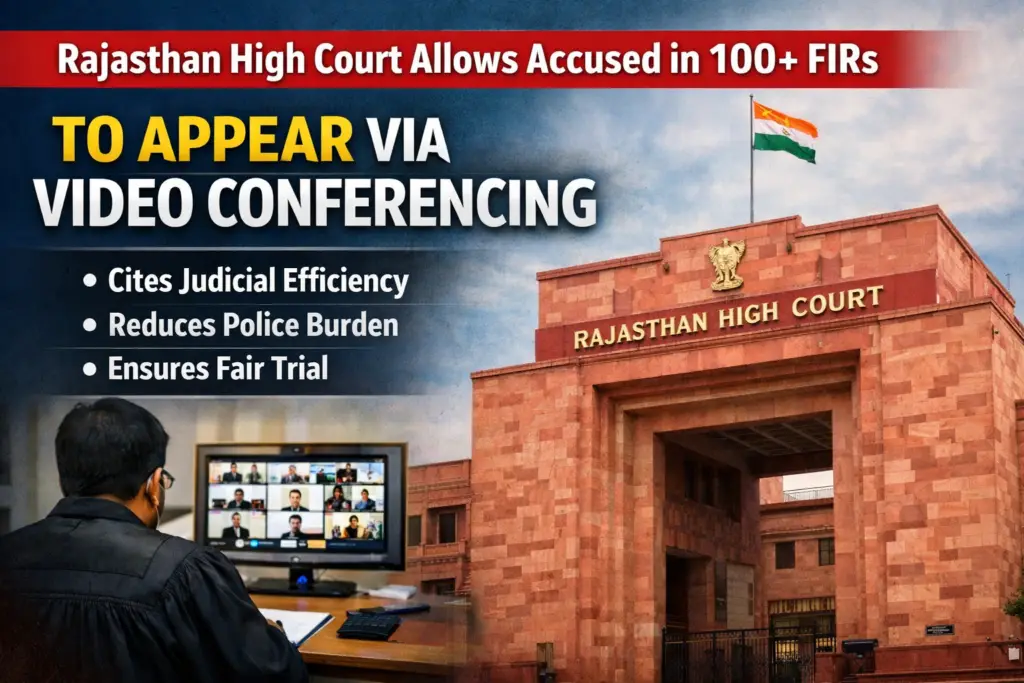
In a significant ruling reinforcing the role of technology in criminal justice, the Rajasthan High Court has allowed accused persons facing multiple criminal cases to attend court proceedings through video conferencing. The judgment was delivered by Justice Farjand Ali in a writ petition filed under Article 226 of the Constitution.
The petitioners, connected with certain business entities, were facing more than 100 FIRs registered across different districts of Rajasthan in relation to alleged investment and real estate transactions. Due to repeated arrests, custody in multiple cases, and the multiplicity of proceedings, they argued that physical appearance in each case caused severe hardship and prejudice.
The High Court examined the statutory framework governing virtual hearings, particularly the Video Conferencing Rules, 2021. These rules clearly permit the use of video conferencing at all stages of judicial proceedings and recognize such proceedings as legally valid and equivalent to physical court hearings. The Court emphasized that virtual proceedings must follow the same decorum, procedural safeguards, and legal standards as physical hearings.
A crucial issue before the Court was whether the accused should be required to file separate applications for video conferencing in each case. Given the unique circumstances involving hundreds of FIRs, the Court held that such a requirement would be impractical and overly burdensome. It noted that insisting on individual applications in each case would defeat the very purpose of the Video Conferencing Rules, which aim to facilitate access to justice and reduce procedural delays.
The Court also highlighted the systemic challenges associated with repeated physical production of accused persons. It observed that transporting undertrial prisoners across districts or states requires deployment of multiple police personnel, often diverting them from essential law enforcement duties. Such movements also involve considerable expenditure on transportation, logistics, and security arrangements, placing a recurring burden on public resources.
Further, the Court noted that frequent custodial transfers often lead to delays in trial proceedings due to coordination issues, transit permissions, and scheduling conflicts. These delays undermine the constitutional mandate of speedy justice under Article 21. Additionally, long-distance transportation exposes both the accused and escort personnel to security risks and unforeseen contingencies such as medical emergencies.
Importantly, the Court invoked the doctrine of proportionality, emphasizing that when a less intrusive yet equally effective alternative is available, it should be preferred. Video conferencing, the Court observed, provides a practical solution that ensures judicial participation without unnecessary physical movement. It preserves judicial control while reducing administrative burden and safeguarding public funds.
The Court further pointed out that in cases arising from similar transactions, repeated physical production of the accused results in redundant processes that do not advance the cause of justice. Instead, such practices lead to avoidable strain on the police machinery and judicial system. By contrast, virtual hearings enable efficient case management and promote procedural fairness.
In conclusion, the High Court allowed the writ petition and granted permission to the petitioners to appear in all pending criminal trials through video conferencing. It also directed jail authorities to ensure the availability of necessary virtual infrastructure to facilitate such appearances.
This ruling marks a progressive step towards integrating digital technology into the criminal justice system and is likely to serve as an important precedent in cases involving multiple FIRs and complex litigation across jurisdictions.